

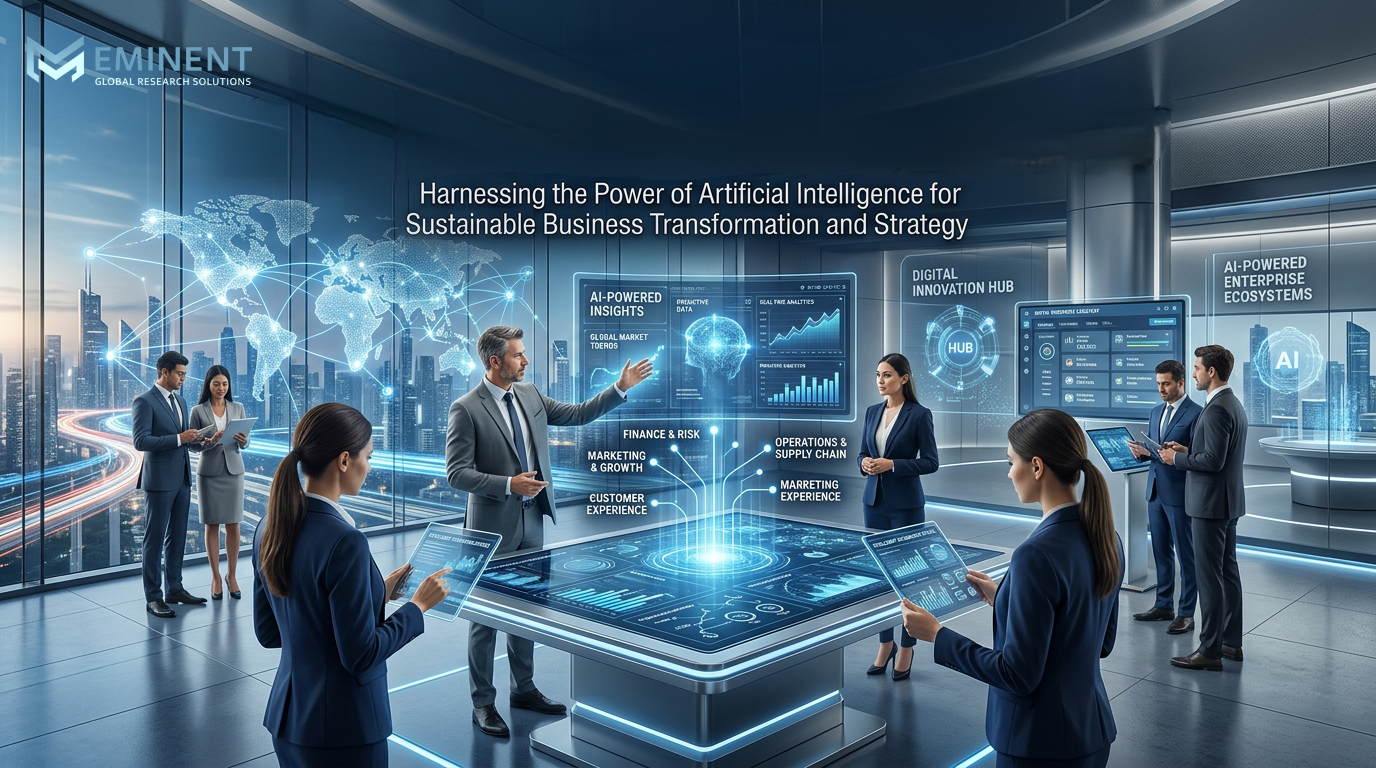
Artificial Intelligence has evolved from an emerging technology trend into a strategic business imperative. Across industries, organizations are increasingly leveraging AI to improve decision-making, automate operations, enhance customer experiences, and unlock new revenue streams. What was once considered a future investment is now becoming a present-day competitive necessity.
As businesses navigate economic uncertainty, digital transformation, labor shortages, and growing customer expectations, Enterprise AI is emerging as one of the most powerful growth enablers of the decade. Companies that successfully integrate AI into their operations are not only improving efficiency but also creating entirely new business models and competitive advantages.
The question is no longer whether organizations should adopt AI. The real question is whether companies can afford not to.
The Shift from Experimentation to Enterprise Deployment
Over the past few years, AI adoption has moved beyond pilot projects and proof-of-concept initiatives. Organizations are increasingly deploying AI solutions at scale across critical business functions.
Enterprise AI is now being used to:
- Automate repetitive tasks
- Improve supply chain management
- Enhance customer service through intelligent assistants
- Optimize marketing campaigns
- Accelerate product development
- Improve financial forecasting
- Support strategic decision-making
The emergence of generative AI has further accelerated adoption by making advanced AI capabilities more accessible to organizations of all sizes.
Executives are no longer viewing AI as a technology project. Instead, it is becoming a core business transformation initiative capable of influencing growth, profitability, and long-term competitiveness.
Why AI Is Becoming a Strategic Growth Driver
Unlike many previous technology innovations, AI impacts nearly every business function simultaneously.
Traditional digital transformation initiatives often focused on improving specific processes. AI, however, has the potential to fundamentally change how organizations operate.
Key growth drivers include:
Operational Efficiency
AI enables organizations to automate routine processes, reduce manual workloads, and improve productivity.
Functions such as procurement, customer support, HR operations, and financial management can benefit significantly from AI-powered automation.
As labor costs continue to rise globally, productivity improvements generated by AI may become a major source of competitive advantage.
Better Decision-Making
Modern enterprises generate massive volumes of data every day.
AI systems can analyze this information at speeds far beyond human capability, helping organizations identify trends, predict outcomes, and make more informed strategic decisions.
This allows leaders to move from reactive decision-making toward predictive and proactive business management.
Revenue Growth Opportunities
AI is not only about cost reduction.
Organizations are increasingly using AI to:
- Personalize customer experiences
- Develop new products
- Improve sales effectiveness
- Create data-driven services
- Identify emerging market opportunities
Companies that successfully monetize AI capabilities may generate entirely new revenue streams while strengthening customer relationships.
The Rise of AI-Powered Competitive Advantage
Historically, competitive advantage was often built through scale, distribution networks, manufacturing capabilities, or brand strength.
Today, AI is becoming a new source of differentiation.
Organizations that effectively leverage AI can:
- Launch products faster
- Improve customer engagement
- Optimize pricing strategies
- Accelerate innovation
- Reduce operational inefficiencies
As AI technologies become increasingly sophisticated, the performance gap between AI-enabled organizations and slower adopters may continue to widen.
This creates a situation where AI adoption becomes less about innovation and more about maintaining competitiveness.
Industry-Wide Impact
Enterprise AI is creating disruption across nearly every sector.
Healthcare
Healthcare providers are using AI to support diagnostics, clinical decision-making, patient monitoring, and operational efficiency.
AI-powered drug discovery platforms are also accelerating pharmaceutical research and development.
Financial Services
Banks and financial institutions are leveraging AI for fraud detection, risk assessment, customer service, and investment analysis.
The ability to process vast amounts of financial data in real time provides significant strategic value.
Manufacturing
Manufacturers are implementing AI-driven predictive maintenance, quality control systems, demand forecasting, and smart factory operations.
These applications help improve productivity while reducing downtime and operational costs.
Retail and Consumer Goods
Retailers are using AI to optimize inventory management, personalize customer experiences, and improve demand forecasting.
Personalization is increasingly becoming a key differentiator in highly competitive consumer markets.
Challenges Organizations Must Address
Despite its significant potential, Enterprise AI adoption is not without challenges.
Many organizations face obstacles including:
Data Quality and Infrastructure
AI systems depend on reliable, high-quality data.
Without strong data governance frameworks, AI performance may be limited or produce inaccurate outcomes.
Talent and Skills Gaps
Organizations often struggle to find employees with expertise in AI, data science, and machine learning.
Workforce development and upskilling initiatives are becoming increasingly important.
Governance and Ethics
As AI becomes more integrated into decision-making processes, organizations must address concerns related to transparency, bias, accountability, and regulatory compliance.
Strong AI governance frameworks are becoming essential.
Integration Complexity
Many enterprises operate with legacy systems that were not designed for AI integration.
Successful implementation often requires significant technology modernization efforts.
The Next Decade of Enterprise AI
The next phase of AI adoption will likely move beyond automation toward intelligent enterprise ecosystems.
Future organizations may leverage AI agents capable of managing workflows, coordinating operations, and supporting strategic decisions with minimal human intervention.
Advances in generative AI, predictive analytics, machine learning, and autonomous systems will continue expanding enterprise applications.
Companies that build strong AI capabilities today may be better positioned to capitalize on these future opportunities.
Strategic Implications for Business Leaders
Enterprise AI is increasingly becoming a boardroom priority.
Organizations that approach AI strategically rather than tactically may achieve stronger outcomes. This requires alignment between technology investments, business objectives, workforce development, and governance frameworks.
Leaders should focus on:
- Developing AI roadmaps aligned with business goals
- Investing in data infrastructure
- Building internal AI capabilities
- Establishing governance frameworks
- Identifying scalable use cases
The companies that successfully integrate AI across their operations are likely to emerge as industry leaders over the next decade.
Conclusion
Enterprise AI adoption is no longer simply a technology trend—it is rapidly becoming a defining driver of business growth, innovation, and competitive advantage.
Organizations that embrace AI strategically can unlock new efficiencies, improve decision-making, enhance customer experiences, and create entirely new business opportunities.
While challenges related to implementation, governance, and talent remain, the potential rewards are substantial.
As AI capabilities continue to mature, Enterprise AI may very well become the defining growth opportunity of the decade, separating tomorrow’s market leaders from those struggling to keep pace in an increasingly intelligent business environment.