

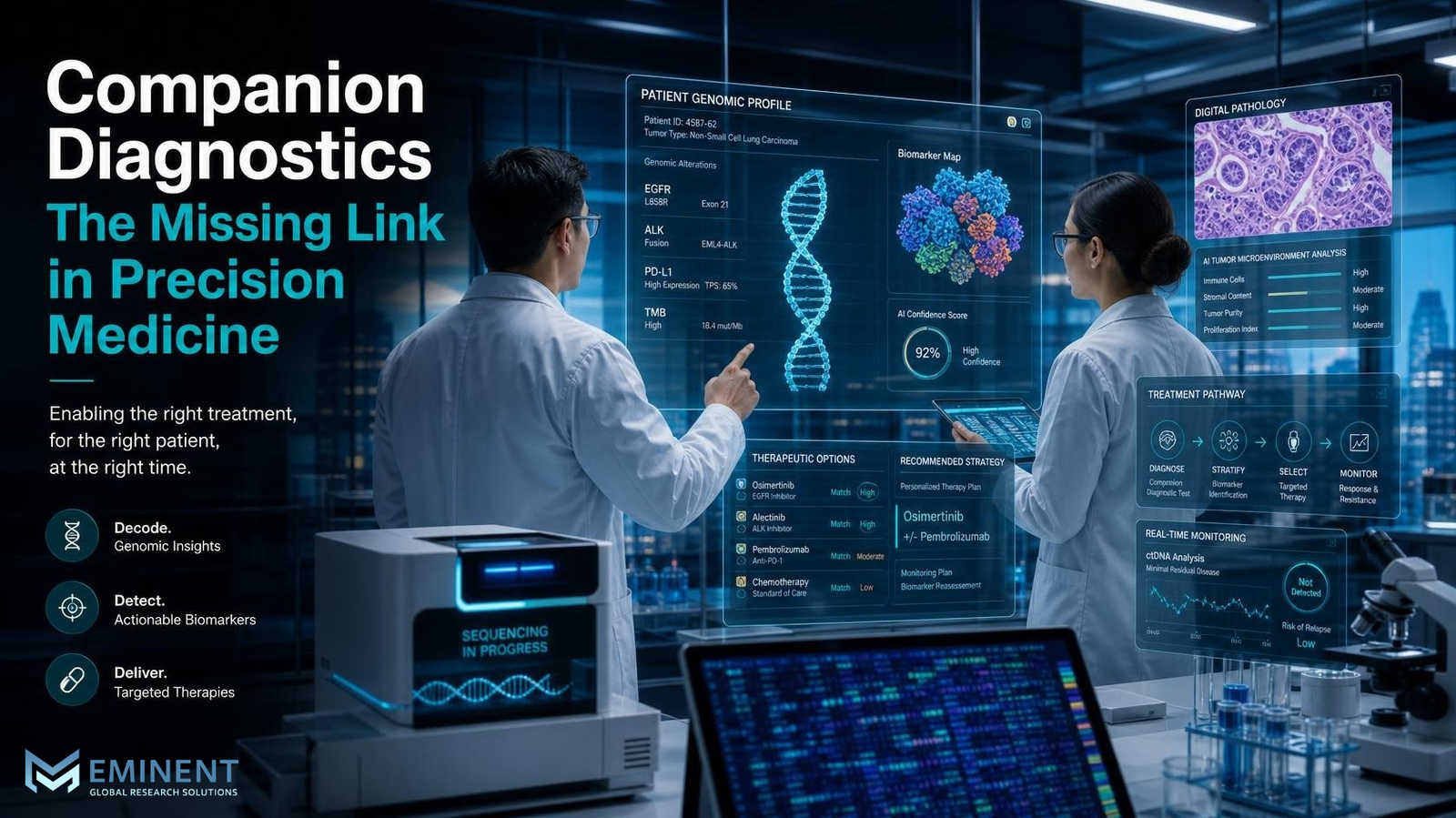
How Companion Diagnostics Are Transforming Personalized Healthcare and Drug Commercialization
Precision medicine has long been recognized as one of the most promising approaches to improving patient outcomes by delivering treatments tailored to an individual’s genetic, molecular, and biological profile. Yet despite remarkable advances in genomics, targeted therapies, and biotechnology, one critical component has often determined whether precision medicine succeeds or falls short: companion diagnostics.
Companion diagnostics (CDx) are rapidly emerging as the bridge between innovative therapeutics and the right patient. By identifying biomarkers that predict treatment response, these diagnostic tools help physicians select therapies that are most likely to benefit individual patients while avoiding unnecessary treatments and adverse effects.
As pharmaceutical pipelines increasingly shift toward targeted therapies, companion diagnostics are no longer simply supporting products—they are becoming strategic assets that influence regulatory approval, clinical adoption, reimbursement, and commercial success.
For pharmaceutical companies, diagnostic developers, healthcare providers, and investors, the question is no longer whether companion diagnostics matter. The question is whether organizations are prepared to integrate diagnostics into their innovation and commercialization strategies.
The Evolution of Precision Medicine
Traditional medicine has historically followed a “one-size-fits-all” approach, where patients with the same disease often receive identical treatments despite significant biological differences.
However, advances in genomic sequencing, molecular biology, and biomarker discovery have revealed that many diseases—including cancer, rare genetic disorders, autoimmune conditions, and neurological diseases—are highly heterogeneous.
Patients who appear clinically similar may respond very differently to the same therapy.
Precision medicine addresses this challenge by matching treatments to the biological characteristics of individual patients.
Companion diagnostics play a central role in making this possible.
Rather than relying solely on clinical symptoms, physicians can now use biomarker testing to determine whether a patient is likely to benefit from a specific targeted therapy.
This significantly improves treatment precision while reducing unnecessary healthcare costs.
What Are Companion Diagnostics?
Companion diagnostics are laboratory tests or diagnostic devices that provide essential information regarding the safe and effective use of a therapeutic product.
These tests help identify:
- Patients most likely to respond to therapy
- Individuals at higher risk of adverse reactions
- Appropriate dosage strategies
- Disease-specific biomarkers
- Molecular targets for treatment
Companion diagnostics are commonly used in:
- Oncology
- Rare diseases
- Gene therapy
- Immunotherapy
- Personalized medicine
- Targeted biologics
As more precision therapies enter clinical development, diagnostics are increasingly becoming integral components of treatment pathways rather than optional testing tools.
Why Companion Diagnostics Matter
The rapid growth of targeted therapies has fundamentally changed pharmaceutical development.
Many modern medicines are designed to act on specific genetic mutations or molecular pathways.
Without accurate diagnostic testing, physicians cannot reliably identify which patients will benefit.
Companion diagnostics improve healthcare by:
- Increasing treatment effectiveness
- Reducing unnecessary medication use
- Supporting earlier intervention
- Improving patient safety
- Enhancing clinical decision-making
- Optimizing healthcare resources
For patients, this means receiving therapies with a higher probability of success.
For healthcare systems, it means reducing waste associated with ineffective treatments.
The Commercial Value Beyond Clinical Success
While companion diagnostics improve patient outcomes, they also deliver substantial commercial advantages.
Historically, diagnostics were often viewed as supporting technologies.
Today, they are becoming strategic enablers of drug commercialization.
Pharmaceutical companies that integrate companion diagnostics early into drug development can:
- Improve clinical trial success rates
- Accelerate regulatory approval
- Strengthen product differentiation
- Increase physician confidence
- Enhance payer acceptance
- Support premium pricing strategies
Rather than launching a therapy into a broad patient population, companies can focus on patients with the highest probability of response.
This creates stronger clinical evidence while improving market adoption.
Regulatory Agencies Are Encouraging Co-Development
Global regulators increasingly recognize that diagnostics and therapeutics should be developed together.
Rather than evaluating drugs independently, regulatory agencies now encourage integrated development pathways where companion diagnostics are validated alongside therapeutic products.
This co-development model offers several benefits:
- More efficient clinical trials
- Stronger safety profiles
- Better patient selection
- Higher regulatory confidence
- Improved post-market outcomes
Companies that align diagnostic strategy with therapeutic development early in the product lifecycle may significantly reduce commercialization risk.
Regulatory excellence is becoming a competitive advantage rather than simply a compliance requirement.
Companion Diagnostics and Market Access
Commercial success depends on more than regulatory approval.
Healthcare payers increasingly require evidence that expensive therapies deliver measurable clinical value.
Companion diagnostics strengthen health economics by ensuring treatments are directed toward patients most likely to benefit.
This supports:
- Better reimbursement decisions
- Outcomes-based payment models
- Reduced healthcare expenditure
- Improved payer confidence
- Stronger value propositions
As precision therapies become more expensive, diagnostics will become increasingly important in demonstrating cost-effectiveness.
Companies that integrate reimbursement planning with diagnostic development may gain faster market access and broader adoption.
AI and Digital Diagnostics Are Expanding Opportunities
Artificial intelligence is rapidly enhancing the capabilities of companion diagnostics.
Machine learning algorithms can now analyze genomic datasets, pathology images, molecular biomarkers, and clinical information simultaneously.
Future companion diagnostic platforms may combine:
- Genomic sequencing
- Digital pathology
- AI-powered biomarker analysis
- Real-world evidence
- Wearable health data
- Predictive analytics
These integrated platforms could further improve treatment selection while supporting personalized disease management.
The convergence of AI, diagnostics, and biotechnology is creating entirely new opportunities across healthcare.
Strategic Considerations for Life Sciences Companies
As precision medicine expands, organizations should view companion diagnostics as strategic investments rather than supporting technologies.
Key priorities include:
- Integrating diagnostics into early R&D programs
- Building partnerships with diagnostic developers
- Aligning regulatory and commercialization strategies
- Investing in biomarker discovery
- Strengthening health economics and reimbursement planning
- Leveraging AI for diagnostic innovation
Companies that successfully combine therapeutic innovation with diagnostic precision may achieve stronger competitive positioning in increasingly specialized healthcare markets.
Looking Ahead
Precision medicine is transforming healthcare by replacing generalized treatment approaches with individualized therapeutic strategies.
Companion diagnostics are the critical link that makes this transformation possible.
As targeted therapies, gene therapies, and personalized medicine continue to expand, diagnostics will play an increasingly important role in determining which products succeed commercially and which struggle to achieve widespread adoption.
For pharmaceutical companies, biotechnology innovators, healthcare providers, and investors, the future of precision medicine will depend not only on breakthrough therapies but also on the ability to identify the right patient at the right time.
Organizations that integrate companion diagnostics into their innovation strategy today will be better positioned to lead the next generation of personalized healthcare.
The growing adoption of companion diagnostics is redefining precision medicine by shifting competitive advantage beyond drug discovery alone. Pharmaceutical companies that integrate diagnostics into clinical development, regulatory strategy, and commercialization can improve trial success, accelerate approvals, strengthen reimbursement outcomes, and enhance patient access. In the future, companion diagnostics will become a core pillar of personalized healthcare and a critical differentiator in the global precision medicine market.