

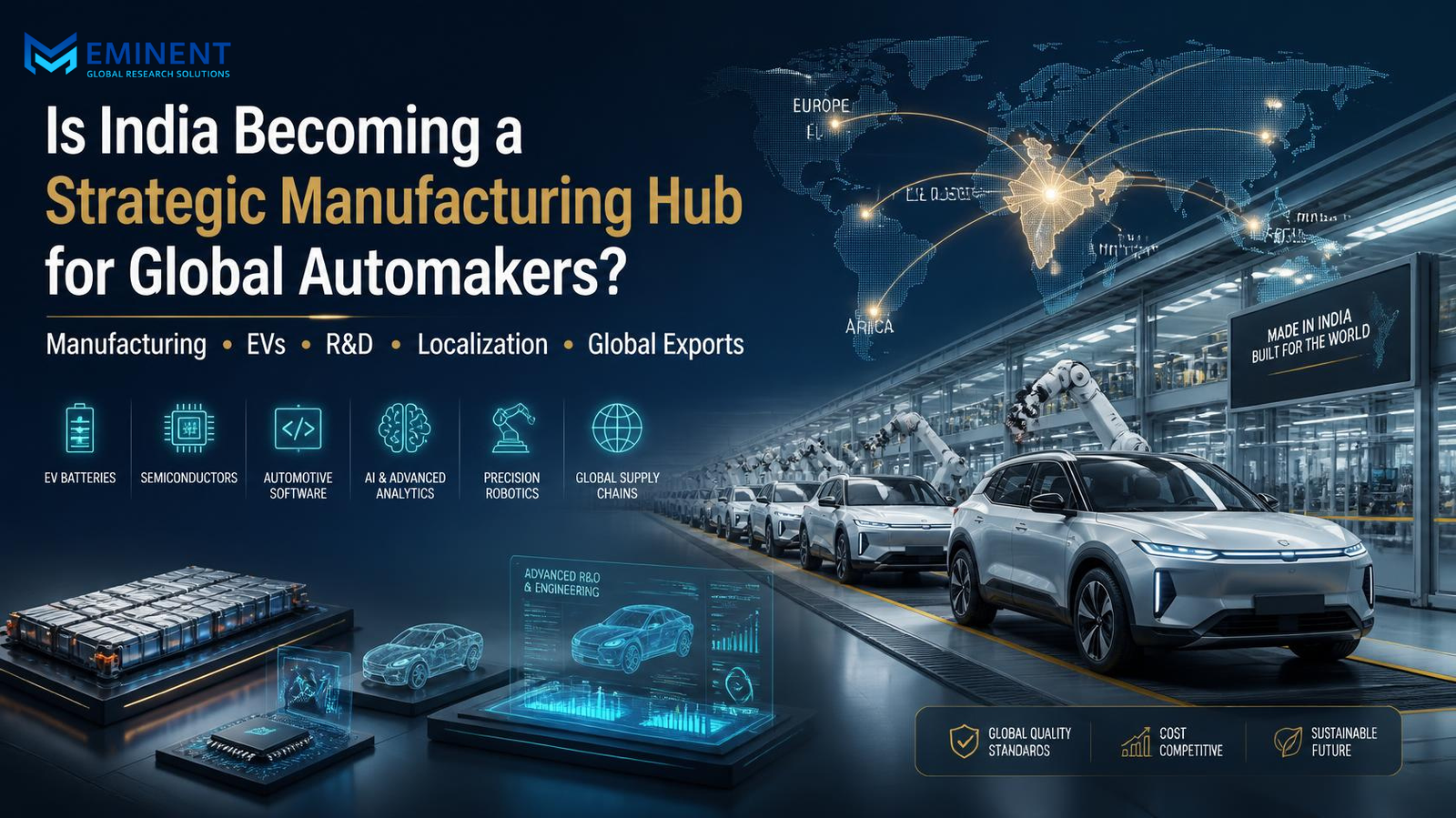
India is increasingly moving beyond its traditional role as a large automotive consumer market and emerging as an important manufacturing, engineering, and export base for global automakers.
The shift is being driven by several forces at once: expanding domestic vehicle demand, growing supplier capabilities, government manufacturing incentives, increasing localization, electric-mobility investment, and the strategic need for automakers to diversify global production networks.
The scale of the ecosystem is significant. India produced about 34.71 million passenger vehicles, three-wheelers, two-wheelers and quadricycles in FY2026, while automobile exports exceeded 6.7 million units. The country also attracted more than US$40 billion in cumulative automotive-sector FDI between April 2000 and March 2026.
Recent investment decisions reinforce this direction. Toyota announced plans for a new 100,000-vehicle-per-year manufacturing facility in Maharashtra, while Hyundai, Tata Motors, Maruti Suzuki and other manufacturers are expanding capacity, EV programs, R&D and export capabilities.
The strategic question for global automakers is therefore no longer simply whether India is an attractive sales market. It is whether India can become an integral part of their global manufacturing and innovation strategies.
From Market Opportunity to Manufacturing Strategy
India’s automotive market provides a natural foundation for manufacturing investment.
A large domestic customer base allows manufacturers to establish scale before expanding internationally. At the same time, the country’s established component ecosystem, engineering talent and manufacturing clusters provide infrastructure for localized production.
Major automotive clusters such as Chennai, Pune, Gurugram-Manesar, Sanand, Hosur and Chakan have developed extensive networks of OEMs, component suppliers, logistics providers, engineering firms and technology companies.
This ecosystem creates an important advantage: automakers can increasingly localize not only assembly but also engineering, sourcing, product development and technology capabilities.
That distinction matters.
A manufacturing hub becomes strategically valuable when it evolves from a production location into an integrated value-chain ecosystem.
Cost Is Important — But It Is Not the Whole Story
India’s manufacturing economics remain an important attraction.
Industry data indicates that India can offer operational cost advantages compared with several established automotive production regions.
However, global automakers are increasingly evaluating manufacturing locations using a much broader set of criteria:
- Total production cost
- Supplier depth
- Workforce availability
- Engineering capabilities
- Export infrastructure
- Localization potential
- Energy availability
- Technology ecosystem
- Government incentives
- Supply-chain resilience
This means India’s competitive proposition is evolving from “lower-cost manufacturing” toward “integrated automotive value creation.”
For multinational automakers, that could include vehicle assembly, component manufacturing, software development, R&D, EV engineering and exports from a single regional ecosystem.
Government Policy Is Accelerating Investment
Government incentives are another important factor.
The Production Linked Incentive scheme for automobiles and auto components has attracted approximately ₹45,477 crore, or US$4.82 billion, in investment as of June 2026 and generated more than 67,000 employment opportunities, according to government figures reported in September.
The broader PLI framework has also been designed to strengthen domestic manufacturing, localization and integration into global value chains. Across 14 sectors, PLI schemes had attracted more than US$25.5 billion in actual investment by March 2026.
For automotive companies, these policies can influence the economics of localizing advanced components and technologies.
The strategic implication is important: policy incentives are increasingly being combined with market demand and industrial capabilities rather than operating as isolated subsidies.
EVs Could Reshape India’s Manufacturing Proposition
Electric vehicles create another major opportunity.
The transition from internal-combustion vehicles to EVs is changing the automotive value chain. Batteries, power electronics, software, electric motors, charging systems and advanced materials are becoming increasingly important.
India’s EV sales reached approximately 2.66 million units in FY2026, according to industry data, although two- and three-wheelers still account for the majority of EV volumes.
This creates an interesting opportunity for global automakers.
Instead of simply transferring conventional vehicle manufacturing into India, companies can use the country to develop capabilities around emerging mobility technologies.
Recent investments demonstrate this direction. Automakers are expanding EV production, battery capabilities, engineering facilities and technology partnerships alongside traditional manufacturing operations.
For global manufacturers, India could therefore become part of the transition toward a more diversified global EV supply chain.
Localization Will Determine Long-Term Competitiveness
One of the most important questions is how deeply global automakers can localize their operations.
Importing large volumes of components can limit cost competitiveness and expose manufacturers to currency, logistics and geopolitical risks.
A deeper local ecosystem can provide:
Lower logistics exposure
Components can be sourced closer to production facilities.
Greater supply-chain resilience
Manufacturers become less dependent on distant suppliers.
Faster product adaptation
Local engineering teams can respond more quickly to market requirements.
Export competitiveness
A mature domestic supplier ecosystem can support vehicles intended for international markets.
Technology development
Local suppliers can increasingly participate in advanced automotive technologies.
For India to strengthen its position as a global manufacturing hub, continued development of high-value components, electronics, batteries, software and advanced materials will therefore be critical.
India as an Export Platform
Domestic demand is only one part of the opportunity.
India is already an important automotive export base, with automobile exports exceeding 6.7 million units in FY2026.
This creates the possibility of using India as a production base serving multiple markets across Asia, Africa, the Middle East and other regions.
For global automakers, this diversification can be strategically valuable.
A company does not necessarily need to manufacture every model in every major market. Instead, it can establish regional production hubs specializing in particular vehicle platforms, components or technologies.
India’s combination of domestic scale and export potential makes this model increasingly relevant.
R&D Could Become as Important as Manufacturing
Another important development is the expansion of engineering and R&D capabilities.
Global automotive companies increasingly require software engineers, battery specialists, electronics experts, AI professionals and advanced manufacturing engineers.
India’s established technology and engineering talent pool provides an opportunity to integrate these capabilities into automotive operations.
Recent investments in automotive R&D facilities illustrate this transition. For example, Škoda Auto Volkswagen India expanded its Pune R&D presence with a new engineering facility focused on vehicle development and software capabilities.
This could gradually change India’s role within multinational automotive organizations—from manufacturing location to engineering and innovation center.
Challenges Global Automakers Must Consider
Despite the opportunities, India is not a frictionless manufacturing environment.
Companies must evaluate:
- Infrastructure differences between regions
- Supply-chain maturity across advanced technologies
- EV charging infrastructure
- Regulatory complexity
- Workforce skill requirements
- Land and logistics considerations
- Supplier quality and scalability
- Localization economics
- Technology-transfer requirements
The competitive landscape is also becoming more complex as domestic manufacturers, established Japanese and Korean automakers, European brands and new EV manufacturers compete for market share.
For global automakers, simply establishing production capacity will not guarantee commercial success.
The stronger strategic approach is to align manufacturing decisions with product-market fit, localization strategy, technology roadmaps and export opportunities.
What This Means for Global Automakers
India’s automotive opportunity should increasingly be viewed through a strategic rather than purely operational lens.
The most important question is not:
“Can we manufacture vehicles in India?”
It is:
“Which parts of our global automotive value chain should India own?”
That could include manufacturing, component sourcing, vehicle engineering, software development, EV production, R&D, regional exports and technology partnerships.
As India develops deeper capabilities across these areas, its importance to global automotive strategies could increase further.
For automakers evaluating India, the opportunity therefore extends beyond factory economics. It involves understanding market demand, competitive dynamics, technology trends, supplier ecosystems, policy developments and future mobility requirements.
For Eminent Global Research Solutions, this creates a clear strategic intelligence opportunity: helping automotive companies evaluate market attractiveness, competitor positioning, supplier ecosystems, localization opportunities, technology trends and potential white spaces before making major investment decisions.
India’s automotive story is increasingly becoming a story of manufacturing + technology + exports + innovation.