

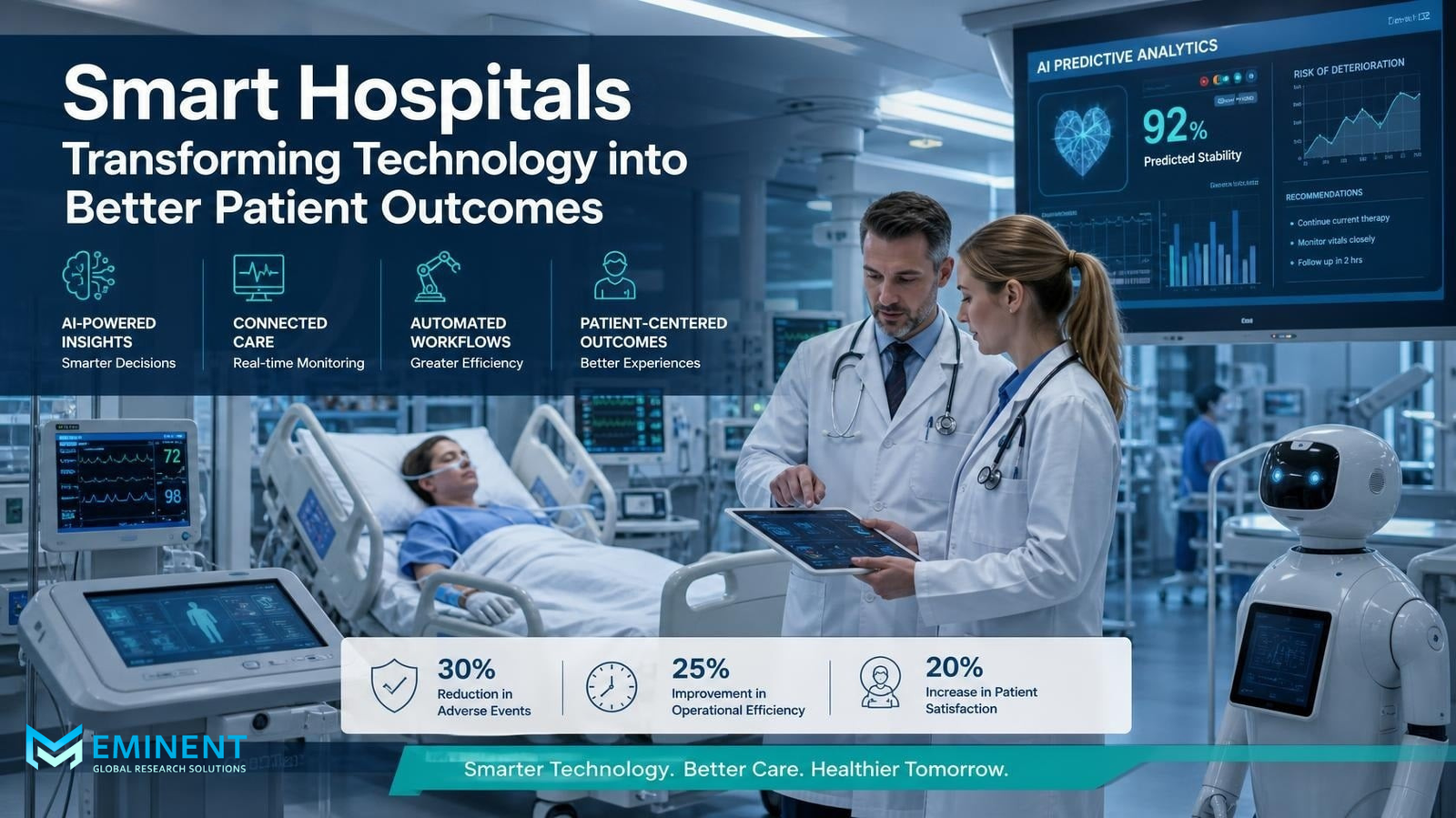
The healthcare industry is undergoing one of its most significant transformations in decades. Rapid advances in artificial intelligence (AI), the Internet of Things (IoT), cloud computing, robotics, and digital health technologies are redefining how hospitals operate and how patient care is delivered. At the center of this evolution is the emergence of the smart hospital a connected healthcare ecosystem where technology enhances clinical decision-making, streamlines operations, and improves patient outcomes.
Unlike traditional hospitals that rely heavily on manual workflows and disconnected systems, smart hospitals integrate digital technologies across clinical, operational, and administrative functions. From AI-assisted diagnostics and connected medical devices to predictive analytics and remote patient monitoring, these hospitals leverage real-time data to support faster, more informed healthcare decisions.
For healthcare providers, technology companies, and investors, smart hospitals represent more than a digital transformation initiative. They are becoming a strategic investment that can improve clinical outcomes, optimize resource utilization, and strengthen long-term operational resilience.
For consulting organizations like Eminent Global Research Solutions, this trend highlights the growing need for integrated strategies that combine technology adoption, regulatory planning, clinical workflow optimization, and healthcare innovation.
The Evolution of the Smart Hospital
Hospitals have traditionally relied on fragmented systems, paper-based documentation, and manual coordination between departments. While electronic health records (EHRs) digitized many processes, data often remained siloed, limiting the ability of clinicians to make fully informed decisions.
Smart hospitals aim to overcome these limitations by creating an interconnected healthcare environment where devices, software platforms, and clinical systems communicate seamlessly.
Key technologies driving smart hospitals include:
- Artificial Intelligence (AI)
- Internet of Things (IoT)
- Electronic Health Records (EHR)
- Predictive analytics
- Robotics and automation
- Digital imaging
- Remote patient monitoring
- Cloud-based healthcare platforms
- Cybersecurity and data protection
- Wearable medical devices
These technologies work together to generate actionable insights that improve patient care while increasing hospital efficiency.
Improving Clinical Decision-Making
One of the greatest advantages of smart hospitals is the ability to support clinicians with real-time data and AI-powered insights.
Instead of relying solely on historical patient records or manual observations, physicians can access comprehensive health information from connected monitoring devices, diagnostic platforms, laboratory systems, and imaging technologies.
Artificial intelligence can assist clinicians by:
- Detecting early signs of patient deterioration
- Prioritizing high-risk patients
- Supporting diagnostic accuracy
- Recommending evidence-based treatment pathways
- Identifying medication interactions
- Predicting complications before symptoms worsen
These capabilities help healthcare professionals make faster and more informed clinical decisions while reducing the likelihood of medical errors.
Rather than replacing physicians, AI serves as a clinical decision-support tool that enhances human expertise and enables more personalized patient care.
Enhancing Patient Safety
Patient safety remains one of the highest priorities in healthcare.
Smart hospitals improve safety through continuous monitoring and automated alerts.
Connected patient monitoring systems can detect changes in vital signs and immediately notify clinicians when intervention is required.
Examples include:
- Early sepsis detection
- Cardiac event monitoring
- Fall prevention systems
- Medication administration verification
- Infection surveillance
- ICU patient monitoring
Early intervention often leads to better treatment outcomes, shorter hospital stays, and reduced mortality.
Hospitals using predictive monitoring technologies may also reduce preventable complications that increase healthcare costs and strain clinical resources.
Operational Efficiency Drives Better Outcomes
Clinical excellence depends not only on medical expertise but also on operational efficiency.
Hospital overcrowding, delayed diagnostics, inefficient scheduling, and resource shortages can negatively impact patient outcomes.
Smart hospitals use AI and analytics to optimize operations by improving:
- Bed management
- Operating room scheduling
- Staff allocation
- Medical equipment utilization
- Emergency department workflows
- Supply chain management
For example, predictive analytics can forecast patient admissions, helping administrators allocate staff and resources more effectively during periods of high demand.
Automation also reduces administrative burdens, allowing healthcare professionals to spend more time delivering direct patient care.
Improved operational performance ultimately supports higher-quality healthcare delivery.
Personalized Patient Care
Healthcare is moving toward increasingly personalized treatment approaches.
Smart hospitals enable personalized care by integrating data from multiple sources, including:
- Electronic medical records
- Genetic information
- Wearable devices
- Lifestyle monitoring
- Imaging systems
- Laboratory testing
By analyzing these datasets collectively, clinicians can develop individualized treatment plans that reflect each patient’s unique health profile.
Remote monitoring technologies also allow providers to continue tracking patients after discharge, reducing readmissions and supporting long-term disease management.
This continuity of care strengthens patient engagement while improving overall health outcomes.
Data-Driven Healthcare
Data has become one of healthcare’s most valuable strategic assets.
Every patient interaction generates clinical, operational, and financial information that can be used to improve healthcare delivery.
Smart hospitals leverage advanced analytics to:
- Measure treatment effectiveness
- Monitor quality indicators
- Identify workflow bottlenecks
- Improve resource planning
- Support population health management
- Guide strategic investment decisions
Healthcare leaders increasingly rely on real-time dashboards to monitor hospital performance and respond proactively to emerging challenges.
Organizations capable of transforming data into actionable insights gain a significant advantage in delivering higher-quality care.
Challenges to Smart Hospital Adoption
Despite the significant benefits, implementing smart hospital technologies presents several challenges.
Infrastructure Investment
Developing connected healthcare ecosystems requires substantial investment in digital infrastructure, cloud platforms, medical devices, and cybersecurity.
Healthcare organizations must carefully evaluate return on investment while balancing financial sustainability.
Cybersecurity Risks
As hospitals become increasingly connected, protecting sensitive patient data becomes even more critical.
Healthcare organizations must strengthen cybersecurity capabilities to defend against ransomware, data breaches, and cyberattacks that could disrupt clinical operations.
Workforce Readiness
Technology adoption requires more than purchasing new systems.
Healthcare professionals need training to effectively integrate AI and digital tools into clinical workflows.
Successful transformation depends on collaboration between clinicians, IT specialists, administrators, and technology partners.
Regulatory Compliance
Smart hospitals must comply with evolving regulations related to patient privacy, data governance, medical device interoperability, and AI governance.
Organizations that proactively integrate regulatory planning into digital transformation initiatives can reduce implementation risks.
Consulting Perspective: Technology Alone Is Not Enough
Many hospitals invest heavily in digital technologies but struggle to achieve measurable clinical improvements because implementation lacks strategic alignment.
Successful smart hospital transformation requires an integrated approach that combines:
- Digital transformation strategy
- Clinical workflow redesign
- Regulatory compliance
- Change management
- Data governance
- Cybersecurity
- Technology integration
- Workforce development
Healthcare organizations should evaluate technology investments based on measurable improvements in patient outcomes, operational efficiency, financial performance, and long-term scalability.
For consulting firms, this creates opportunities to support healthcare providers in developing comprehensive digital transformation roadmaps that maximize both clinical and business value.
The Future of Smart Hospitals
The future hospital will be increasingly intelligent, connected, and patient-centric.
Emerging innovations such as AI-assisted surgery, digital twins, autonomous logistics robots, predictive population health analytics, and personalized precision medicine will continue expanding the capabilities of smart healthcare environments.
Hospitals will increasingly shift from reactive treatment models toward predictive and preventive care powered by continuous data analysis.
Organizations that invest today in digital infrastructure, interoperable systems, cybersecurity, and AI-driven clinical support will be better positioned to deliver superior patient outcomes while improving operational resilience.
Smart hospitals are no longer a vision of the future they are becoming the foundation of next-generation healthcare.