

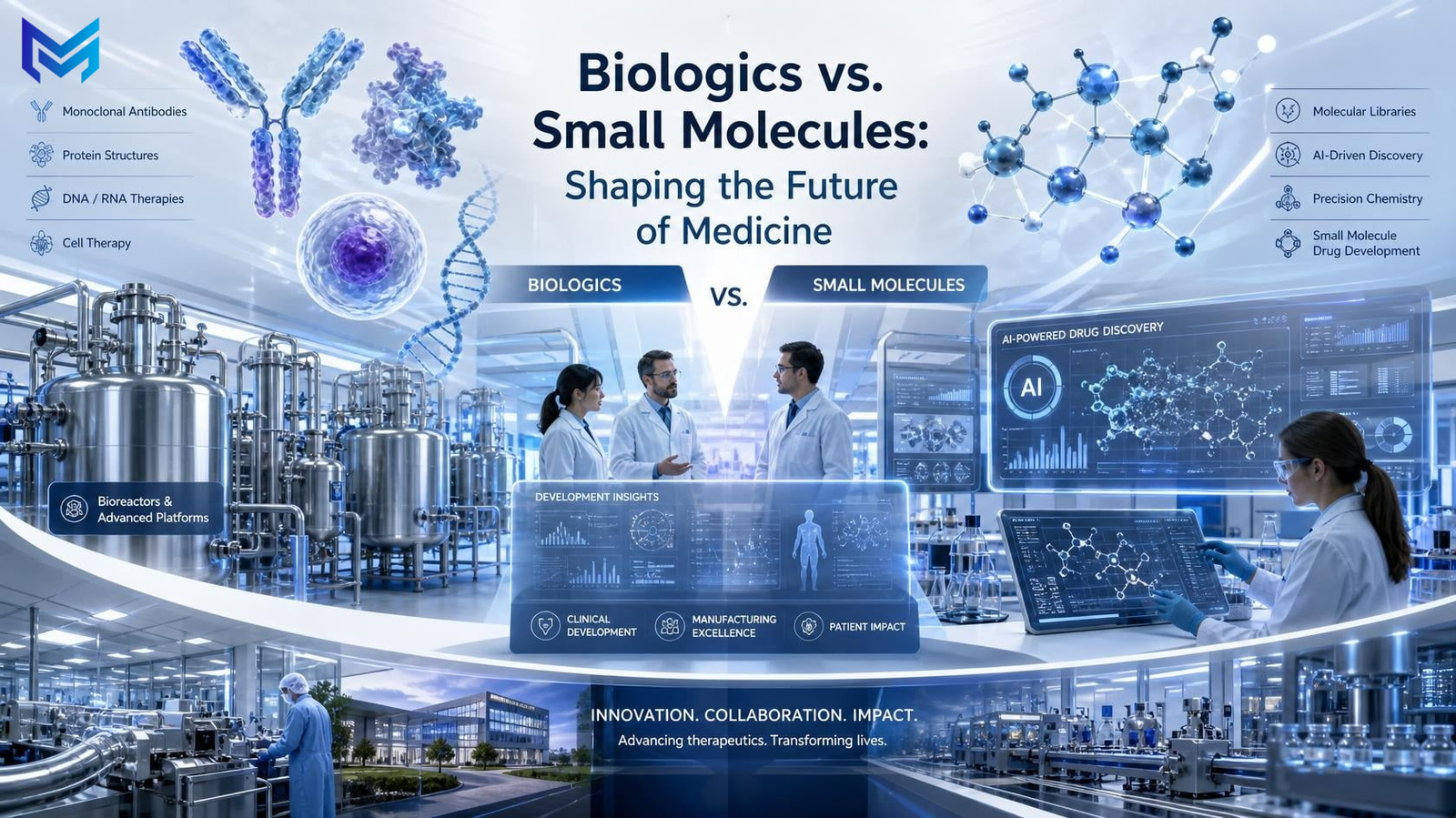
How Innovation, Precision Medicine, and Commercial Strategy Are Reshaping the Pharmaceutical Industry
The pharmaceutical industry is undergoing one of the most significant transformations in its history. Over the past two decades, biologics have evolved from a niche therapeutic category into one of the primary drivers of global pharmaceutical growth. Monoclonal antibodies, cell therapies, gene therapies, recombinant proteins, and antibody-drug conjugates have redefined treatment standards across oncology, immunology, rare diseases, and autoimmune disorders.
Meanwhile, small molecule drugs continue to play a critical role in treating chronic diseases, infectious diseases, cardiovascular disorders, and metabolic conditions. They remain essential because of their oral availability, lower manufacturing costs, and broad accessibility.
The key question for pharmaceutical companies is no longer whether biologics will replace small molecules—it is whether biologics will continue to grow faster and capture a larger share of industry investment and commercial success.
The answer increasingly appears to be yes, but the future will depend on innovation, manufacturing capabilities, regulatory strategy, and commercialization excellence.
The Rise of Biologics
Biologics have transformed modern medicine because they target diseases with greater precision than many conventional therapies.
Unlike small molecule drugs, which are chemically synthesized and typically act inside cells, biologics are complex molecules produced from living organisms. Their ability to interact with highly specific biological pathways has enabled breakthroughs in treating diseases that were once difficult—or impossible—to manage effectively.
Today, biologics dominate many high-value therapeutic areas, including:
- Oncology
- Autoimmune diseases
- Rheumatology
- Hematology
- Rare diseases
- Neurology
- Ophthalmology
Many of the world’s highest-revenue medicines are biologics, demonstrating strong physician adoption and sustained demand despite higher treatment costs.
The continued expansion of precision medicine further strengthens biologics’ position, as therapies become increasingly tailored to specific patient populations based on genetics, biomarkers, and disease biology.
Why Small Molecules Still Matter
Despite the impressive growth of biologics, small molecule drugs remain the foundation of global healthcare.
Their advantages include:
- Oral administration
- Lower manufacturing costs
- Easier storage and transportation
- Well-established regulatory pathways
- Broad patient accessibility
- Large-scale manufacturing capacity
Small molecules continue to dominate therapeutic areas such as:
- Cardiovascular disease
- Diabetes
- Hypertension
- Infectious diseases
- Mental health
- Pain management
In addition, advances in medicinal chemistry, computational drug design, and artificial intelligence are enabling researchers to develop increasingly sophisticated small molecule therapies capable of targeting previously “undruggable” proteins.
Rather than disappearing, small molecules are evolving alongside biologics.
Precision Medicine Is Fueling Biologics Growth
One of the biggest reasons biologics continue to outperform is the rise of precision medicine.
Healthcare is moving away from the traditional “one-size-fits-all” treatment approach toward therapies designed for specific patient populations.
Advancements in:
- Genomic sequencing
- Biomarker discovery
- Companion diagnostics
- AI-driven drug discovery
- Molecular profiling
allow clinicians to identify patients most likely to benefit from highly targeted biologic therapies.
This improves:
- Clinical outcomes
- Treatment response
- Safety profiles
- Healthcare efficiency
As personalized medicine becomes increasingly integrated into healthcare systems, biologics are expected to capture an even larger share of innovative drug development.
Manufacturing Is Becoming a Strategic Differentiator
Scientific discovery alone is no longer enough.
Commercial success increasingly depends on manufacturing scalability.
Biologics require highly specialized production involving:
- Cell culture systems
- Bioreactors
- Purification technologies
- Cold-chain logistics
- Strict quality control
These complexities increase production costs but also create high barriers to entry.
Companies capable of building efficient biologics manufacturing platforms can accelerate commercialization while maintaining regulatory compliance and product quality.
Manufacturing excellence is becoming a competitive advantage rather than simply an operational requirement.
Biosimilars Are Reshaping the Market
The rapid expansion of biosimilars is another factor influencing biologics growth.
As patents expire for blockbuster biologics, biosimilar manufacturers are entering the market with lower-cost alternatives.
This creates several important dynamics:
- Increased patient access
- Greater pricing competition
- Expanded global adoption
- Healthcare cost reduction
While biosimilars may reduce revenue for originator products, they also increase the overall biologics market by making advanced therapies available to more patients worldwide.
For pharmaceutical companies, lifecycle management strategies and next-generation biologics will become increasingly important.
AI Is Accelerating Both Drug Classes
Artificial intelligence is transforming both biologics and small molecule development.
AI is improving:
- Target identification
- Protein engineering
- Molecular optimization
- Clinical trial design
- Patient recruitment
- Manufacturing optimization
For biologics, AI enables more efficient antibody engineering and protein design.
For small molecules, AI significantly reduces discovery timelines by identifying promising compounds more quickly than traditional screening methods.
Rather than favoring one modality over another, AI is accelerating innovation across the pharmaceutical landscape.
Commercialization Will Determine Market Leadership
The companies leading the next generation of pharmaceutical growth will not necessarily be those with the most scientific breakthroughs—they will be those capable of commercializing innovation efficiently.
Successful commercialization requires:
- Strong regulatory strategy
- Global manufacturing capacity
- Market access planning
- Health economics expertise
- Reimbursement strategy
- Physician engagement
- Patient support programs
As biologics become more sophisticated and personalized, commercialization capabilities become increasingly important.
Organizations that successfully integrate scientific innovation with operational excellence will likely dominate future pharmaceutical markets.
The Future Is a Hybrid Pharmaceutical Ecosystem
The future of medicine is unlikely to be defined by biologics versus small molecules.
Instead, healthcare is moving toward a diversified therapeutic ecosystem where different modalities are selected based on disease biology, patient characteristics, clinical outcomes, and economic considerations.
Future treatment portfolios may include:
- Small molecule drugs
- Monoclonal antibodies
- Cell therapies
- Gene therapies
- RNA-based medicines
- Antibody-drug conjugates
- Combination therapies
This integrated approach allows pharmaceutical companies to address a broader range of diseases while maximizing therapeutic effectiveness.
Consultant Perspective
The continued growth of biologics reflects a broader shift toward precision medicine and high-value specialty therapies. However, scientific innovation alone will not secure market leadership. Pharmaceutical companies that invest in scalable manufacturing, regulatory excellence, market access planning, and commercialization capabilities will be best positioned to capture long-term growth. At the same time, advancements in AI and medicinal chemistry ensure that small molecules will remain indispensable, creating a hybrid innovation landscape where strategic portfolio diversification becomes a key competitive advantage.