

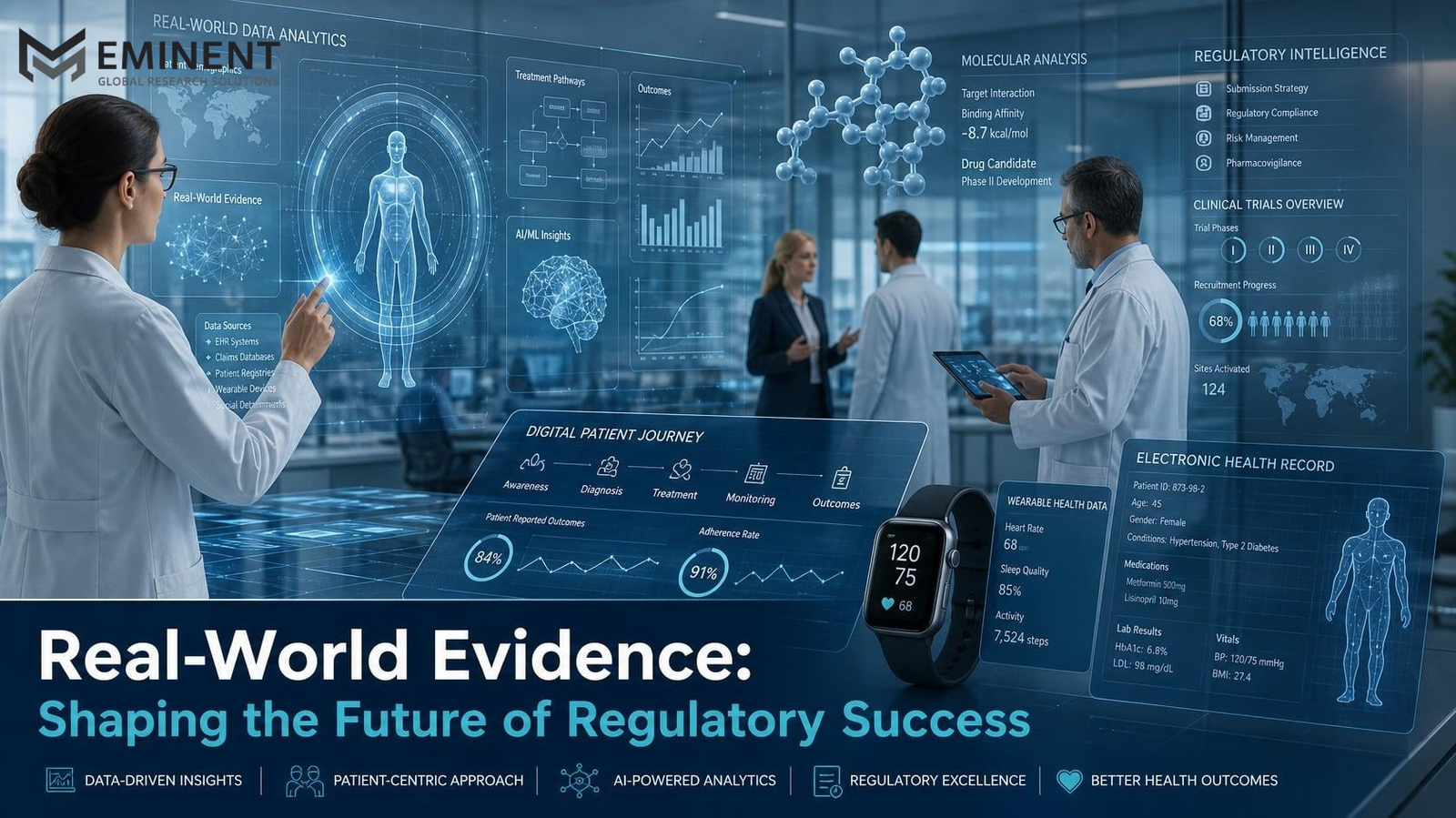
How Real-World Data Is Transforming Drug Development, Regulatory Decision-Making, and Commercialization
The pharmaceutical industry is experiencing one of its most significant transformations in decades. While randomized controlled trials (RCTs) remain the gold standard for establishing the safety and efficacy of new therapies, they are no longer the sole source of evidence influencing regulatory decisions.
Today, Real-World Evidence (RWE) is emerging as a strategic asset that is reshaping regulatory submissions, accelerating product approvals, supporting label expansions, and strengthening post-market surveillance. Regulatory agencies across the globe are increasingly recognizing that healthcare decisions should not rely solely on controlled clinical environments but also reflect how therapies perform in routine clinical practice.
For pharmaceutical companies, biotechnology firms, and healthcare innovators, this shift represents more than a regulatory trend—it is a fundamental change in drug development and commercialization strategy.
Organizations that successfully integrate Real-World Evidence into their development programs can improve regulatory engagement, reduce development risks, strengthen payer negotiations, and generate long-term competitive advantages.
Understanding Real-World Evidence
Real-World Evidence refers to clinical evidence regarding the use, effectiveness, and safety of medical products derived from Real-World Data (RWD) collected outside traditional clinical trials.
Sources of Real-World Data include:
- Electronic Health Records (EHRs)
- Patient registries
- Insurance claims databases
- Pharmacy records
- Wearable health devices
- Mobile health applications
- Patient-reported outcomes
- Digital health platforms
- Genomic databases
Unlike randomized clinical trials conducted under tightly controlled conditions, Real-World Evidence reflects how therapies perform across diverse patient populations in everyday healthcare settings.
This provides valuable insights into treatment effectiveness, safety profiles, patient adherence, healthcare utilization, and long-term outcomes.
Why Regulatory Agencies Are Embracing RWE
Healthcare is becoming increasingly personalized.
Traditional clinical trials often involve carefully selected patient populations that may not fully represent real-world demographics. Elderly patients, individuals with multiple chronic conditions, and diverse ethnic populations are frequently underrepresented.
Regulators increasingly recognize that understanding therapy performance across broader populations is essential for informed decision-making.
Real-World Evidence can help support:
- Post-market safety monitoring
- Label expansion applications
- Rare disease research
- Comparative effectiveness studies
- Long-term treatment outcomes
- External control arms in clinical research
- Regulatory lifecycle management
Rather than replacing clinical trials, RWE complements them by providing additional evidence that enhances confidence in regulatory decisions.
Accelerating Drug Development
One of the most significant advantages of Real-World Evidence is its ability to improve development efficiency.
Drug development remains expensive, time-consuming, and high risk. Clinical trials frequently encounter delays related to patient recruitment, protocol complexity, and limited enrollment.
Real-World Data helps companies:
- Identify eligible patient populations
- Optimize trial design
- Improve site selection
- Monitor disease progression
- Support adaptive trial strategies
- Reduce recruitment timelines
For rare diseases, where recruiting sufficient patient numbers is particularly challenging, Real-World Evidence can play an especially valuable role.
External control arms constructed from historical patient data may reduce the need for placebo groups while maintaining scientific rigor.
This approach can shorten development timelines while improving patient access to innovative therapies.
Strengthening Regulatory Strategy
Regulatory success increasingly depends on presenting comprehensive evidence packages.
Today’s regulators evaluate not only clinical efficacy but also long-term effectiveness, safety, and patient outcomes.
Companies that incorporate RWE into regulatory planning may strengthen submissions by demonstrating:
- Long-term therapeutic durability
- Treatment effectiveness across diverse populations
- Real-world safety monitoring
- Patient adherence patterns
- Healthcare resource utilization
- Quality-of-life improvements
As regulatory expectations evolve, evidence generation strategies must also evolve.
Organizations that build integrated clinical and real-world evidence capabilities are likely to gain greater flexibility throughout the product lifecycle.
Supporting Market Access and Reimbursement
Regulatory approval represents only one stage of commercialization.
Payers increasingly require evidence demonstrating that therapies provide measurable value in routine healthcare settings.
Real-World Evidence supports:
- Health economics analysis
- Cost-effectiveness evaluations
- Budget impact modeling
- Comparative treatment assessments
- Outcomes-based reimbursement agreements
Healthcare systems worldwide are placing greater emphasis on value-based care.
Companies capable of demonstrating improved patient outcomes alongside economic value may strengthen reimbursement negotiations and accelerate market access.
AI Is Expanding the Value of Real-World Evidence
Artificial intelligence is dramatically increasing the usefulness of Real-World Data.
Modern AI platforms can analyze millions of patient records to identify trends that would be impossible through manual review.
Machine learning enables organizations to:
- Detect safety signals earlier
- Predict treatment response
- Identify patient subgroups
- Improve disease progression models
- Generate predictive healthcare insights
- Support personalized medicine strategies
As healthcare datasets continue growing, AI-powered analytics will become increasingly important for extracting actionable regulatory intelligence.
The convergence of AI, digital health, and Real-World Evidence represents one of the most important developments in modern healthcare innovation.
Challenges That Must Be Addressed
Despite its growing importance, Real-World Evidence presents several challenges.
Organizations must ensure:
- High-quality data collection
- Standardized data formats
- Patient privacy protection
- Regulatory compliance
- Transparent analytical methodologies
- Bias reduction
- Cross-system interoperability
Poor-quality data can reduce confidence in evidence generation.
Therefore, governance frameworks and robust validation processes remain essential for successful RWE implementation.
The Future of Regulatory Success
The pharmaceutical industry is moving toward a more integrated evidence ecosystem.
Future regulatory submissions are likely to combine:
- Randomized clinical trial data
- Real-World Evidence
- AI-generated insights
- Digital biomarkers
- Patient-reported outcomes
- Genomic data
- Wearable health information
This comprehensive approach enables regulators to better understand how therapies perform throughout their entire lifecycle.
Companies that invest early in advanced data infrastructure, digital health integration, and Real-World Evidence capabilities will be better positioned to navigate evolving regulatory expectations.
Consultant Perspective
At Eminent Global Research Solutions, we believe Real-World Evidence is no longer a supplementary data source—it is becoming a strategic pillar of pharmaceutical innovation and commercialization.
Organizations that integrate RWE into clinical development, regulatory strategy, health economics, and market access planning can accelerate approvals, strengthen payer negotiations, and generate long-term competitive advantages.
The future of regulatory success will not be defined solely by clinical trial results. It will increasingly depend on an organization’s ability to demonstrate how therapies improve outcomes in real-world clinical practice.
As healthcare becomes more data-driven and patient-centric, Real-World Evidence is poised to become one of the most valuable strategic assets across the pharmaceutical value chain.