

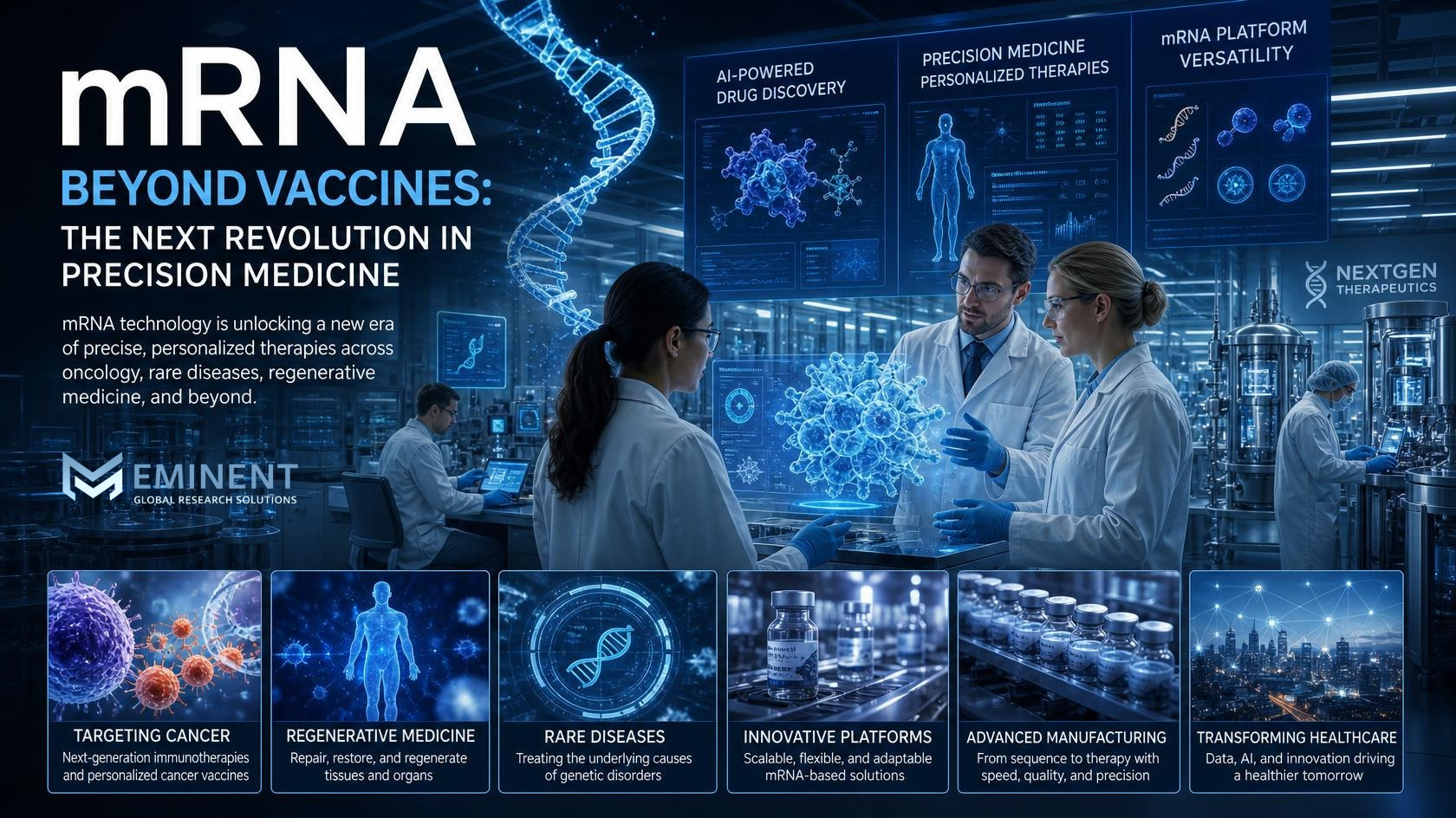
How Messenger RNA Could Transform the Future of Medicine
The remarkable success of messenger RNA (mRNA) technology during the COVID-19 pandemic fundamentally changed the perception of what modern biotechnology can achieve. Once considered an emerging platform with limited commercial applications, mRNA has now established itself as one of the most promising technologies in the pharmaceutical industry.
While vaccines brought mRNA into the global spotlight, they may represent only the beginning of its potential. Researchers and biotechnology companies are rapidly exploring applications that extend far beyond infectious diseases, including cancer immunotherapy, rare genetic disorders, cardiovascular diseases, autoimmune conditions, and regenerative medicine.
For pharmaceutical companies, investors, and healthcare systems, the critical question is no longer whether mRNA technology works—it is whether it can become the foundation of the next generation of precision medicine.
The answer appears increasingly optimistic. However, realizing that vision will depend on overcoming scientific, manufacturing, regulatory, and commercialization challenges.
For organizations operating in life sciences, mRNA represents not only a scientific breakthrough but also a strategic platform capable of reshaping drug development, accelerating innovation, and creating entirely new commercial opportunities.
From Vaccines to a Universal Therapeutic Platform
Messenger RNA functions as the body’s biological instruction manual. Instead of introducing proteins directly, mRNA provides cells with the genetic instructions needed to produce specific proteins naturally.
This mechanism creates remarkable flexibility.
Unlike conventional pharmaceuticals that often require years of discovery and optimization, mRNA therapies can be designed relatively quickly by modifying the genetic sequence while maintaining the same delivery platform.
This modular approach has transformed drug development.
Rather than developing entirely new manufacturing systems for every therapy, companies can potentially adapt existing mRNA platforms for multiple diseases, reducing development timelines and increasing operational efficiency.
The success of COVID-19 vaccines demonstrated that this platform could be developed, manufactured, and distributed globally at unprecedented speed.
Today, researchers are applying those lessons across numerous therapeutic areas.
Cancer May Be the Next Major Opportunity
One of the most promising applications of mRNA lies in oncology.
Traditional cancer treatments often attack healthy cells alongside cancerous ones, resulting in significant side effects.
mRNA-based cancer therapies offer a more personalized approach.
Scientists are developing individualized cancer vaccines capable of training a patient’s immune system to recognize tumor-specific proteins and selectively attack cancer cells.
These therapies may eventually be used alongside:
- Immune checkpoint inhibitors
- Cell therapies
- Targeted oncology drugs
- Personalized precision medicine
If successful, mRNA could significantly improve treatment outcomes while reducing unnecessary toxicity.
For oncology companies, this creates opportunities to build highly differentiated treatment platforms that combine AI-driven genomic analysis with personalized therapeutic development.
Rare Diseases Could Benefit Significantly
Thousands of rare diseases currently have limited or no effective treatment options.
Many are caused by missing or defective proteins resulting from genetic mutations.
mRNA therapies provide a unique opportunity to temporarily replace these missing proteins without permanently altering a patient’s DNA.
Unlike gene editing technologies, mRNA does not integrate into the genome, potentially reducing long-term safety concerns while offering repeated therapeutic dosing when necessary.
This flexibility makes mRNA particularly attractive for diseases requiring controlled protein expression.
As genomic sequencing becomes increasingly accessible, personalized mRNA therapies may emerge for many currently untreatable inherited disorders.
Beyond Infectious Diseases
Although vaccines remain the most visible application, researchers are expanding mRNA into multiple therapeutic categories.
Potential future applications include:
- Cardiovascular disease treatment
- Autoimmune disorders
- Regenerative medicine
- Protein replacement therapies
- Metabolic diseases
- Neurological disorders
- Liver diseases
- Chronic inflammatory conditions
The versatility of mRNA allows researchers to develop treatments across diverse biological systems using a common technological platform.
This dramatically expands commercial opportunities for pharmaceutical companies investing in RNA-based innovation.
Manufacturing Is Becoming a Competitive Advantage
One of mRNA technology’s greatest strengths is platform manufacturing.
Traditional biologics often require highly specialized production processes unique to each therapy.
mRNA manufacturing is comparatively standardized.
Companies that establish scalable manufacturing infrastructure today may gain long-term competitive advantages as more RNA-based therapies enter clinical development.
Key priorities include:
- Large-scale RNA production
- Lipid nanoparticle manufacturing
- Cold-chain optimization
- Quality assurance systems
- Global supply chain resilience
Organizations investing early in advanced manufacturing capabilities may significantly reduce future commercialization timelines.
As the number of RNA therapies grows, manufacturing excellence may become just as important as scientific discovery.
Regulatory Evolution Is Accelerating Innovation
Regulatory agencies gained valuable experience evaluating mRNA products during the pandemic.
That experience is helping create clearer development pathways for future RNA-based therapies.
Regulators are becoming increasingly familiar with:
- Platform technologies
- Manufacturing standards
- Clinical trial design
- Quality control requirements
- Long-term safety monitoring
This growing regulatory confidence could reduce uncertainty for future product approvals while accelerating innovation across multiple therapeutic areas.
Companies that build strong regulatory capabilities alongside scientific expertise may move products to market more efficiently.
Commercialization Will Determine Long-Term Success
Scientific innovation alone will not guarantee commercial success.
To maximize the value of mRNA platforms, companies must develop integrated commercialization strategies focused on:
- Market access planning
- Reimbursement strategy
- Manufacturing scalability
- Global regulatory alignment
- Strategic partnerships
- Healthcare provider education
As RNA therapies become increasingly personalized, pharmaceutical companies will also need new approaches to pricing, patient identification, and treatment delivery.
Organizations capable of integrating scientific innovation with commercial execution may become leaders in the expanding RNA therapeutics market.
The Investment Landscape Is Changing
The success of mRNA has attracted substantial investment from pharmaceutical companies, venture capital firms, and public markets.
Major organizations are expanding RNA research through acquisitions, licensing agreements, and strategic collaborations.
Investment is increasingly focused on:
- AI-driven RNA design
- Delivery technologies
- Lipid nanoparticle innovation
- Personalized medicine platforms
- Manufacturing automation
- Rare disease applications
This growing investment ecosystem is likely to accelerate innovation while expanding the number of commercial opportunities across biotechnology.
The Future of mRNA Medicine
The evolution of mRNA technology represents one of the most important developments in modern biotechnology.
While vaccines demonstrated the platform’s potential, future growth will likely come from therapeutic applications across oncology, rare diseases, cardiovascular medicine, regenerative medicine, and precision healthcare.
For pharmaceutical companies, the competitive landscape is shifting rapidly.
Future market leaders will not simply be those that develop effective RNA therapies.
They will be organizations capable of combining:
- Platform innovation
- Scalable manufacturing
- Regulatory excellence
- Strategic partnerships
- Commercial execution
- Global market access
For consulting firms, investors, and life sciences organizations, mRNA technology represents a transformational opportunity requiring long-term strategic planning rather than short-term product development.
The question is no longer whether mRNA will expand beyond vaccines.
The more important question is how quickly organizations can position themselves to lead the next generation of RNA-powered medicine.