

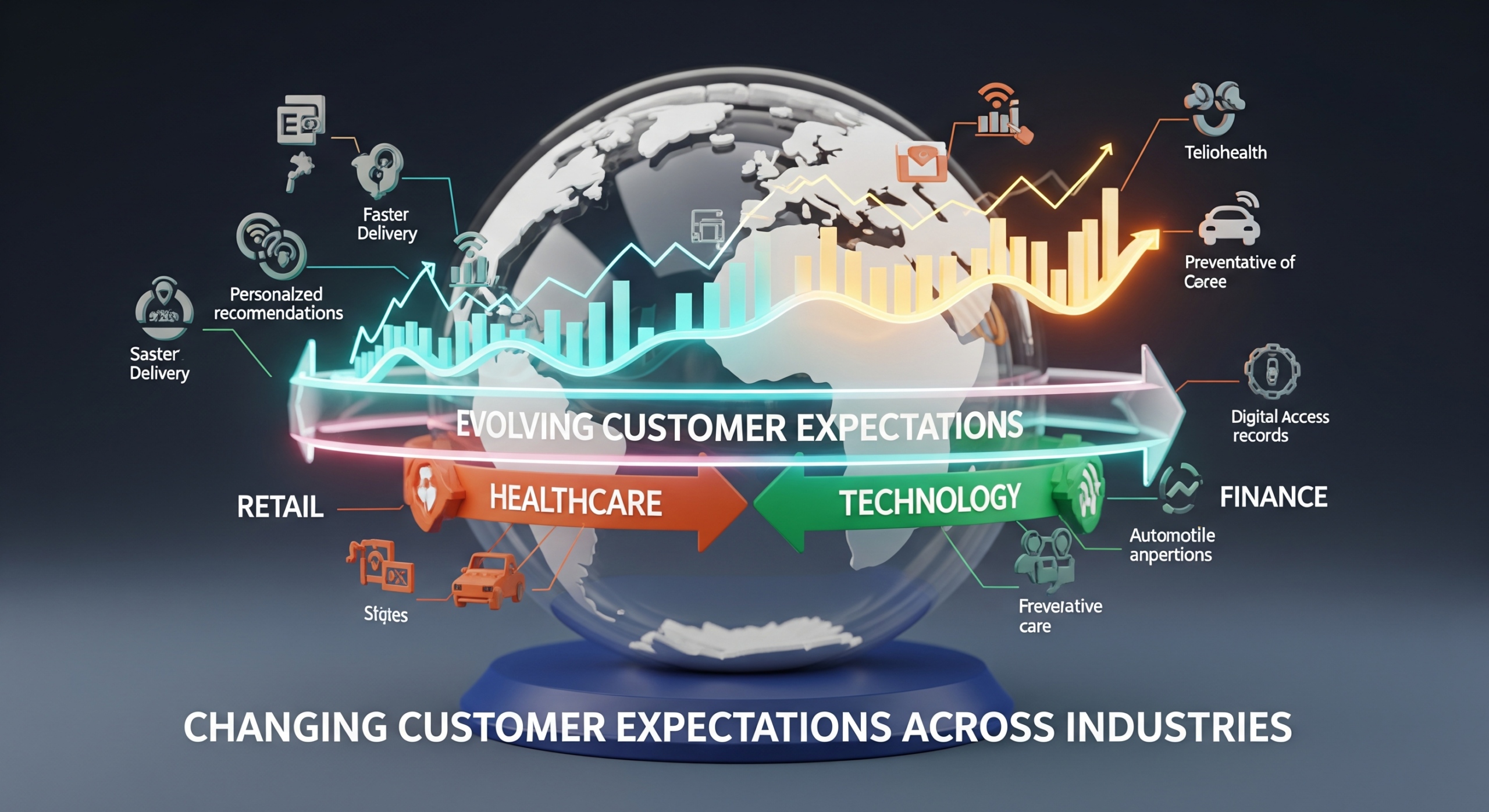
Changing Customer Expectations Across Industries
Customer expectations are evolving faster than business models. Driven by digital experiences, increased transparency, and global competition, customers today expect more—regardless of industry. Whether in B2B or B2C markets, organizations are being judged not just on what they sell, but on how they deliver value at every interaction.
Understanding and responding to these shifting expectations has become a critical success factor across industries.
From Product-Centric to Experience-Centric
Historically, competitive advantage was built on product quality, pricing, or scale. Today, customers expect seamless experiences, not isolated transactions.
Across industries, this means:
Faster response times
Simpler buying journeys
Consistent experiences across digital and physical channels
Companies that still operate in silos—sales, service, operations—are increasingly outpaced by those designing end-to-end customer journeys.
Speed, Convenience, and Real-Time Access
Digital-first platforms have reset expectations around speed and convenience. Customers now expect:
Instant access to information
Real-time order tracking or service updates
Minimal friction in onboarding, purchasing, and support
This shift affects industries as diverse as manufacturing, healthcare, finance, logistics, and professional services. Delays that were once acceptable are now seen as poor service.
Personalization Is No Longer Optional
Customers increasingly expect solutions tailored to their specific needs. Generic offerings are being replaced by:
Customized pricing or service models
Industry- or role-specific solutions
Personalized communication and recommendations
Data analytics and AI are enabling personalization at scale, making it a baseline expectation rather than a premium feature.
Transparency and Trust Matter More Than Ever
With easy access to information, customers demand greater transparency across industries:
Clear pricing and contract terms
Visibility into supply chains and sourcing
Honest communication during disruptions
Trust has become a decisive factor, especially in regulated and high-stakes sectors such as healthcare, finance, and energy.
Sustainability and Ethics Influence Decisions
Customer expectations now extend beyond performance and price. Sustainability, environmental impact, and ethical practices are increasingly influencing purchasing decisions—both in B2C and B2B markets.
Organizations are expected to:
Demonstrate measurable sustainability efforts
Align with ESG commitments
Communicate impact credibly, not superficially
Failure to address these expectations can directly affect brand reputation and customer loyalty.
B2B Buyers Are Behaving Like B2C Customers
One of the most significant shifts is the consumerization of B2B buying. Business customers now expect:
Self-service portals
Transparent pricing
Digital-first engagement
Personalized account experiences
B2B decision-makers compare vendors not only within their industry, but against the best digital experiences they encounter elsewhere.
Data-Driven Expectations
Customers increasingly expect companies to “know them” without repeated explanations. This requires:
Integrated customer data across touchpoints
Predictive insights into customer needs
Proactive service and support
Organizations that effectively use data to anticipate needs gain a measurable competitive edge.
Implications for Businesses Across Industries
Changing customer expectations demand structural change, not cosmetic improvements. Successful organizations are:
Investing in customer experience (CX) strategy
Breaking down internal silos
Using analytics to continuously refine engagement
Aligning technology, people, and processes around the customer
Customer-centricity is no longer a marketing message—it is an operational discipline.
Conclusion
Across industries, customer expectations are converging around a common standard: speed, personalization, transparency, and trust. Organizations that fail to adapt risk losing relevance, while those that listen, analyze, and evolve will build stronger, longer-lasting customer relationships.
The future belongs to companies that treat changing customer expectations not as a challenge, but as a strategic opportunity.