

Introduction
The biotechnology sector has evolved into one of the most patent-intensive industries in the global innovation economy. From gene-editing breakthroughs to monoclonal antibodies and cell-based therapies, biotech companies rely heavily on strong patent protection to justify massive R&D investments. However, as innovation accelerates, so does litigation.
In recent years, invalidity challenges and opposition proceedings have become central strategic tools in biotech competition. Innovators, biosimilar manufacturers, generic entrants, and even investors are increasingly leveraging patent challenges to clear market pathways or weaken competitors.
This article explores the evolving invalidity and opposition trends in biotech patents, key jurisdictions driving activity, legal grounds most frequently invoked, and strategic implications for companies navigating complex IP landscapes.
Understanding Invalidity & Opposition in Biotech
Patent invalidation can occur through:
Pre-grant opposition
Post-grant opposition
Inter partes review (IPR)
Revocation or nullity proceedings
Court litigation
Unlike mechanical or software patents, biotech patents face unique scrutiny due to scientific complexity, enablement requirements, and rapid technological evolution.
Major patent offices and courts playing significant roles include:
European Patent Office
United States Patent and Trademark Office
Patent Trial and Appeal Board
Controller General of Patents, Designs & Trade Marks
Each jurisdiction presents distinct procedural nuances, influencing global biotech patent strategy.
Why Biotech Patents Face High Invalidity Risk
Biotechnology patents are particularly vulnerable to invalidation due to:
1. Rapid Scientific Advancements
Biotech evolves quickly. What is groundbreaking today may become obvious tomorrow, increasing obviousness-based invalidity arguments.
2. Broad Functional Claiming
Many biotech patents attempt to claim broad biological functions (e.g., “an isolated antibody binding to X protein”). Courts increasingly demand detailed structural disclosure and robust experimental support.
3. Enablement & Written Description Challenges
Especially in the U.S., recent case law has tightened enablement standards for genus claims covering large families of biological molecules.
4. Natural Phenomena & Patent Eligibility
Biotech patents often intersect with subject matter eligibility concerns, especially after landmark rulings such as:
Supreme Court of the United States
Association for Molecular Pathology (Myriad Genetics case context)
These rulings reshaped the patentability of isolated DNA sequences and natural correlations.
Key Grounds for Invalidity in Biotech Patents
A. Lack of Novelty
Prior art in biotech may include:
Earlier journal publications
Conference abstracts
Public genetic databases
Clinical trial disclosures
The digitalization of genomic databases has significantly increased prior art accessibility.
B. Obviousness
Obviousness arguments frequently rely on:
Combination of prior art references
Predictability of protein engineering
Routine experimentation doctrines
As biotechnology techniques become standardized, challengers argue that certain modifications are routine.
C. Insufficient Disclosure (Enablement)
Courts increasingly require:
Representative species disclosure
Working examples
Functional data across the claimed scope
Broad genus antibody claims have been repeatedly narrowed or invalidated for insufficient disclosure.
D. Subject Matter Ineligibility
Diagnostic method claims remain highly vulnerable, particularly in the U.S., where natural law doctrines restrict patentability.
Opposition Trends in the European Union
The European Patent Office (EPO) remains one of the most active forums for biotech oppositions.
Why EPO Opposition Is Popular:
Centralized challenge across multiple EU states
Cost-effective compared to multi-country litigation
Technical Boards of Appeal with scientific expertise
Commonly Opposed Biotech Patents:
Monoclonal antibodies
CRISPR-based gene-editing technologies
Biosimilars
Plant biotechnology
Immunotherapy compositions
Oppositions are frequently filed by:
Biosimilar manufacturers
Competitor biotech firms
Anonymous strawman opponents
Revocation rates in complex biotech cases remain significant, reinforcing opposition as a core strategic tool.
Inter Partes Review (IPR) & U.S. Trends
In the United States, the Patent Trial and Appeal Board (PTAB) has become a preferred venue for challenging biotech patents.
Key Trends:
Increased scrutiny of broad antibody claims
Higher success rates in written description challenges
Strategic timing aligned with biosimilar launches
IPRs are often used in parallel with:
Hatch-Waxman litigation
BPCIA biosimilar litigation
Biotech companies now anticipate PTAB review when drafting claims, particularly for biologics.
Biosimilars Driving Opposition & Invalidity
The global biosimilars market expansion has significantly increased patent disputes.
Biologics generate multi-billion-dollar revenues, and as exclusivity periods expire, biosimilar entrants aggressively challenge:
Composition claims
Formulation patents
Dosing regimen patents
Manufacturing process claims
Patent thickets—large portfolios surrounding single biologics—have led to complex, multi-layer invalidity battles.
High-profile biologic disputes involving companies like:
Amgen
AbbVie
Roche
have demonstrated how invalidity strategies shape market entry timelines.
CRISPR & Gene Editing Patent Battles
Gene editing technologies have produced some of the most publicized patent interference and invalidity proceedings.
The CRISPR patent landscape has involved institutions such as:
Broad Institute
University of California
These disputes highlight:
Priority conflicts
Interference proceedings
Cross-jurisdiction inconsistencies
Such cases underscore how cutting-edge science magnifies patent vulnerability.
Indian Perspective: Growing Opposition Activity
India has emerged as an active jurisdiction for biotech patent oppositions.
The Controller General of Patents, Designs & Trade Marks oversees both pre-grant and post-grant opposition mechanisms.
Notable Characteristics:
Public interest-driven oppositions
Strict standards for inventive step
Heightened scrutiny of pharmaceutical evergreening
Indian biotech and pharma patents face robust challenges, particularly when access-to-medicine concerns arise.
Strategic Trends for Patent Owners
Biotech innovators are adapting by:
1. Drafting Narrower but Defensible Claims
Instead of broad functional language, companies are focusing on:
Structural definitions
Sequence-based claims
Experimental validation
2. Layered Patent Portfolios
Rather than relying on one primary patent, companies build:
Composition patents
Process patents
Formulation patents
Combination therapy patents
3. Early Freedom-to-Operate (FTO) Analysis
Comprehensive FTO searches reduce downstream invalidity risks.
4. Data-Driven Patent Landscaping
Advanced analytics identify:
Weak competitor patents
Expiring claims
Litigation hotspots
Emerging Global Regulatory & Litigation Trends
Unified Patent Court (UPC) Impact
The European Unified Patent Court is reshaping cross-border enforcement and revocation strategy.
AI-Generated Biotech Innovations
Questions are emerging around:
Inventorship
Enablement
Data ownership
Increased Transparency of Clinical Trial Data
Expanded disclosures create more prior art risks.
ESG & Access-to-Medicine Pressure
NGOs and public interest groups are increasingly participating in opposition proceedings.
Risk Mitigation Strategies for Biotech Companies
Conduct periodic invalidity risk audits
Monitor competitor patent filings continuously
Prepare technical expert declarations early
Anticipate opposition within 9-month EPO window
Integrate IP strategy with regulatory timelines
Companies that align legal, scientific, and commercial teams outperform in patent defense scenarios.
Future Outlook: 2026–2030
The next five years will likely see:
Increased antibody genus claim invalidations
Stronger enablement jurisprudence
More biosimilar-driven challenges
Greater cross-border coordination in revocation
Enhanced reliance on AI-driven prior art search
Invalidity proceedings are no longer reactive tools—they are proactive competitive strategies.
Conclusion
Invalidity and opposition trends in biotech patents reflect the maturation of a high-stakes innovation ecosystem. As biotechnology advances into gene therapy, cell engineering, and personalized medicine, patent scrutiny intensifies.
For biotech innovators, patent protection remains critical but defensibility is paramount.
Robust claim drafting, proactive patent analytics, and global opposition monitoring are essential to maintaining competitive advantage.
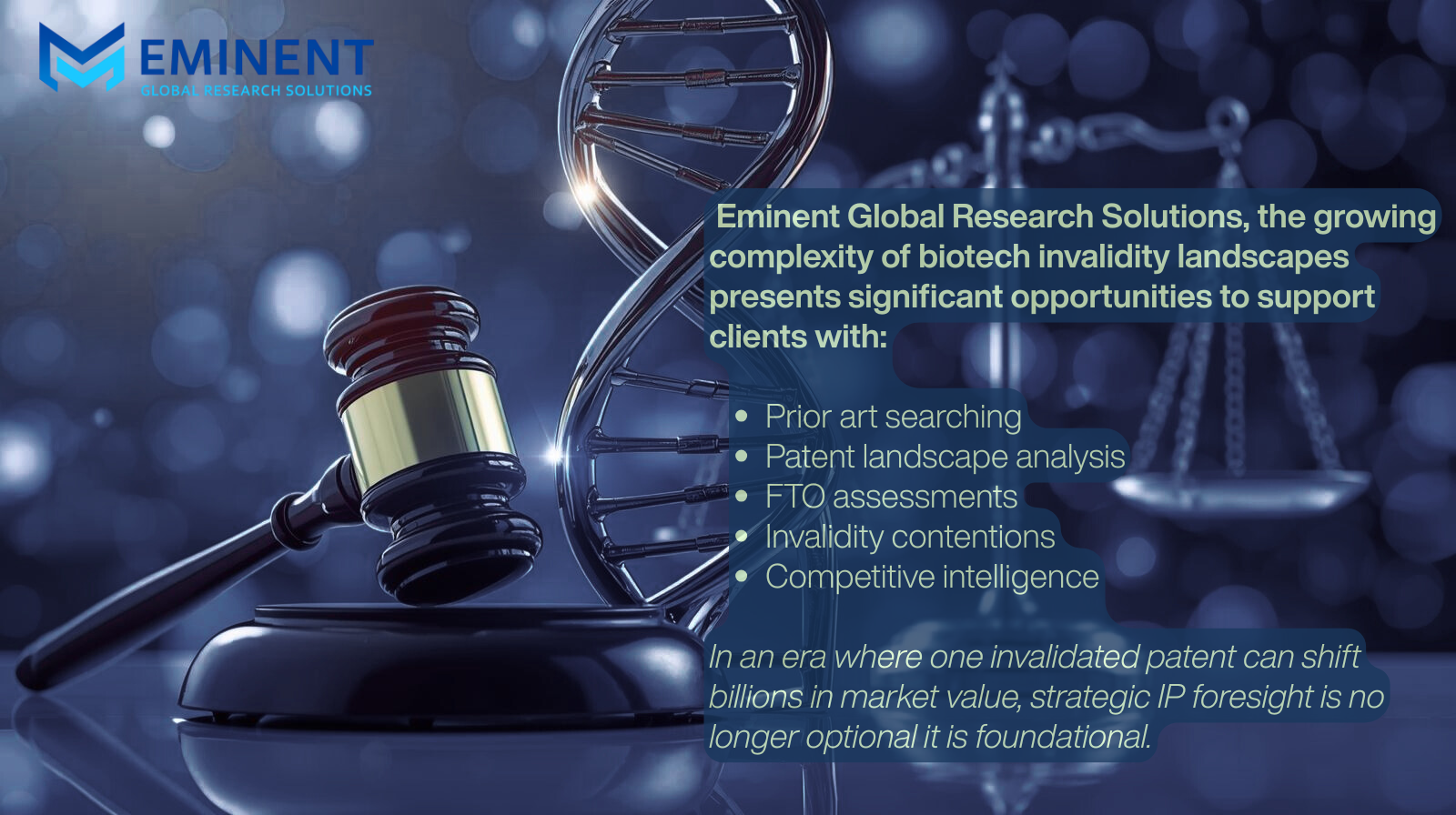
For IP consultancies and research firms like Eminent Global Research Solutions, the growing complexity of biotech invalidity landscapes presents significant opportunities to support clients with:
Prior art searching
Patent landscape analysis
FTO assessments
Invalidity contentions
Competitive intelligence
In an era where one invalidated patent can shift billions in market value, strategic IP foresight is no longer optional it is foundational.