

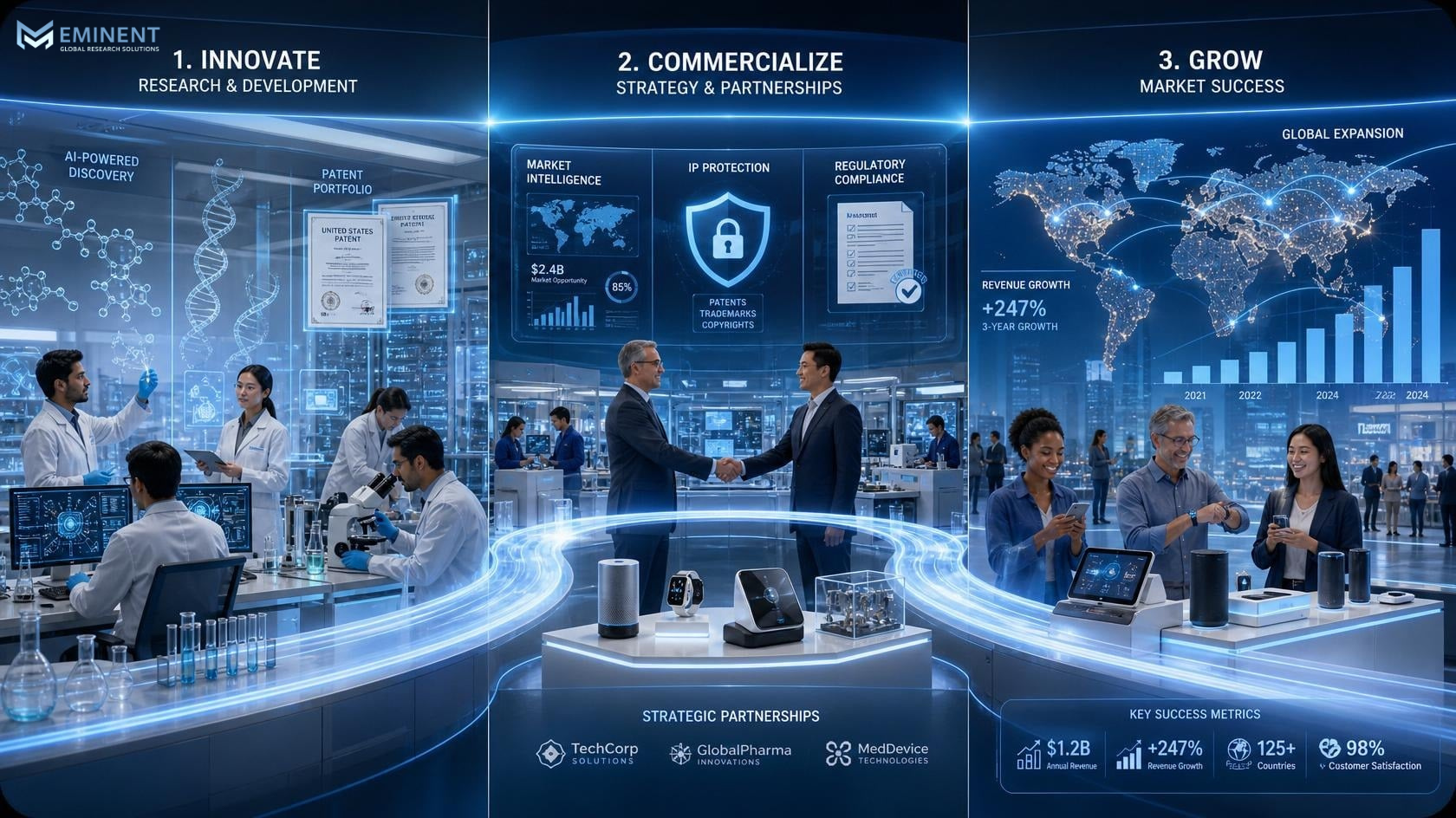
Innovation has become one of the most significant drivers of competitive advantage in today’s global economy. Organizations across industries are investing billions of dollars annually in research and development (R&D), emerging technologies, intellectual property, and digital transformation initiatives. Yet despite these investments, many breakthrough innovations never reach the market or generate meaningful commercial returns.
The gap between invention and market success remains one of the greatest challenges facing businesses today.
A groundbreaking technology, patented invention, or scientific discovery does not automatically translate into business growth. Without a structured commercialization strategy, even the most promising innovations can remain confined to laboratories, research centers, or pilot projects.
Technology commercialization bridges this gap. It transforms scientific discoveries and technological innovations into viable products, scalable businesses, and sustainable revenue streams. As industries become increasingly innovation-driven, commercialization is emerging as the critical capability that separates market leaders from organizations whose innovations fail to achieve their full potential.
For businesses, investors, research institutions, and governments, the question is no longer whether innovation matters it is whether organizations have the capabilities to commercialize innovation effectively.
Innovation Alone Is No Longer Enough
Across sectors such as biotechnology, pharmaceuticals, advanced manufacturing, artificial intelligence, clean energy, and healthcare, organizations continue to accelerate innovation.
Companies are developing:
- Advanced AI platforms
- Novel therapeutic technologies
- Sustainable materials
- Smart manufacturing systems
- Robotics solutions
- Digital health platforms
However, a significant percentage of these innovations never reach commercial markets.
Common reasons include:
- Poor market validation
- Weak commercialization planning
- Regulatory barriers
- Manufacturing limitations
- Inadequate funding
- Lack of strategic partnerships
- Limited customer adoption
Innovation creates potential value.
Commercialization converts that potential into measurable business outcomes.
Organizations that excel at commercialization recognize that technology development and market development must progress simultaneously rather than sequentially.
Understanding Technology Commercialization
Technology commercialization is the structured process of transforming research outcomes, intellectual property, and technological discoveries into commercially successful products or services.
It extends well beyond product development.
Successful commercialization typically includes:
- Market opportunity assessment
- Competitive intelligence
- Intellectual property strategy
- Regulatory planning
- Product positioning
- Manufacturing readiness
- Pricing strategy
- Go-to-market planning
- Strategic partnerships
- Customer adoption planning
Each stage reduces uncertainty while increasing the probability of commercial success.
Organizations that integrate commercialization planning early during innovation development often achieve faster market entry and stronger financial performance.
Why Commercialization Determines Revenue Growth
Many organizations measure innovation success by the number of patents filed or research projects completed.
However, investors and business leaders ultimately measure success through commercial impact.
Revenue growth occurs only when innovation creates market value.
Technology commercialization enables organizations to:
- Accelerate product launches
- Reduce commercialization risks
- Improve return on R&D investments
- Expand into new markets
- Build sustainable competitive advantages
- Generate recurring revenue opportunities
Companies with mature commercialization capabilities often achieve higher innovation productivity because they systematically prioritize projects with the greatest commercial potential.
Rather than pursuing innovation for its own sake, they align research investments with customer needs and market demand.
Market Intelligence Drives Commercial Success
One of the most overlooked components of commercialization is market intelligence.
Many technically successful innovations fail because organizations underestimate competitive dynamics or overestimate customer demand.
Comprehensive market intelligence provides insights into:
- Market size and growth potential
- Customer pain points
- Technology adoption trends
- Competitive positioning
- Regulatory environments
- Pricing expectations
- Regional expansion opportunities
These insights help organizations prioritize investments, refine product strategies, and reduce market uncertainty before significant commercialization expenditures occur.
Technology development without market intelligence increases commercialization risk.
Technology development supported by market intelligence improves strategic decision-making throughout the product lifecycle.
Intellectual Property as a Strategic Asset
Strong intellectual property (IP) protection is another cornerstone of successful commercialization.
Patents, trademarks, trade secrets, and licensing strategies help organizations protect innovation while creating opportunities for monetization.
Effective IP strategies enable companies to:
- Secure competitive differentiation
- Attract investors
- Establish licensing partnerships
- Expand internationally
- Increase company valuation
However, IP should not be viewed solely as legal protection.
When aligned with commercialization objectives, intellectual property becomes a powerful business asset capable of generating licensing revenue, supporting partnerships, and strengthening long-term market positioning.
Strategic Partnerships Accelerate Commercialization
Few organizations possess every capability required to commercialize advanced technologies independently.
Strategic collaborations increasingly play a central role in commercialization success.
Partnerships may involve:
- Research institutions
- Manufacturing organizations
- Technology providers
- Regulatory specialists
- Distribution partners
- Healthcare systems
- Venture capital firms
These collaborations reduce development timelines while expanding technical expertise, manufacturing capacity, and market reach.
Open innovation models are becoming particularly valuable in industries characterized by rapid technological advancement.
Organizations that build collaborative commercialization ecosystems often outperform companies relying exclusively on internal capabilities.
Regulatory Readiness Matters
Commercial success also depends on regulatory preparedness.
Highly regulated industries such as pharmaceuticals, medical devices, food, cosmetics, and advanced biotechnology require comprehensive regulatory planning throughout development.
Delays in regulatory approval can postpone market entry, increase development costs, and reduce competitive advantage.
Organizations that integrate regulatory strategy early often experience:
- Faster approvals
- Lower compliance risks
- Improved investor confidence
- Smoother global expansion
Regulatory intelligence has therefore become an essential component of commercialization planning rather than a final-stage compliance activity.
Measuring Commercialization Success
Technology commercialization should be evaluated through business outcomes rather than research achievements alone.
Key performance indicators include:
- Revenue generated from new products
- Time-to-market
- Customer adoption rates
- Market share growth
- Return on innovation investment
- Licensing income
- Partnership development
- Global market expansion
These metrics provide a clearer understanding of how innovation contributes to sustainable business growth.
Organizations that continuously monitor commercialization performance can improve future innovation investments and strengthen long-term competitiveness.
The Future of Technology Commercialization
As innovation cycles accelerate, commercialization capabilities will become increasingly important across industries.
Emerging technologies such as artificial intelligence, synthetic biology, quantum computing, advanced materials, and precision medicine will generate extraordinary opportunities—but only for organizations capable of translating technical breakthroughs into scalable business models.
The future will reward companies that integrate:
- Market intelligence
- Intellectual property strategy
- Regulatory planning
- Customer insights
- Manufacturing scalability
- Strategic partnerships
- Commercial execution
into a unified commercialization framework.
For organizations seeking sustainable growth, technology commercialization is no longer an optional business function.
It is the critical link between innovation investment and long-term revenue generation.
At Eminent Global Research Solutions, we believe successful innovation is measured not only by what is invented—but by what reaches the market, creates customer value, and drives measurable business growth. Organizations that invest in commercialization strategy today will be better positioned to lead tomorrow’s innovation economy.