

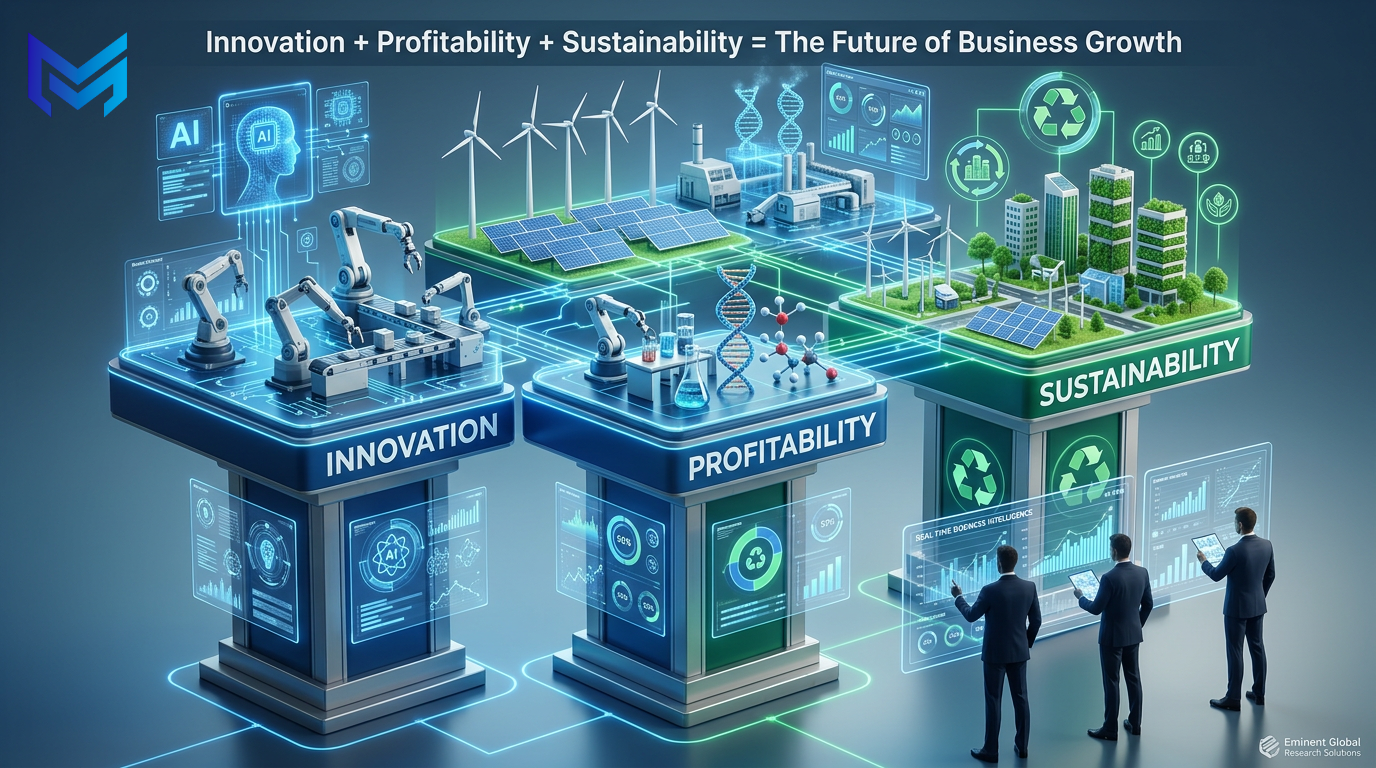
In today’s rapidly evolving business environment, organizations are under increasing pressure to achieve what was once considered an impossible balance: driving innovation, maintaining profitability, and advancing sustainability all at the same time. Investors expect strong financial performance, customers demand environmentally responsible products, regulators continue introducing stricter environmental standards, and competitors are accelerating innovation across industries.
For many organizations, these objectives can appear to compete with one another. Innovation often requires significant investment, sustainability initiatives may increase short-term costs, and profitability remains a primary expectation from shareholders. However, the companies leading global markets are demonstrating that these three priorities are not mutually exclusive. Instead, when approached strategically, they can reinforce one another and become powerful drivers of long-term competitive advantage.
The question is no longer whether businesses should pursue innovation, profitability, and sustainability together. The real challenge is how to integrate them into a cohesive growth strategy.
The Evolution of Business Success
For decades, business success was measured primarily through financial performance. Revenue growth, market share, and profitability dominated corporate decision-making. While these metrics remain essential, the expectations placed on businesses have expanded significantly.
Today, organizations are increasingly evaluated on their ability to innovate responsibly, reduce environmental impact, support social well-being, and create long-term value for stakeholders. Environmental, Social, and Governance (ESG) considerations, circular economy principles, and responsible innovation are becoming integral to strategic planning rather than optional initiatives.
This shift is driven by several global trends:
- Rising consumer demand for sustainable products
- Increasing regulatory oversight
- Investor focus on long-term resilience
- Rapid technological advancement
- Climate change and resource scarcity
- Greater corporate accountability
Businesses that fail to adapt risk losing market relevance, while those that embrace these changes can unlock new opportunities for growth and differentiation.
Innovation as a Catalyst for Sustainable Growth
Innovation has traditionally been associated with new products, technologies, and business models. Increasingly, it is also becoming the foundation for achieving sustainability goals without sacrificing profitability.
Companies are leveraging innovation to:
- Develop low-carbon manufacturing processes
- Design recyclable and biodegradable materials
- Improve energy efficiency
- Optimize supply chains using artificial intelligence
- Reduce waste through circular economy practices
- Create digital services that lower resource consumption
Rather than viewing sustainability as a cost, leading organizations are using innovation to transform sustainability into a source of operational efficiency and market differentiation.
For example, advances in biotechnology are enabling sustainable ingredient production in the beauty and food industries. Artificial intelligence is helping manufacturers optimize energy consumption and reduce emissions. Digital twins are improving asset utilization while minimizing waste. These innovations not only support environmental objectives but also reduce costs and improve operational performance.
Profitability and Sustainability Are No Longer Opposing Goals
A common misconception is that sustainability reduces profitability. While some sustainability initiatives require upfront investment, many generate long-term financial returns through improved efficiency, risk reduction, and stronger customer loyalty.
Organizations embracing sustainable practices often experience:
- Lower energy and operational costs
- Improved supply chain resilience
- Reduced regulatory risks
- Increased investor confidence
- Enhanced brand reputation
- Greater customer retention
Consumers are increasingly willing to support brands that align with their values. Similarly, institutional investors are directing more capital toward companies demonstrating sustainable business practices and long-term resilience.
Profitability is no longer driven solely by cost management. It is increasingly linked to innovation, trust, resilience, and responsible growth.
The Role of Technology in Achieving Balance
Technology has become one of the most powerful enablers of balancing innovation, profitability, and sustainability.
Artificial intelligence, automation, advanced analytics, and digital transformation allow businesses to make smarter decisions while improving operational efficiency and reducing environmental impact.
Examples include:
- AI-powered demand forecasting to reduce inventory waste
- Predictive maintenance to extend equipment life
- Blockchain for supply chain transparency
- Internet of Things (IoT) for energy monitoring
- Advanced analytics for resource optimization
- Cloud-based collaboration reducing travel and emissions
These technologies demonstrate that digital transformation and sustainability are increasingly interconnected.
Organizations investing in smart technologies are often improving productivity while advancing environmental goals simultaneously.
Industry Convergence Is Creating New Opportunities
One of the most significant trends shaping the future of business is industry convergence.
Healthcare is collaborating with technology companies. Beauty brands are investing in biotechnology. Automotive manufacturers are partnering with energy providers. Food companies are embracing precision fermentation and AI-driven agriculture.
This convergence enables organizations to combine expertise from multiple sectors to solve complex challenges more efficiently.
Cross-industry innovation often leads to:
- Faster product development
- Lower research costs
- Improved sustainability outcomes
- New revenue opportunities
- Enhanced customer experiences
Businesses willing to look beyond traditional industry boundaries are often better positioned to identify emerging market opportunities.
Measuring Long-Term Value
Balancing innovation, profitability, and sustainability requires organizations to rethink how success is measured.
Traditional financial metrics remain important, but they should be complemented by indicators that reflect long-term value creation, such as:
- Carbon reduction achievements
- Resource efficiency improvements
- Innovation pipeline strength
- Customer trust and loyalty
- Employee engagement
- Supply chain resilience
- Regulatory compliance readiness
Companies that measure both financial and non-financial performance gain a more comprehensive understanding of business health and future competitiveness.
Leadership Will Define the Winners
Successfully balancing these priorities requires leadership that embraces long-term thinking.
Organizations must foster cultures where innovation is encouraged, sustainability is embedded into decision-making, and profitability is viewed as the outcome of responsible business practices rather than the sole objective.
Effective leaders:
- Encourage collaboration across functions
- Invest in continuous learning
- Build innovation ecosystems
- Support data-driven decision-making
- Prioritize transparency and accountability
- Align sustainability with corporate strategy
This integrated approach enables organizations to respond more effectively to changing market conditions while maintaining financial performance.
The Strategic Opportunity Ahead
The future belongs to organizations that recognize innovation, profitability, and sustainability as interconnected drivers of business success rather than competing priorities.
Companies that successfully integrate these elements can strengthen resilience, attract investment, build stronger customer relationships, and unlock new growth opportunities.
For consulting firms, business leaders, and investors, the challenge is not choosing between growth and responsibility—it is designing strategies that deliver both.
At Eminent Global Research Solutions, we believe that sustainable competitive advantage is created through informed decision-making, technology-driven innovation, and market intelligence. By helping organizations identify emerging trends, evaluate market opportunities, and develop commercialization strategies, businesses can build growth models that are not only profitable but also resilient and future-ready.
In an increasingly complex global economy, the most successful companies will not be those that pursue innovation, profitability, or sustainability independently. They will be the ones that master all three simultaneously.