

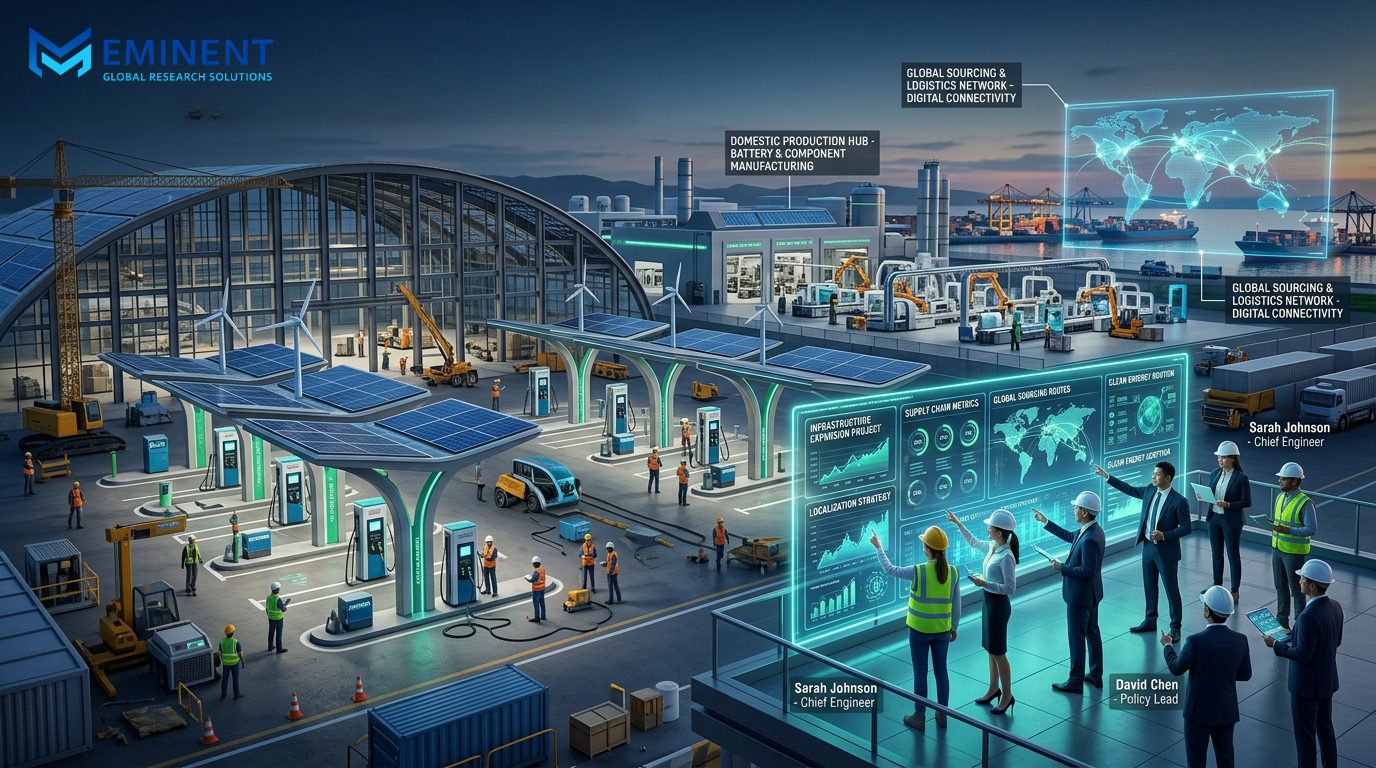
The ongoing debate around stricter electric vehicle (EV) charger sourcing requirements in the United States reflects a broader challenge facing the global clean energy transition: balancing domestic manufacturing priorities with the urgent need for rapid infrastructure deployment.
As governments accelerate investments in EV ecosystems and renewable infrastructure, policymakers are increasingly introducing localization mandates designed to strengthen domestic manufacturing capacity, reduce foreign dependency, and create national industrial advantages.
However, stricter domestic sourcing requirements can also create unintended consequences. Delays in infrastructure rollout, supply chain bottlenecks, increased project costs, and reduced investment momentum may slow the pace of clean energy adoption if regulatory frameworks become too restrictive.
The growing tension between industrial policy and deployment efficiency is becoming one of the defining strategic issues in the evolving EV ecosystem.
For companies operating across EV infrastructure, manufacturing, energy technology, and supply chain sectors, this environment demands a new level of strategic agility. Organizations will increasingly need to redesign sourcing, manufacturing, and supply chain models to balance regulatory compliance with scalability, speed, and long-term competitiveness.
The Expanding Importance of EV Charging Infrastructure
EV adoption continues to accelerate globally as governments pursue decarbonization goals, automakers expand electric vehicle portfolios, and consumers gradually transition toward cleaner transportation options.
However, widespread EV adoption depends heavily on the availability of reliable charging infrastructure.
Public charging networks are becoming essential components of national transportation and energy strategies. Governments worldwide are investing billions of dollars into charging infrastructure to support future mobility demand and reduce range anxiety among consumers.
In the United States, federal funding programs were designed to accelerate charger deployment nationwide while supporting broader clean energy and industrial policy goals.
At the same time, policymakers are increasingly focused on ensuring that public investment also strengthens domestic manufacturing capabilities.
This has created growing emphasis on:
- Local sourcing requirements
- Domestic manufacturing incentives
- Supply chain localization
- National industrial competitiveness
- Reduced dependency on foreign suppliers
While these objectives align with long-term economic and geopolitical priorities, they also introduce operational complexity for companies trying to rapidly scale EV infrastructure deployment.
Localization Mandates vs. Deployment Speed
The central challenge highlighted by stricter EV charger rules is the conflict between two strategic priorities:
- Accelerating clean energy infrastructure deployment
- Building localized manufacturing ecosystems
In theory, domestic sourcing requirements help stimulate national manufacturing growth, create jobs, and improve supply chain resilience. However, overly aggressive mandates can reduce supplier flexibility and limit access to available components during critical scale-up periods.
The EV charging ecosystem depends on a highly globalized supply chain involving:
- Power electronics
- Semiconductors
- Charging hardware
- Cables and connectors
- Software systems
- Battery technologies
- Grid infrastructure components
Many of these components currently rely on international sourcing networks.
If localization requirements outpace domestic production capacity, companies may face:
- Project delays
- Increased procurement costs
- Reduced supplier availability
- Infrastructure deployment slowdowns
- Investment uncertainty
This creates a difficult balancing act for both policymakers and industry participants.
Governments must support domestic manufacturing growth without unintentionally slowing the broader energy transition they are attempting to accelerate.
Supply Chain Complexity in the EV Ecosystem
The EV industry has already experienced significant supply chain disruption over recent years due to semiconductor shortages, geopolitical tensions, inflationary pressures, and logistics instability.
Localization mandates add another layer of complexity.
Companies operating in EV charging infrastructure now face increasing pressure to redesign supply chain strategies around:
- Regional manufacturing capacity
- Domestic content compliance
- Supplier diversification
- Trade restrictions
- Cost optimization
- Long-term resilience
This transition requires substantial operational investment.
Organizations may need to:
- Build new manufacturing facilities
- Establish local supplier partnerships
- Relocate production capabilities
- Develop alternative sourcing networks
- Increase inventory flexibility
- Invest in compliance management systems
These changes can improve long-term resilience but may also temporarily increase operational costs and slow deployment timelines.
For many companies, the challenge is no longer simply securing components — it is building supply chains that remain both compliant and commercially viable under evolving regulatory frameworks.
Investment Momentum May Face Pressure
The EV infrastructure market has attracted significant public and private investment due to strong long-term growth expectations.
However, regulatory uncertainty can impact investor confidence.
If sourcing requirements become unpredictable or operationally difficult to implement, infrastructure developers and manufacturers may delay expansion decisions or reduce deployment pace while reassessing risk exposure.
Investors generally prioritize:
- Regulatory clarity
- Stable policy environments
- Predictable incentive structures
- Scalable deployment opportunities
- Supply chain reliability
Frequent regulatory adjustments or highly restrictive compliance conditions may create uncertainty around project economics and return on investment.
This is especially important because EV charging infrastructure often involves long investment cycles and substantial capital expenditure.
The broader clean energy transition depends not only on technological innovation but also on maintaining strong investment momentum across infrastructure ecosystems.
The Globalization vs. Nationalization Debate
The tension surrounding EV charger sourcing reflects a larger global debate around economic globalization and industrial self-sufficiency.
Governments increasingly view clean energy technologies as strategically important industries tied to:
- Economic competitiveness
- National security
- Technological leadership
- Energy independence
- Supply chain resilience
As a result, many countries are implementing policies designed to localize manufacturing and reduce foreign dependency in critical sectors such as:
- EV batteries
- Semiconductors
- Renewable energy equipment
- Advanced electronics
- Critical minerals
However, clean energy technologies evolved through deeply interconnected global supply chains optimized for scale and cost efficiency.
Rapidly restructuring these ecosystems around domestic production creates transitional friction that may temporarily reduce efficiency and increase costs.
Companies operating globally must now navigate a more fragmented regulatory environment where localization requirements vary significantly across regions.
This increases the importance of flexible and regionally diversified operating models.
Strategic Implications for Companies
The evolving regulatory environment requires EV ecosystem companies to rethink long-term operational strategy.
Future competitiveness may increasingly depend on an organization’s ability to integrate:
- Regulatory adaptability
- Regional manufacturing flexibility
- Supply chain resilience
- Cost management
- Deployment scalability
Companies that proactively redesign operations around evolving localization requirements may gain strategic advantages as regulatory expectations continue to tighten globally.
Several strategic priorities are becoming increasingly important:
1. Regionalized Manufacturing Models
Companies may need to establish localized production hubs to meet domestic sourcing thresholds while maintaining deployment speed.
2. Supplier Diversification
Reducing dependency on single-region suppliers can improve resilience against both geopolitical and regulatory disruption.
3. Strategic Partnerships
Collaborating with domestic manufacturers, utilities, and infrastructure developers may accelerate compliance readiness and market expansion.
4. Compliance-Driven Innovation
Organizations that integrate compliance planning into product design and sourcing strategies early may reduce future operational risk.
The Future of the EV Infrastructure Market
The debate over stricter EV charger rules demonstrates that the clean energy transition is no longer solely about technological advancement. It is increasingly shaped by industrial policy, trade strategy, and geopolitical competition.
Over the next decade, the EV ecosystem will likely experience continued tension between:
- Global supply chain efficiency
- Domestic industrial priorities
- Infrastructure deployment speed
- Regulatory compliance demands
Companies capable of balancing these competing pressures effectively may emerge as long-term leaders in the global energy transition.
For consulting firms, infrastructure developers, manufacturers, and investors, the evolving EV landscape creates growing demand for expertise in:
- Supply chain transformation
- Localization strategy
- Regulatory planning
- Infrastructure scalability
- Manufacturing optimization
- Cross-border operational strategy
The future EV market will not be defined solely by vehicle innovation — it will also depend on how successfully companies adapt supply chains and infrastructure strategies to an increasingly complex regulatory environment.