

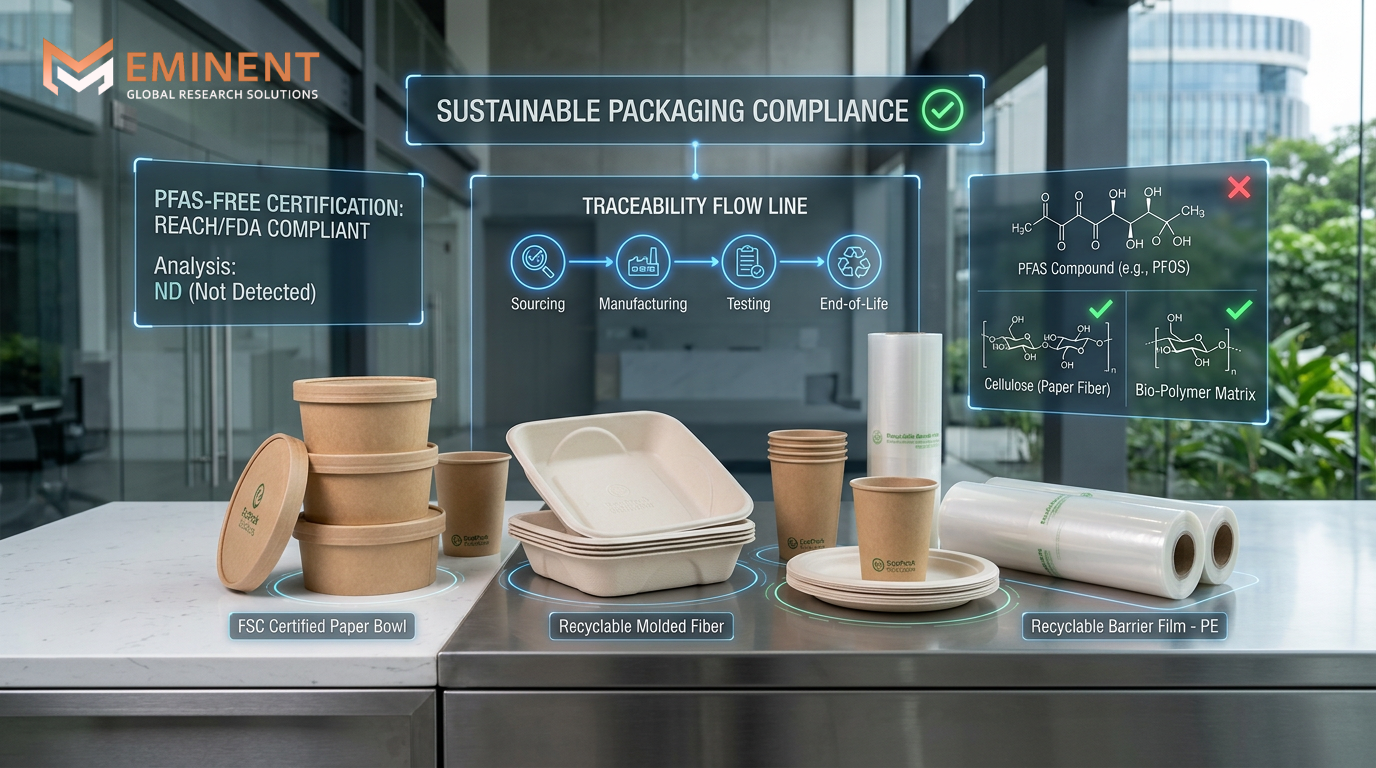
The European Union is entering a decisive phase in its sustainability journey with the implementation of the Packaging and Packaging Waste Regulation (PPWR). Effective August 12, 2026, the regulation introduces stringent restrictions on per- and polyfluoroalkyl substances (PFAS) in food-contact packaging—without any transition window for newly placed products.
This is not just another regulatory update. It marks a structural shift in how organizations approach packaging—from reactive compliance to proactive, innovation-led transformation.
Understanding the PPWR-PFAS Nexus
PFAS, often referred to as “forever chemicals,” have long been used in packaging for their grease- and water-resistant properties. However, their persistence in the environment and potential health risks have triggered regulatory scrutiny across global markets.
Under PPWR:
- PFAS use in food-contact packaging will face strict limits
- Enforcement begins immediately upon applicability
- Non-compliant packaging cannot be introduced into the EU market
The absence of a transition period creates urgency, particularly for companies with complex global supply chains.
Why This Changes Everything
Historically, compliance has been treated as a downstream function—activated once regulations are finalized. PPWR disrupts this model entirely.
Organizations now face three fundamental challenges:
1. Portfolio-Level Transformation
Companies must assess and redesign entire packaging portfolios—not just individual SKUs. This includes identifying PFAS-containing materials, evaluating alternatives, and ensuring performance parity.
2. Data-Driven Compliance Infrastructure
Traceability is no longer optional. Businesses must implement systems that track material composition, supplier inputs, and regulatory alignment in real time.
3. Supplier Ecosystem Realignment
Compliance risk now extends beyond internal operations. Vendors, converters, and raw material suppliers must align with PFAS-free requirements, demanding deeper collaboration and auditing.
The Consulting Perspective: From Obligation to Opportunity
At Eminent Global Research Solutions, we see PPWR as more than a regulatory milestone—it’s a catalyst for strategic differentiation.
Forward-looking organizations are already leveraging this shift in three key ways:
1. Innovation-Led Material Substitution
Early adopters are investing in bio-based coatings, barrier technologies, and recyclable alternatives. The goal is not just substitution—but enhancement.
2. Competitive Positioning Through Sustainability
Brands that achieve PFAS-free certification ahead of deadlines can position themselves as trusted, future-ready players, particularly in ESG-conscious markets like the EU.
3. Digital Transformation of Compliance
Advanced analytics, blockchain-enabled traceability, and AI-driven risk monitoring are emerging as critical enablers of scalable compliance.
Industry Implications
The ripple effects of PPWR will extend across industries:
- Food & Beverage: Immediate reformulation of packaging materials
- Retail & E-commerce: Pressure to adopt compliant secondary packaging
- Chemicals & Materials: Surge in demand for PFAS-free alternatives
- Pharmaceuticals: Heightened scrutiny on sterile and barrier packaging
This is not a sector-specific disruption—it’s a cross-industry transformation.
Key Strategic Actions for 2026 Readiness
To stay ahead, organizations should prioritize:
- Comprehensive PFAS audits across all packaging formats
- R&D investments in alternative materials and coatings
- Supplier compliance frameworks with clear accountability metrics
- Digital traceability systems for end-to-end visibility
- Regulatory intelligence capabilities to anticipate future amendments
Delaying action is no longer viable. The cost of non-compliance—both financial and reputational—will be significant.
The Road Ahead
PPWR signals the EU’s intent to lead globally on sustainable packaging standards. For companies operating in or exporting to Europe, this regulation will set the benchmark for years to come.
The organizations that succeed will not be those that merely comply—but those that reimagine packaging as a strategic asset.
At Eminent Global Research Solutions, we believe this is the moment to transition from compliance-driven thinking to innovation-driven execution—where sustainability, regulation, and competitive advantage converge.