

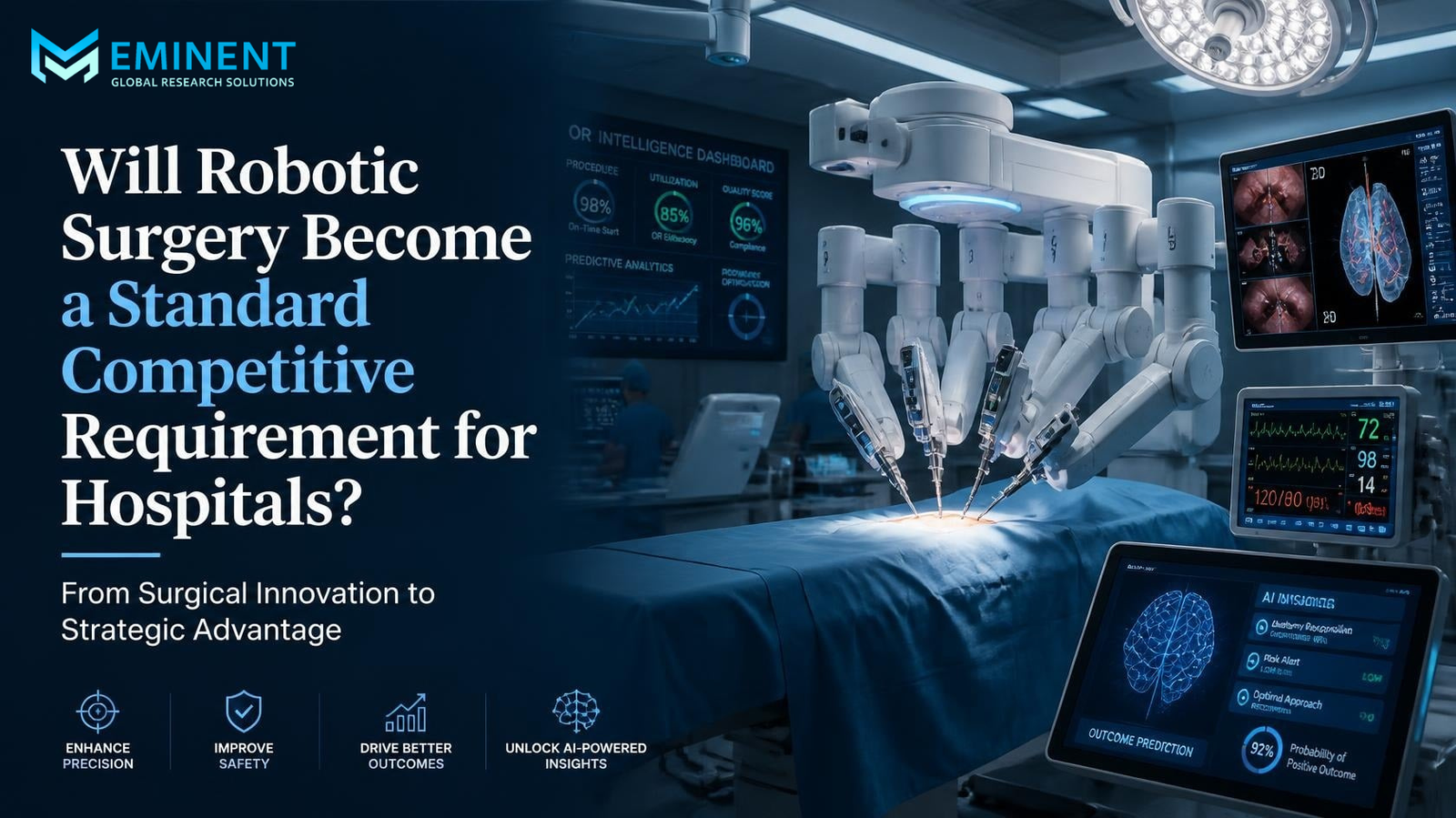
Robotic surgery is rapidly moving from a premium technological differentiator to a potentially important component of modern hospital strategy. Once concentrated in a limited number of advanced surgical centers, robotic-assisted systems are increasingly being adopted across specialties including urology, gynecology, general surgery, colorectal surgery, thoracic surgery, and orthopedics.
The strategic question for hospital leaders is no longer simply whether robotic surgery is innovative. It is whether not having robotic capabilities could eventually become a competitive disadvantage.
As healthcare systems face rising patient expectations, surgeon shortages, pressure to improve clinical outcomes, and growing competition between hospitals, robotic surgery could become an increasingly important component of a hospital’s technology, talent, and market-access strategy.
However, adoption is not automatically a guarantee of competitive advantage. High capital expenditure, maintenance costs, surgeon training, operating-room utilization, and reimbursement considerations mean hospitals need to evaluate robotic surgery through a broader business and clinical lens.
For healthcare organizations, the real opportunity lies in determining where robotic surgery can generate measurable clinical, operational, and commercial value.
From Surgical Innovation to Strategic Capability
Robotic-assisted surgery has evolved significantly over the past two decades.
The technology enables surgeons to control specialized instruments through advanced visualization and computer-assisted interfaces. Depending on the procedure and platform, robotic systems can provide enhanced dexterity, visualization, precision, and ergonomic benefits compared with conventional minimally invasive surgery.
As technology improves, robotic platforms are becoming increasingly sophisticated, with developments in artificial intelligence, image guidance, advanced visualization, data analytics, and surgical planning.
This evolution is changing the strategic role of robotics within hospitals.
Previously, purchasing a robotic system could be viewed primarily as an investment in advanced clinical technology. Today, it can influence multiple areas of hospital strategy:
- Surgeon recruitment and retention
- Patient acquisition
- Operating-room efficiency
- Clinical differentiation
- Training and education
- Hospital brand positioning
- Partnerships with technology companies
- Data-driven surgical innovation
Consequently, robotic surgery is increasingly becoming an enterprise-level decision rather than simply a procurement decision.
Patient Expectations Are Changing
One of the strongest forces supporting robotic surgery adoption is changing patient behavior.
Patients are increasingly researching treatment options before selecting physicians and hospitals. Online information, physician reviews, hospital websites, and healthcare platforms have made advanced surgical capabilities more visible to prospective patients.
For some patients, the availability of robotic-assisted procedures may influence hospital selection.
This creates a competitive dynamic.
Hospitals that offer advanced robotic procedures can position themselves as technology-enabled centers of excellence, particularly in specialties where robotic surgery has become increasingly established.
However, technology alone does not guarantee patient preference. Hospitals must demonstrate the clinical value of robotic procedures and communicate benefits responsibly rather than relying solely on the presence of a robotic platform as a marketing message.
Surgeon Recruitment Could Become a Major Driver
The availability of advanced surgical technology may also influence the ability of hospitals to recruit and retain high-quality surgeons.
Younger surgeons increasingly train in environments where minimally invasive and robotic techniques are integrated into surgical education. Hospitals that lack modern platforms may therefore face challenges competing for specialists who want access to advanced surgical technologies.
Robotic platforms can also support structured training through simulation, mentoring, and standardized procedural workflows.
For hospitals, this creates an important strategic consideration: investing in robotic surgery may not only support current clinical capabilities but also strengthen the institution’s future talent pipeline.
The Economics of Robotic Surgery
Despite its advantages, robotic surgery involves significant financial considerations.
A hospital must evaluate the complete lifecycle cost rather than simply the initial acquisition price.
Relevant costs can include:
- Robotic system acquisition
- Instruments and consumables
- Maintenance contracts
- Software upgrades
- Operating-room modifications
- Surgeon training
- Staff training
- Service and technical support
- Procedure-related costs
The financial return depends heavily on utilization.
A robotic system operating at low capacity may create a substantial financial burden. Conversely, high utilization across multiple specialties can improve the economics of the investment.
This makes capacity planning and procedure-volume forecasting critical components of robotic surgery strategy.
Before investing, hospitals should evaluate their addressable patient population, referral networks, surgeon capabilities, competing hospitals, procedure volumes, reimbursement environment, and expected utilization rates.
Operating-Room Efficiency Matters
Robotic surgery can potentially contribute to improved surgical workflows, but the impact depends heavily on hospital-specific implementation.
Operating-room efficiency can be influenced by:
- Setup and turnover time
- Staff familiarity
- Surgeon experience
- Instrument availability
- Scheduling
- Procedure complexity
- Platform utilization
Hospitals therefore need an implementation strategy rather than simply purchasing technology.
A successful robotic surgery program requires coordination among surgeons, nurses, anesthesiologists, technicians, administrators, procurement teams, and hospital leadership.
Organizations that treat robotics as an integrated operating model are more likely to capture its full value.
Robotics and the Healthcare Talent Challenge
Healthcare workforce shortages are creating another potential driver for surgical robotics.
Robotic systems cannot replace surgeons, but they can enhance the capabilities of highly trained clinicians and potentially support standardized workflows.
As surgical demand increases and specialist availability becomes constrained, technology that improves surgeon ergonomics, procedural consistency, and training may become increasingly valuable.
Over the longer term, the integration of robotics with artificial intelligence could further change surgical workflows.
Future systems may support surgeons with:
- Real-time image analysis
- Anatomical recognition
- Surgical planning
- Procedure guidance
- Automated data capture
- Postoperative analytics
The industry is therefore moving toward increasingly intelligent surgical ecosystems rather than standalone robotic machines.
Competition Between Hospitals Is Intensifying
For hospital executives, robotic surgery must also be evaluated in the context of competitive positioning.
If neighboring hospitals invest in robotic platforms while a hospital does not, the institution could potentially lose surgeons, referrals, and technology-conscious patients.
This creates a strategic feedback loop:
Technology adoption → surgeon attraction → procedure volume → patient demand → stronger utilization → greater competitive positioning.
However, the reverse can also occur.
A hospital that invests heavily without sufficient patient volume or clinical expertise may struggle to achieve an attractive return on investment.
Therefore, competitive intelligence should be an important component of robotic surgery planning.
Hospitals should understand:
- Which competitors have robotic platforms
- Which surgical specialties they support
- Procedure volumes
- Surgeon capabilities
- Patient demographics
- Technology partnerships
- Expansion plans
- Regional referral patterns
This market intelligence can help executives identify genuine opportunities rather than simply following competitors.
Will Robotic Surgery Become a Requirement?
The answer will vary by hospital type and specialty.
For large academic medical centers, tertiary hospitals, and high-volume surgical institutions, robotic surgery may increasingly become an expected component of advanced surgical capabilities.
For smaller community hospitals, however, the economics and utilization requirements may make direct ownership less attractive.
Alternative models could include:
- Shared robotic facilities
- Regional centers of excellence
- Managed technology partnerships
- Pay-per-use models
- Partnerships with specialized surgical networks
This suggests that the future will not necessarily involve every hospital owning a robotic platform.
Instead, robotic surgery may become a strategic capability that hospitals must either provide, partner for, or strategically access depending on their market position.
The Consulting Opportunity
For healthcare organizations, robotic surgery represents a multidimensional strategic decision.
Eminent Global Research Solutions can support organizations evaluating this opportunity through market intelligence, competitive benchmarking, technology assessment, opportunity analysis, and commercialization strategy.
Key questions for hospital executives include:
Where is robotic surgery generating measurable value?
Which specialties offer the strongest growth potential?
How does our robotic capability compare with competitors?
What patient segments could support increased utilization?
Which technology platforms align with our long-term strategy?
What is the potential return on investment?
Answering these questions requires more than clinical evaluation. It requires an integrated understanding of technology, market demand, competition, economics, and healthcare strategy.
Conclusion
Robotic surgery is unlikely to become a universal requirement for every hospital overnight. But in high-volume surgical markets, it is increasingly becoming an important competitive capability.
The winners will not necessarily be the hospitals that purchase the most advanced technology. They will be the organizations that deploy robotic surgery where it creates measurable clinical, operational, and commercial value.
As robotics, artificial intelligence, imaging, and data analytics converge, surgical care is moving toward a more technology-enabled future.
For hospital leaders, the strategic question is therefore shifting from:
“Should we invest in robotic surgery?”
to:
“How can robotic surgery strengthen our clinical and competitive position?”
That distinction will determine whether robotic surgery becomes simply another expensive piece of hospital equipment—or a genuine engine of healthcare transformation.