
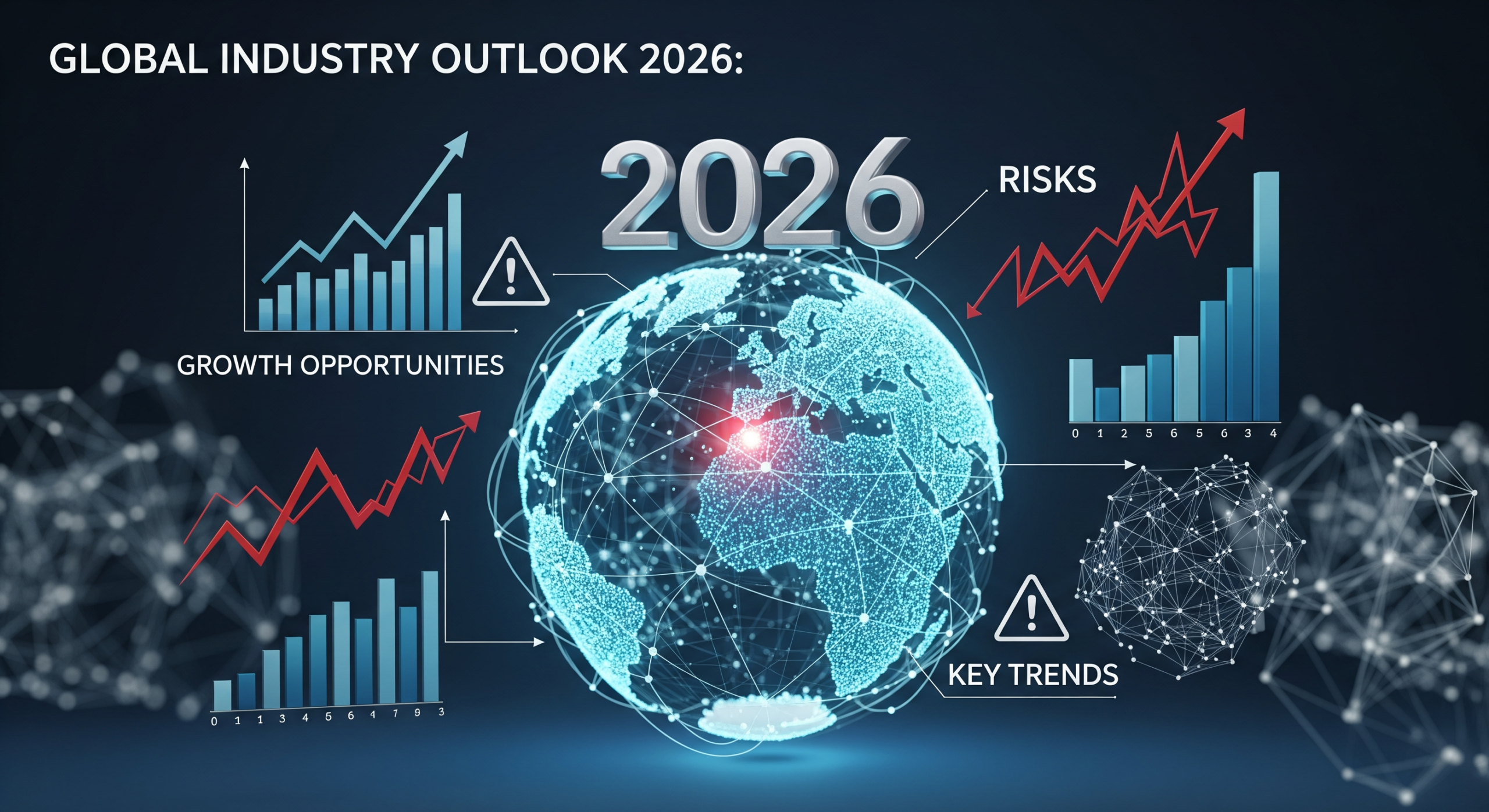
Global Industry Outlook 2026: Key Trends, Risks, and Growth Opportunities
As global markets move toward 2026, industries across sectors are navigating a complex mix of technological acceleration, geopolitical uncertainty, sustainability mandates, and shifting customer expectations. While growth opportunities remain strong, success will increasingly depend on strategic agility, data-driven decision-making, and long-term resilience.
This outlook examines the key trends shaping industries worldwide, the primary risks businesses must manage, and the growth opportunities emerging across global markets.
Key Global Industry Trends for 2026
1. Acceleration of Digital and AI-Driven Transformation
Artificial intelligence, automation, and advanced analytics are no longer experimental tools. By 2026, they are becoming embedded in core business operations—driving productivity, improving forecasting accuracy, and enabling faster decision-making.
Industries that fail to integrate digital intelligence risk falling behind more agile, data-enabled competitors.
2. Sustainability Moves from Compliance to Strategy
Environmental, social, and governance (ESG) considerations are evolving from regulatory checkboxes into strategic differentiators. Companies are aligning sustainability goals with cost optimization, brand positioning, and long-term investment planning.
Decarbonization, energy efficiency, and circular economy models are shaping procurement, operations, and capital allocation across sectors.
3. Shift Toward Regionalized and Resilient Supply Chains
Supply chain disruptions over the past few years have permanently altered sourcing strategies. Organizations are prioritizing:
Regional manufacturing and sourcing
Multi-supplier risk diversification
Digital supply chain visibility
Resilience is now valued as highly as cost efficiency.
4. Rising Importance of Data Analytics and Predictive Insights
Industries are moving beyond historical reporting toward predictive and prescriptive analytics. Real-time data is being used to anticipate demand shifts, manage risk exposure, and identify growth opportunities faster than traditional models.
The ability to translate data into actionable insights is becoming a core competitive advantage.
5. Changing Workforce Dynamics
Talent shortages, hybrid work models, and evolving skill requirements are transforming workforce strategies. Companies are investing in upskilling, automation, and flexible operating models to maintain productivity and innovation.
Key Risks Facing Global Industries
1. Economic and Geopolitical Volatility
Inflationary pressures, interest rate fluctuations, and geopolitical tensions continue to impact trade flows, investment confidence, and operating costs. Businesses must plan for multiple economic scenarios rather than relying on linear growth assumptions.
2. Regulatory and Compliance Complexity
Evolving regulations around data privacy, emissions, trade, and labor are increasing compliance burdens. Regulatory uncertainty can delay investment decisions and complicate market entry strategies, especially in cross-border operations.
3. Technology Adoption Gaps
While digital transformation is widespread, uneven adoption creates performance gaps within industries. Legacy systems, cybersecurity risks, and talent constraints can limit the return on technology investments.
4. Energy and Resource Constraints
Rising energy demand, grid limitations, and resource scarcity are becoming operational risks for energy-intensive industries. Companies without proactive energy and resource strategies may face cost volatility and capacity constraints.
Growth Opportunities Across Industries
1. Emerging Markets as Growth Engines
Asia-Pacific, the Middle East, Africa, and parts of Latin America continue to offer strong demand growth driven by urbanization, digital adoption, and infrastructure development. Strategic localization will be critical to capturing these opportunities.
2. Green and Sustainable Technologies
Investments in renewable energy, energy storage, sustainable materials, and low-carbon solutions are opening new revenue streams across manufacturing, energy, construction, and technology sectors.
3. Industry Convergence and New Business Models
Boundaries between industries are blurring. Technology is enabling new value chains, partnerships, and service-based models, particularly in areas such as mobility, healthcare, fintech, and smart infrastructure.
4. Data-Driven Products and Services
Companies are monetizing data through analytics-driven offerings, subscription models, and performance-based services. This shift is creating recurring revenue opportunities and deeper customer engagement.
Strategic Priorities for 2026 and Beyond
To remain competitive in 2026, industry leaders should focus on:
Building flexible, scenario-based strategies
Embedding sustainability into core business planning
Investing in analytics and digital intelligence
Strengthening supply chain and energy resilience
Aligning talent strategy with future skill needs
Conclusion
The global industry landscape in 2026 will reward organizations that balance innovation with resilience. While risks remain significant, companies that proactively adapt to technological, regulatory, and market shifts will be best positioned to capture long-term growth.
The outlook is clear: future-ready businesses are those that anticipate change rather than react to it.