

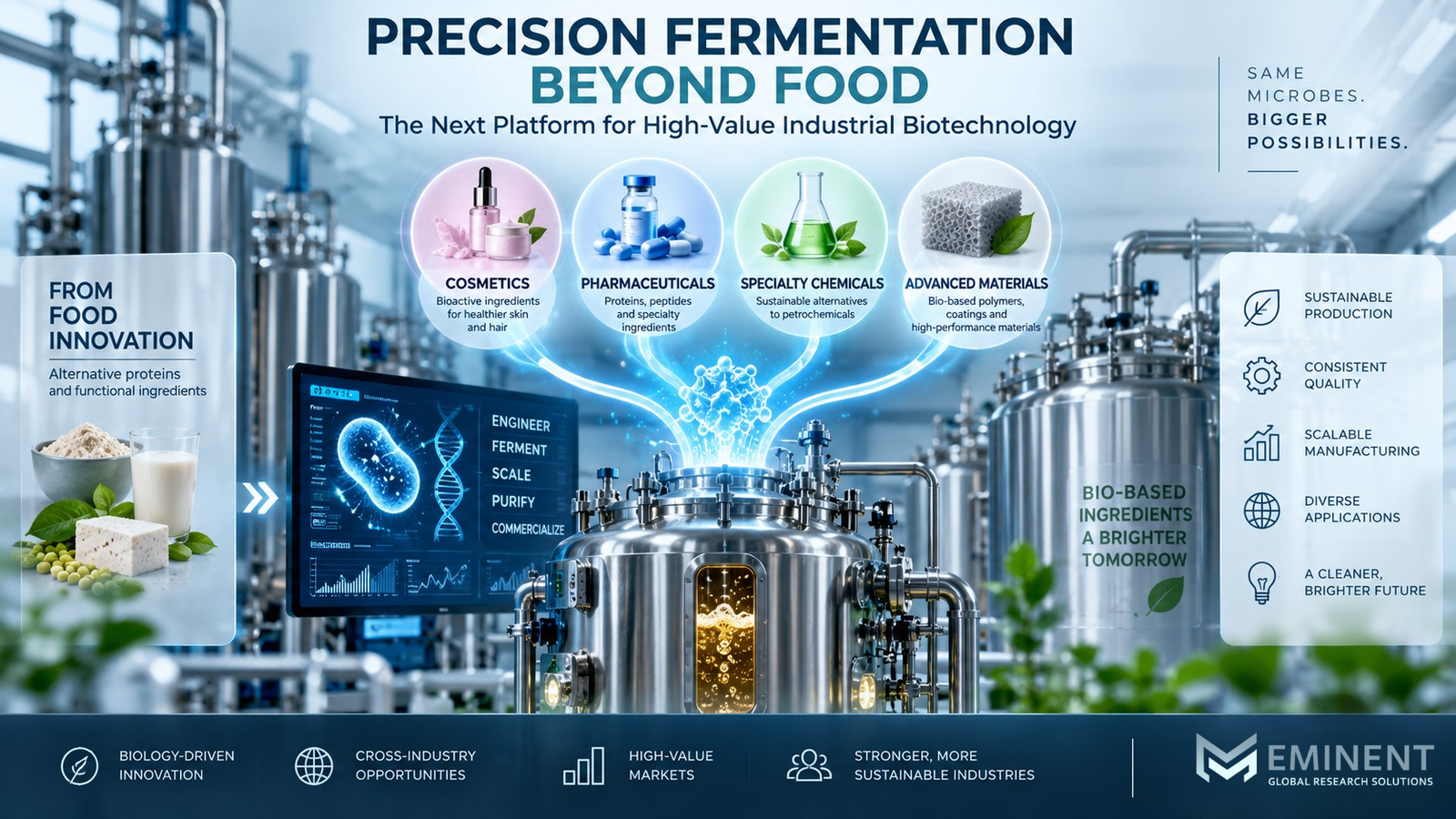
Precision fermentation is rapidly evolving from a food technology into a broader industrial biotechnology platform. Once primarily associated with alternative proteins, dairy proteins, and functional food ingredients, the technology is now attracting interest across cosmetics, pharmaceuticals, specialty chemicals, biomaterials, nutrition, and other high-value applications.
This evolution could fundamentally change how companies manufacture complex biological and chemical compounds.
Rather than relying exclusively on traditional agricultural extraction, petrochemical synthesis, or animal-derived inputs, precision fermentation enables microorganisms such as yeast, bacteria, or fungi to be programmed to produce specific target molecules under controlled conditions.
The strategic question is no longer whether precision fermentation can support alternative food production. It is whether the technology can become a scalable manufacturing platform for high-value ingredients and industrial materials across multiple sectors.
For companies operating in biotechnology, chemicals, cosmetics, pharmaceuticals, and specialty ingredients, this represents an emerging technology landscape worth closely monitoring.
From Alternative Food to Industrial Biotechnology
The initial commercial attention around precision fermentation focused heavily on food.
Companies developed fermentation-based alternatives to conventional dairy proteins, animal proteins, fats, and other food components. The technology offered potential advantages in terms of production consistency, resource utilization, and the ability to manufacture specific proteins without relying directly on traditional livestock production.
However, the underlying platform has much broader applications.
At its core, precision fermentation is a method of biological manufacturing. If microorganisms can be engineered to produce one valuable molecule, the same fundamental approach can potentially be adapted to produce many others.
This creates opportunities across industries where companies currently depend on complex extraction processes, scarce natural resources, or expensive chemical synthesis.
Potential applications include:
- Bioactive cosmetic ingredients
- Specialty enzymes
- Pharmaceutical intermediates
- Proteins and peptides
- Nutraceutical ingredients
- Sustainable chemicals
- Biomaterials
- Functional polymers
- Industrial enzymes
- High-value specialty compounds
The shift from food to these higher-value markets could significantly improve the commercial economics of precision fermentation.
Why High-Value Applications Are Attractive
One of the biggest challenges facing precision fermentation is production economics.
Manufacturing biological products at scale requires sophisticated fermentation infrastructure, downstream processing, purification, quality control, and reliable feedstocks. For relatively inexpensive commodities, these costs can make biological production difficult to justify against established manufacturing technologies.
High-value applications present a different opportunity.
A specialty ingredient with significant commercial value can potentially absorb higher production costs while delivering differentiated functionality or sustainability benefits.
This makes sectors such as pharmaceuticals, cosmetics, specialty chemicals, and premium nutrition particularly attractive targets.
For example, a biotechnology company may not need to replace an entire commodity chemical market to build a successful business. Producing a small-volume, high-value molecule with limited natural availability could represent a commercially compelling opportunity.
This creates an important strategic distinction: the most attractive precision-fermentation markets may not necessarily be the largest markets by volume, but the markets with the strongest combination of value, scarcity, functionality, and customer demand.
Cosmetics Could Become a Major Opportunity
The beauty and personal care industry is particularly well positioned to benefit from precision fermentation.
Cosmetic brands are increasingly seeking ingredients that combine efficacy, sustainability, traceability, and consistent quality.
Precision fermentation can potentially support the production of complex biological ingredients that are difficult to obtain through conventional sourcing.
Potential applications include peptides, proteins, polysaccharides, bioactive molecules, and other functional ingredients used in skincare and haircare.
The technology could also address supply-chain challenges associated with naturally sourced ingredients.
Instead of depending entirely on agricultural conditions or geographically concentrated biological resources, manufacturers could potentially produce certain ingredients in controlled fermentation facilities.
For beauty companies, this could create opportunities for:
- Consistent ingredient quality
- More predictable supply
- Novel bioactive ingredients
- Reduced dependence on scarce natural resources
- Science-backed product positioning
- New premium product categories
As beauty increasingly converges with biotechnology and skin health, precision fermentation could become an important platform for next-generation ingredient development.
Pharmaceutical Applications Could Increase Commercial Value
Pharmaceuticals represent another potentially high-value application area.
Biotechnology manufacturing already plays a major role in pharmaceutical production, but precision fermentation could expand the range of molecules produced through engineered microbial systems.
Potential applications include specialized proteins, enzymes, therapeutic intermediates, and other biological compounds.
The opportunity is particularly relevant for molecules that are difficult or expensive to manufacture using conventional processes.
However, pharmaceutical applications also introduce substantially higher regulatory and quality requirements.
Manufacturers must demonstrate process consistency, purity, safety, reproducibility, and compliance with stringent regulatory standards.
Consequently, success in pharmaceutical precision fermentation will depend not only on biological engineering but also on manufacturing expertise, quality systems, regulatory strategy, and process economics.
Specialty Chemicals and Materials Could Be the Next Frontier
One of the most strategically interesting opportunities lies beyond traditional consumer applications.
Industrial biotechnology is increasingly exploring biological alternatives to conventional chemical manufacturing.
Precision fermentation could potentially enable production of specialty chemicals and materials with specific performance characteristics while reducing dependence on fossil-based feedstocks.
Applications may eventually extend to:
- Performance chemicals
- Bio-based polymers
- Coatings
- Adhesives
- Textile materials
- Industrial enzymes
- Specialty additives
- Sustainable packaging materials
The commercial opportunity will depend heavily on production economics and the ability to integrate fermentation into existing industrial supply chains.
Companies that successfully solve these challenges could create new business models around biological manufacturing rather than simply selling individual ingredients.
The Importance of Scale-Up
Laboratory success does not automatically translate into commercial success.
Scaling precision fermentation from laboratory vessels to industrial-scale bioreactors can introduce significant challenges.
Companies must optimize:
Strain performance: Microorganisms must reliably produce the desired molecule at commercially viable yields.
Fermentation efficiency: Production conditions need to be optimized for productivity and consistency.
Downstream processing: Separating and purifying the target compound can represent a substantial portion of total manufacturing costs.
Feedstock economics: The availability and cost of fermentation inputs directly influence profitability.
Infrastructure: Commercial-scale production requires specialized facilities and capital investment.
Quality control: Industrial customers require consistent specifications across production batches.
This means that technology commercialization—not just scientific innovation—will determine which precision fermentation platforms ultimately succeed.
A New Competitive Landscape Is Emerging
The expansion of precision fermentation beyond food is also creating a new competitive landscape.
Competition may come from several directions simultaneously:
- Traditional chemical manufacturers
- Biotechnology startups
- Ingredient suppliers
- Pharmaceutical companies
- Food technology companies
- Industrial biotechnology firms
- Contract manufacturing organizations
This convergence makes technology intelligence increasingly important.
Companies need to understand not only who is developing precision fermentation technologies, but also which molecules are being targeted, what production platforms are being used, where manufacturing capacity is being established, and which commercial partnerships are forming.
Patent activity, licensing agreements, startup investments, pilot plants, technology partnerships, and product launches can all provide early signals about where the market is heading.
Strategic Implications for Industry Leaders
For companies evaluating precision fermentation, the key question should not simply be, “Can this technology produce the ingredient?”
A more strategic assessment should consider:
- Is the target molecule commercially attractive?
- How difficult is conventional production?
- Does precision fermentation provide a meaningful cost or performance advantage?
- Can production scale economically?
- Are customers willing to switch suppliers?
- What regulatory requirements apply?
- Is intellectual property defensible?
- Who are the emerging technology leaders?
- What manufacturing partnerships are available?
- How quickly could the technology reach commercial scale?
These questions help distinguish technological potential from genuine commercial opportunity.
The Consulting Opportunity
For organizations operating across life sciences, chemicals, beauty, food, and advanced materials, precision fermentation should increasingly be evaluated as a cross-industry technology platform rather than a single-market innovation.
Technology scouting can identify emerging fermentation platforms and companies.
Competitive intelligence can track investments, partnerships, patents, product launches, and manufacturing expansion.
Market intelligence can identify the highest-value application areas.
IP intelligence can assess technology ownership and potential freedom-to-operate considerations.
Together, these capabilities can help organizations determine where precision fermentation represents a genuine strategic opportunity.
Conclusion
Precision fermentation is entering a new phase.
What began as a disruptive approach to food production is increasingly being explored as a broader platform for manufacturing high-value biological ingredients, specialty chemicals, pharmaceutical components, cosmetic actives, and advanced materials.
The biggest opportunity may ultimately lie in applications where conventional production is expensive, environmentally challenging, supply-constrained, or unable to deliver sufficient functionality.
For companies, the strategic priority is therefore not simply to follow the technology trend but to identify where precision fermentation creates a defensible commercial advantage.
As the boundaries between food, biotechnology, pharmaceuticals, cosmetics, and industrial chemicals continue to converge, precision fermentation could become one of the defining manufacturing technologies of the next generation of industrial biotechnology.