
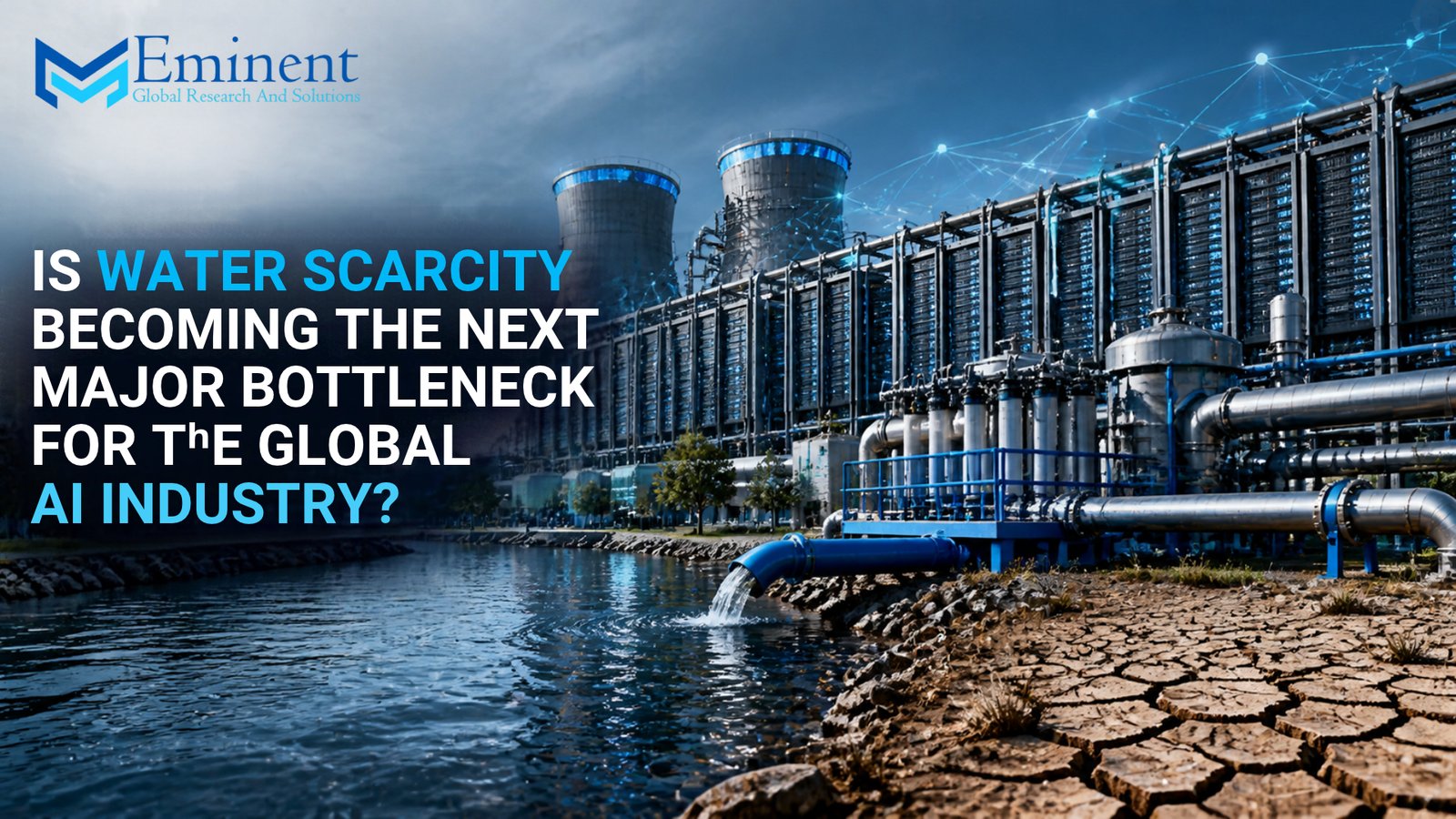
Is Water Scarcity Becoming the Next Major Bottleneck for the Global AI Industry?
Published Date: 20 November 2026
Category: Electronics & IT | Artificial Intelligence | Sustainability | Water Management
Introduction
Artificial intelligence is transforming the global economy. From generative AI and cloud computing to autonomous systems and advanced semiconductor technologies, businesses are investing heavily in the infrastructure needed to support increasingly powerful computing applications.
However, behind every AI model is a physical infrastructure network that requires electricity, cooling systems, semiconductor components, and substantial industrial resources. While energy consumption and carbon emissions have received considerable attention, water is emerging as another important challenge for the global AI industry.
Data centres require effective cooling to manage the heat generated by thousands of servers. Semiconductor manufacturing facilities also depend on highly purified water for chip production. In addition, electricity generation can create a significant indirect water footprint.
According to the International Energy Agency (IEA), water consumption associated with data centres reached approximately 885 billion litres in 2025. Of this amount, around 240 billion litres was consumed directly within data centres. The remaining water footprint was associated with electricity generation, semiconductor and microchip manufacturing, and primary energy supply.
As AI infrastructure expands, the availability of reliable water supplies could influence data centre locations, operating costs, investment decisions, and the long-term sustainability of digital infrastructure.
The question is no longer simply how much computing power the world can build. It is also whether the resources needed to operate that infrastructure will be available in the right locations.
1. Why Is the AI Industry Increasing Global Water Demand?
The growing adoption of artificial intelligence is increasing demand for high-performance computing systems. Training large AI models, processing complex datasets, and operating generative AI applications require powerful processors that produce substantial amounts of heat.
Water is used directly in some cooling systems and indirectly through electricity generation and semiconductor manufacturing.
Several factors are contributing to this growing demand.
Expansion of AI Data Centres
Technology companies are developing large-scale data centres to support cloud services, AI applications, and enterprise computing.
These facilities operate continuously and require reliable cooling infrastructure. As computing capacity increases, operators must manage higher thermal loads while maintaining equipment performance and operational reliability.
Higher Heat Generation from AI Processors
AI servers use advanced graphics processing units (GPUs), high-performance memory, and specialised computing components.
These systems can generate more heat than conventional servers. As a result, operators are increasingly exploring liquid cooling, advanced heat exchangers, and other thermal management technologies.
Growing Semiconductor Manufacturing
AI infrastructure depends on advanced processors and high-bandwidth memory chips.
Semiconductor manufacturing requires highly purified water for wafer cleaning, rinsing, and several other production processes. As demand for advanced chips increases, manufacturers must ensure that their facilities have access to reliable water supplies and treatment infrastructure.
Water Consumption in Electricity Generation
Data centres consume large amounts of electricity. Depending on the energy source and power-generation technology, producing that electricity can also require water.
This means a data centre’s water footprint extends beyond the facility itself. Even when an operator reduces direct cooling consumption, water may still be consumed upstream by the electricity supply chain.
2. How Much Water Does the Global Data Centre Industry Consume?
Recent research provides a clearer picture of the relationship between data centre expansion and water consumption.
The IEA’s World Energy Outlook 2026 estimates that water consumption associated with data centres reached approximately 885 billion litres in 2025.
The report identifies three important areas of water use:
- Electricity generation: Nearly 40% of the overall water footprint.
- Direct data centre cooling: Approximately one-quarter of the overall water footprint.
- Other activities: The remaining share is associated with semiconductor and microchip manufacturing and primary energy supply.
The IEA estimates that approximately 240 billion litres was consumed directly within data centres in 2025.
These figures show why direct cooling measurements alone cannot explain the industry’s complete water footprint.
Data Centre Water Consumption: Key Figures
| Indicator | Reported figure |
|---|---|
| Water consumption associated with data centres in 2025 | 885 billion litres |
| Direct water consumption inside data centres in 2025 | 240 billion litres |
| Share associated with electricity generation | Nearly 40% |
| Share associated with direct cooling | Approximately 25% |
| Existing and planned data centre capacity in high water-stress areas | Around 30% |
Source: International Energy Agency, World Energy Outlook 2026. Figures refer to the wider data centre water footprint, not exclusively to AI workloads.
A separate forecast from Rystad Energy estimates that direct data centre cooling-water consumption could increase from approximately 222 billion litres in 2025 to 644 billion litres annually by 2030 if significant water-saving measures are not implemented.
The same analysis suggests that stronger efficiency measures could reduce projected direct cooling-water consumption to approximately 543 billion litres under a moderate-saving scenario or 388 billion litres under a more aggressive-saving scenario.
These are scenario estimates rather than guaranteed outcomes. Actual consumption will depend on data centre growth, climate conditions, cooling technologies, and the availability of alternative water sources.
3. Why Are Data Centres in Water-Stressed Regions a Growing Concern?
Water scarcity is not evenly distributed across the world. Some regions have reliable freshwater supplies, while others experience seasonal shortages, groundwater depletion, and increasing competition between households, agriculture, and industry.
The location of a data centre therefore matters as much as its cooling technology.
A 2026 study published in Environmental Science & Technology examined 9,347 data centres worldwide and assessed their exposure to water scarcity.
The research found that:
- Approximately 25% of the identified data centres were located in areas experiencing at least one month of water scarcity annually under the study’s baseline hydrological conditions.
- This share could increase to approximately 33% under future hydrological conditions.
- Around 15% were located in regions experiencing at least five months of water scarcity annually.
- Approximately 6% were located in areas facing at least nine months of water scarcity.
The study also found that data centres frequently share water resources with other sectors. Approximately 41% were located in river basins where municipalities were the main water users, while 28% were in areas where agriculture was the primary user.
These findings highlight a major concern: data centre expansion may increase pressure on local water systems, particularly where communities and industries already depend on limited freshwater resources.
4. Which Global Markets Face the Greatest Water-Related Risks?
United States
The United States is one of the world’s largest data centre markets and a major destination for AI infrastructure investment.
According to the 2026 global water-stress study, the country hosts approximately 39% of the identified data centres worldwide. Around 21% of US data centres are located in regions experiencing at least one month of water scarcity annually.
The western and southwestern parts of the country require particular attention because of drought conditions and competition for water among cities, agriculture, energy facilities, and industrial users.
India
India is becoming an important market for data centres, cloud computing, semiconductor manufacturing, and AI services.
However, water availability differs considerably between states and cities. Some regions already experience groundwater stress and seasonal shortages.
As new data centre projects are planned, developers will need to assess local water availability, municipal infrastructure, wastewater treatment capacity, and the requirements of surrounding communities.
For India, the opportunity is not limited to building more data centres. It also includes developing water-efficient cooling systems, industrial recycling facilities, and sustainable infrastructure services.
China
China is investing in AI computing infrastructure, semiconductor production, and large-scale digital services.
Water availability varies significantly across the country. Industrial expansion in water-stressed areas can create additional challenges for infrastructure developers.
Efficient cooling, water recycling, and careful site selection will be important for supporting future data centre development.
Taiwan and South Korea
Taiwan and South Korea play important roles in the global semiconductor supply chain.
Advanced chip manufacturing requires reliable supplies of ultrapure water. Water shortages or interruptions can create operational risks for manufacturing facilities and the wider electronics supply chain.
The growth of AI-related semiconductor demand therefore makes industrial water management increasingly important in these markets.
Middle East
Countries across the Middle East are investing in AI infrastructure, cloud computing, and digital transformation.
However, freshwater availability is limited across much of the region. Data centre developers may need to consider desalination, treated wastewater reuse, and advanced cooling technologies when planning new facilities.
5. How Could Water Scarcity Affect the Global AI Industry?
Water shortages may influence the AI industry through several operational, financial, and strategic channels.
Higher Operating and Infrastructure Costs
Companies may need to invest in additional water storage, purification, recycling, and cooling infrastructure.
These investments can increase the initial cost of data centre development and affect long-term operating expenses.
Delays in New Data Centre Projects
Projects located in water-stressed regions may face additional environmental assessments, local opposition, or restrictions on industrial water use.
These factors can delay construction and affect investment timelines.
Semiconductor Supply Chain Risks
Advanced semiconductor manufacturing depends on consistent supplies of ultrapure water.
Disruptions to water availability can affect production processes and create risks for manufacturers supplying AI processors, memory chips, and other electronic components.
Competition with Local Communities
Data centres may share water resources with households, farmers, and other industries.
If companies do not manage water use responsibly, projects can face public opposition and concerns about the fair allocation of local resources.
Changing Investment Decisions
Investors and infrastructure developers may increasingly evaluate water availability before selecting locations for new projects.
Water risk could become an important factor alongside electricity prices, network connectivity, land availability, and regulatory conditions.
6. What Technologies Can Reduce AI’s Water Footprint?
The growing water challenge is creating demand for technologies that can improve cooling efficiency and reduce dependence on freshwater.
Direct-to-Chip Liquid Cooling
Direct-to-chip liquid cooling transfers heat away from processors through specialised cooling plates and circulating coolant.
These systems can support high-density AI computing while reducing dependence on conventional facility-level cooling methods.
However, liquid cooling does not automatically eliminate water consumption. The overall impact depends on whether the system uses a closed loop, how heat is rejected, and the cooling infrastructure supporting it.
Air-Based and Dry Cooling
Air-based cooling systems can reduce or avoid direct evaporative water consumption.
Dry cooling may be particularly useful in regions where freshwater is limited. However, performance depends on outdoor temperatures and humidity, and some designs require additional electricity.
Wastewater Recycling
Treated wastewater can be used for suitable industrial cooling applications instead of relying entirely on freshwater.
Data centre operators can work with local utilities and treatment providers to develop systems that improve water reuse and reduce demand for drinking-quality supplies.
Advanced Water Treatment
Reverse osmosis, membrane filtration, and other purification technologies can support industrial water treatment and semiconductor manufacturing.
These systems are important for facilities that require high-quality water for specialised production processes.
Smart Water Monitoring
Sensors, automation, and data analytics can help companies monitor water consumption, detect leaks, and improve cooling-system performance.
AI-based monitoring can also support predictive maintenance and more efficient resource allocation.
7. Business Opportunities Emerging from the AI Water Challenge
The demand for sustainable AI infrastructure is creating opportunities beyond traditional technology companies.
Industrial Water Treatment Companies
Companies providing filtration, purification, and industrial wastewater treatment solutions may benefit from increasing demand from data centres and semiconductor manufacturers.
Cooling Technology Manufacturers
Manufacturers of liquid cooling systems, heat exchangers, pumps, and thermal management equipment could find new opportunities as AI facilities adopt higher-density computing systems.
Water Recycling and Reuse Providers
Businesses offering wastewater recovery, advanced treatment, and water reuse solutions may become important partners for infrastructure operators.
Semiconductor Manufacturing Support
Suppliers of ultrapure water systems, purification equipment, monitoring technologies, and industrial process solutions could benefit from continued semiconductor investment.
Engineering and Infrastructure Consultants
Consulting and engineering firms may find opportunities in water-risk assessments, site selection, infrastructure planning, and sustainability advisory services.
Investors and Infrastructure Developers
Water availability and resource efficiency may increasingly influence the attractiveness of data centre investments.
Investors could assess companies developing water-efficient cooling, recycling infrastructure, and sustainable industrial technologies.
8. What Challenges Could Slow the Adoption of Water-Efficient Technologies?
Although several solutions are available, implementing them across the global AI infrastructure ecosystem will require investment and careful planning.
High initial investment: Advanced cooling and water recycling systems can require significant capital expenditure.
Retrofitting existing facilities: Older data centres may need major engineering changes to adopt newer cooling technologies.
Water and energy trade-offs: Some systems reduce water consumption but increase electricity demand. Companies must evaluate both resources together.
Limited transparency: Differences in reporting methods make it difficult to compare water performance across data centre operators.
Local regulations: Water allocation, environmental requirements, and wastewater standards vary across regions, making infrastructure planning more complex.
Community acceptance: New projects must consider the water requirements of local households, agriculture, and ecosystems to maintain public trust.
9. What Does the Future Hold for AI Infrastructure and Water Sustainability?
The global AI industry is entering a period of significant infrastructure investment. However, future expansion will depend on more than access to computing hardware and electricity.
The IEA’s 2026 analysis indicates that water availability is already an important consideration for data centre development. Its research also identifies a substantial share of AI data centre capacity in areas experiencing high or extremely high baseline water stress.
Over the coming years, companies may increasingly prioritise:
- Data centre locations with reliable and sustainable water supplies.
- Closed-loop and advanced liquid cooling systems.
- Recycled and non-potable water for suitable industrial applications.
- Water-efficient semiconductor manufacturing.
- Transparent reporting of direct and indirect water consumption.
- Water-risk assessments at the local river-basin level.
Governments, technology companies, utilities, and local communities will also need to work together to ensure that digital infrastructure does not place unnecessary pressure on freshwater resources.
The future of AI will depend not only on how efficiently companies process data, but also on how responsibly they manage the resources that make that computing possible.
10. How Eminent Global Research Solutions Supports Businesses
At Eminent Global Research Solutions, we help organisations understand emerging market developments and identify business opportunities across technology, industrial infrastructure, and sustainability markets.
Our research capabilities include:
- Market Research & Analysis: Evaluating the global data centre cooling, industrial water treatment, and sustainable infrastructure markets.
- Industry Forecasting: Assessing future demand for AI infrastructure, water management technologies, and advanced cooling systems.
- Competitive Intelligence: Analysing market participants, technology providers, competitive positioning, and industry developments.
- Technology Assessment: Evaluating liquid cooling, water recycling, advanced filtration, and smart water monitoring technologies.
- Investment Opportunity Assessment: Identifying opportunities across industrial water treatment, data centre infrastructure, and sustainability solutions.
- Regulatory & Policy Analysis: Understanding environmental regulations, water-use requirements, and sustainability standards across different markets.
- Strategic Consulting: Supporting businesses with market entry, expansion planning, technology adoption, and long-term growth strategies.
Through data-driven research and strategic insights, we help organisations understand changing market conditions and make informed business decisions.
Conclusion
Artificial intelligence is creating significant opportunities for global businesses, but its expansion is also increasing demand for the physical resources required to operate digital infrastructure.
Water scarcity is emerging as an important challenge for data centres, semiconductor manufacturers, and electricity supply chains. The latest research shows that a significant share of data centres is already located in areas experiencing seasonal water shortages, while future infrastructure expansion could increase pressure on local water systems.
However, water scarcity does not mean that AI development must stop. It means that infrastructure planning, cooling technology, water recycling, and responsible resource management must become central to the industry’s growth strategy.
Companies that invest in water-efficient technologies and understand local water risks may be better positioned to build resilient infrastructure and capture emerging business opportunities.
The next major challenge for the AI industry may not be how much computing power it can build, but whether it can sustain that growth while using water responsibly.
Post a Comment