

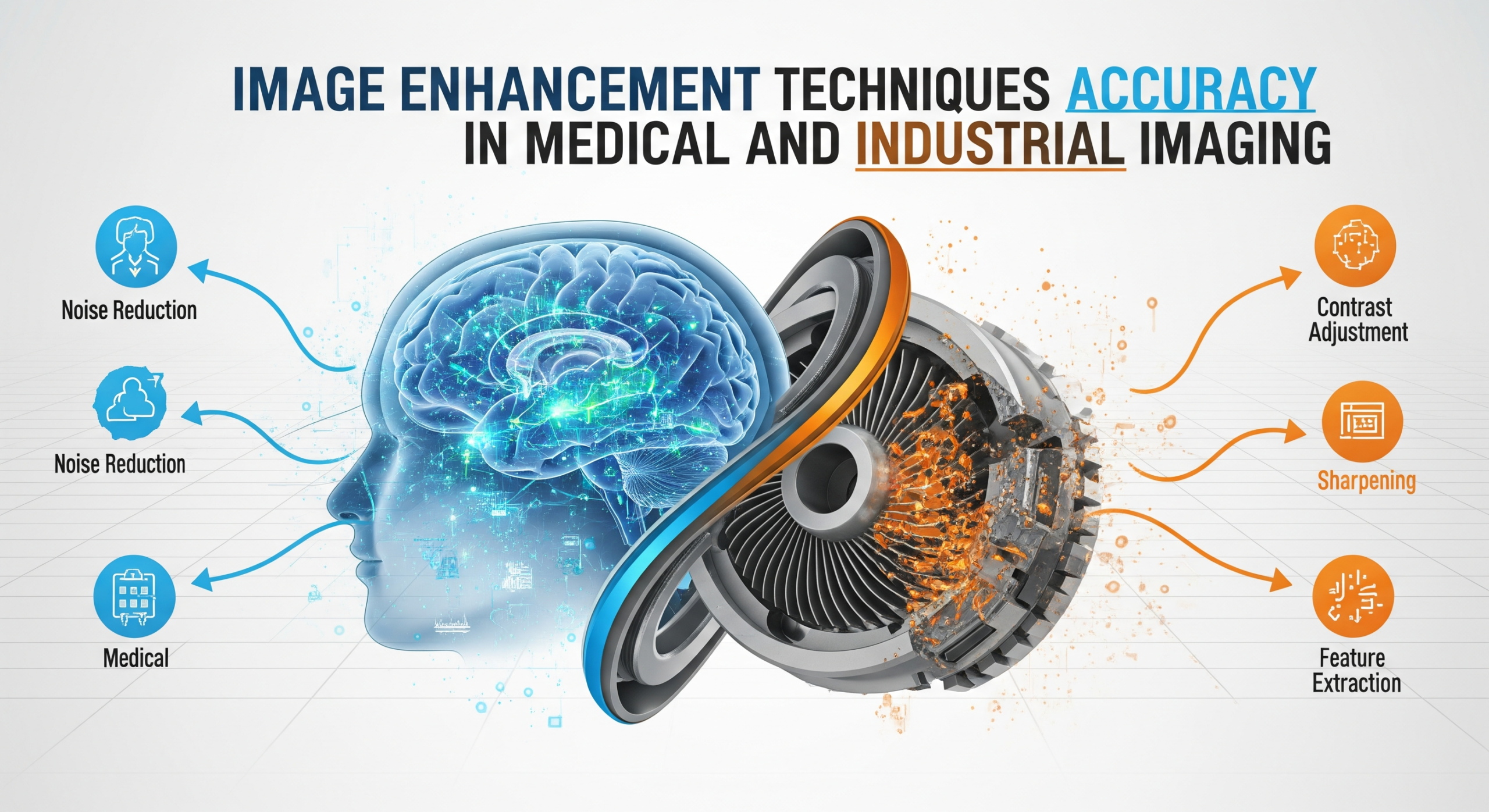
In today’s data-driven world, image quality plays a critical role in decision-making across industries. From detecting early-stage diseases in healthcare to identifying microscopic defects in manufacturing, the accuracy of imaging systems directly impacts outcomes. This is where image enhancement techniques become essential.
Image enhancement improves the visual quality of images, making important details more visible while reducing noise and distortion. With rapid advancements in artificial intelligence and computing power, these techniques are now redefining precision in both medical and industrial imaging.
Understanding Image Enhancement
Image enhancement refers to the process of improving image interpretability for human viewers or machine analysis systems. Unlike image restoration, which aims to reconstruct the original image, enhancement focuses on highlighting meaningful features such as edges, textures, and contrast.
The goal is simple:
better visibility leads to better decisions.
Key Image Enhancement Techniques
1. Noise Reduction
Noise can obscure critical details in images, especially in low-light or high-speed imaging environments.
Common methods include:
Median filtering
Gaussian filtering
Bilateral filtering
AI-based denoising models
Applications:
MRI and CT scan clarity
Industrial X-ray inspection
Semiconductor wafer analysis
2. Contrast Enhancement
Low contrast often hides important structural information.
Popular techniques:
Histogram equalization
Adaptive histogram equalization (CLAHE)
Gamma correction
Benefits:
Improves visibility of tumors or fractures in medical scans
Enhances surface defect detection in manufacturing
3. Edge Detection and Sharpening
Edges define boundaries between objects and structures.
Techniques include:
Sobel and Prewitt operators
Canny edge detection
Unsharp masking
These methods help highlight fine details such as cracks, contours, or anatomical boundaries.
4. Image Normalization
Normalization ensures consistency across images captured under varying conditions.
Used for:
Machine learning model accuracy
Multi-device imaging systems
Long-term quality comparison
This is especially critical in industrial automation and diagnostic AI systems.
5. AI and Deep Learning-Based Enhancement
Modern imaging increasingly relies on AI-powered enhancement.
Capabilities include:
Super-resolution imaging
Intelligent noise suppression
Automated feature highlighting
Context-aware image reconstruction
Deep learning models adapt to complex imaging conditions far better than traditional algorithms.
Impact on Medical Imaging
In healthcare, enhanced images directly influence diagnosis and treatment planning.
Key benefits include:
Earlier disease detection
Reduced diagnostic errors
Improved visualization of soft tissues
Faster clinical workflows
Enhanced imaging supports radiologists by improving clarity while enabling AI-based diagnostic tools to operate more reliably.
Impact on Industrial Imaging
In industrial environments, precision is non-negotiable.
Image enhancement helps in:
Automated defect detection
Surface inspection
Dimensional measurement
Predictive maintenance
Industries such as automotive, electronics, aerospace, and pharmaceuticals rely on enhanced imaging to maintain quality standards and reduce operational losses.
Challenges in Image Enhancement
Despite advancements, several challenges remain:
Over-enhancement causing false positives
High computational requirements
Real-time processing limitations
Maintaining original image integrity
Balancing enhancement quality with processing speed remains a key research focus.
Future Outlook
The future of image enhancement lies in:
AI-driven adaptive algorithms
Edge-based real-time processing
Integration with digital twins
Cross-domain imaging intelligence
As imaging systems become smarter, enhancement techniques will play a foundational role in achieving higher accuracy, efficiency, and reliability.
Conclusion
Image enhancement is no longer just a visual improvement tool—it is a critical enabler of accuracy in both medical and industrial imaging. By revealing hidden details and improving interpretability, these techniques empower professionals to make faster, safer, and more informed decisions.
As technology evolves, image enhancement will continue to bridge the gap between raw data and actionable insight.