

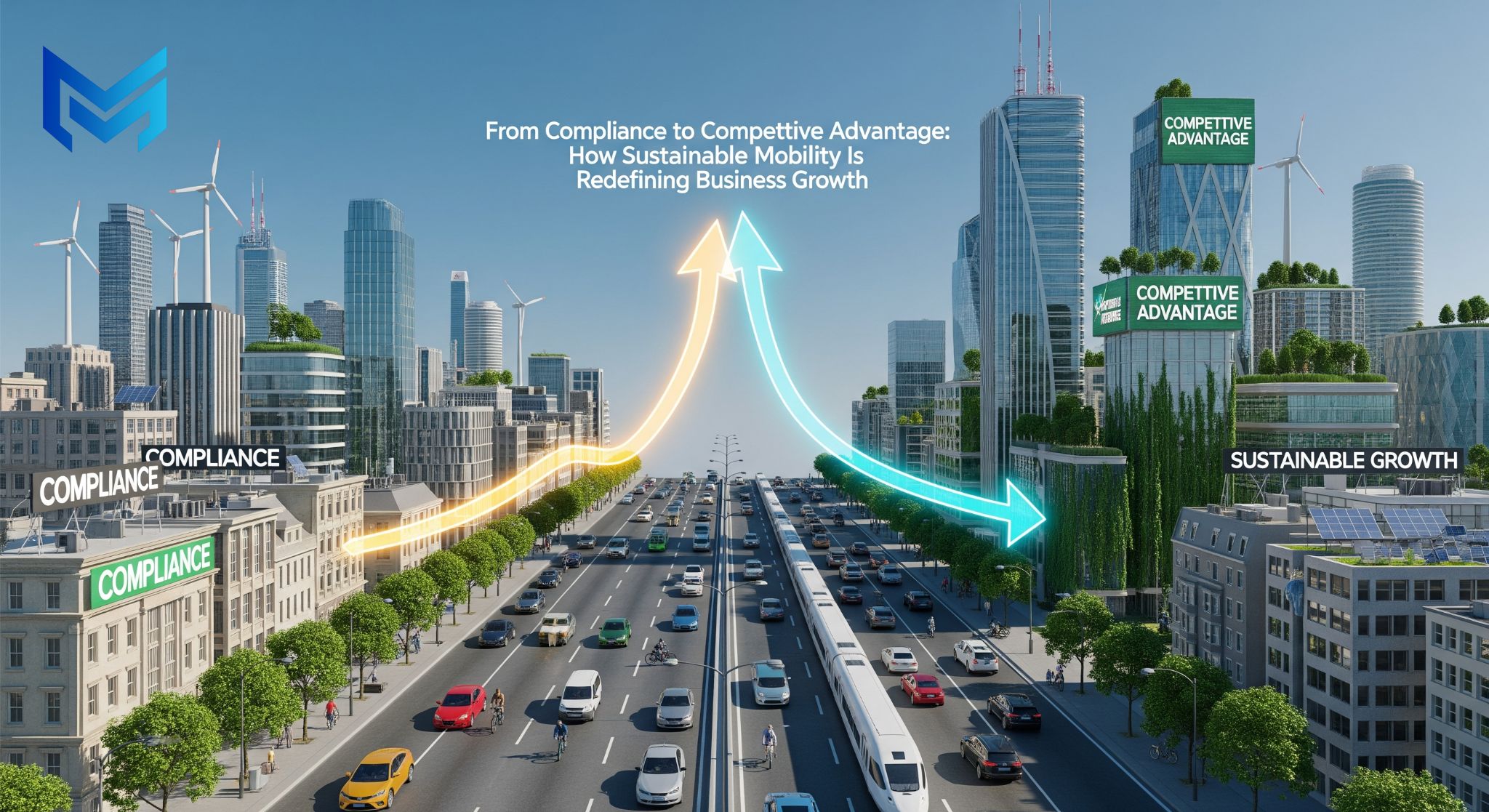
Introduction: Sustainability Moves From Obligation to Opportunity
For much of the last two decades, sustainability in mobility was largely viewed through the narrow lens of regulatory compliance. Governments imposed emissions standards, reporting requirements, and fuel-efficiency mandates, and businesses responded defensively—doing just enough to avoid penalties, reputational risk, or operational disruption. Sustainability was treated as a cost center, a box to be checked, or a constraint on growth.
That mindset is rapidly becoming obsolete.
Today, sustainable mobility—encompassing electric vehicles (EVs), alternative fuels, shared and autonomous transportation, digital logistics optimization, and low-carbon infrastructure—is emerging as a powerful driver of competitive advantage. Companies that embrace it strategically are unlocking new revenue streams, reducing long-term costs, strengthening supply-chain resilience, attracting capital, and building future-ready brands. In contrast, organizations that remain stuck in a compliance-only mindset risk falling behind in a market that increasingly rewards speed, innovation, and environmental leadership.
This article explores how sustainable mobility is redefining business growth, why leading organizations are reframing decarbonization as a value-creation lever, and how Eminent can help businesses transform sustainability challenges into durable competitive advantages.
The Evolution of Sustainable Mobility
From Emissions Control to System Transformation
Early sustainability efforts in mobility focused primarily on tailpipe emissions and fuel efficiency. Regulations such as Euro standards, CAFE norms, and emissions reporting frameworks forced automakers, logistics providers, and fleet operators to incrementally reduce environmental impact.
However, climate urgency, urbanization pressures, and technological advances have expanded the scope dramatically. Sustainable mobility now encompasses:
Electrification of passenger and commercial fleets
Hydrogen and alternative fuel adoption
Smart logistics and route optimization
Shared and multimodal transportation systems
Lifecycle-based emissions management
Circular economy approaches to batteries and components
This shift reflects a deeper transformation: mobility is no longer just about moving people and goods efficiently—it is about doing so in a way that is resilient, intelligent, and aligned with long-term environmental and economic goals.
The Market Forces Driving Change
Several converging forces are accelerating this transition:
Regulatory pressure is intensifying – Net-zero commitments, carbon pricing mechanisms, and stricter disclosure requirements are expanding globally.
Capital is flowing toward sustainability – Investors increasingly favor companies with credible decarbonization and ESG strategies.
Customers are more discerning – B2B and B2C customers prefer partners with low-carbon operations and transparent sustainability commitments.
Technology costs are declining – EVs, batteries, AI-driven logistics, and digital platforms are becoming economically viable at scale.
Together, these forces are pushing sustainable mobility beyond compliance and into the core of business strategy.
Why Compliance-Only Strategies No Longer Work
The Hidden Cost of Minimalism
Organizations that pursue sustainability purely for compliance often focus on short-term fixes: purchasing offsets, meeting minimum reporting standards, or adopting isolated green initiatives. While these actions may satisfy regulators, they rarely create lasting value.
In fact, compliance-only strategies often result in:
Fragmented initiatives with limited business impact
Higher long-term operating costs
Missed opportunities for innovation and differentiation
Vulnerability to future regulatory tightening
As regulations evolve, these companies are forced into repeated reactive investments, increasing cost and complexity.
Sustainability as a Strategic Risk—and Opportunity
Conversely, companies that integrate sustainable mobility into their core operations treat decarbonization as a strategic transformation. They ask different questions:
How can low-carbon mobility improve our cost structure?
How can it enable new products, services, or markets?
How can it strengthen our brand and customer loyalty?
The answers often reveal opportunities that go far beyond compliance.
Sustainable Mobility as a Growth Engine
Cost Reduction and Operational Efficiency
One of the most immediate benefits of sustainable mobility is cost efficiency. Electrified fleets, for example, typically offer:
Lower fuel and energy costs
Reduced maintenance requirements
Predictable operating expenses
When combined with AI-powered route optimization and telematics, companies can significantly reduce total cost of ownership (TCO) while lowering emissions.
Logistics and mobility leaders are already leveraging these efficiencies to improve margins and reinvest savings into growth initiatives.
Innovation and New Revenue Models
Sustainable mobility enables entirely new business models, including:
Mobility-as-a-Service (MaaS)
Subscription-based vehicle access
Low-carbon logistics solutions for ESG-focused customers
Data-driven mobility platforms
Organizations that move early can define market standards, build ecosystems, and capture first-mover advantages.
Brand Differentiation and Customer Trust
In a crowded marketplace, sustainability has become a powerful differentiator. Companies with credible sustainable mobility strategies are perceived as:
More innovative
More responsible
Better long-term partners
This perception translates into stronger customer loyalty, higher employee engagement, and improved talent attraction—critical factors in competitive growth.
Supply Chain Resilience
Sustainable mobility strategies often go hand-in-hand with supply chain redesign. By localizing production, optimizing transport routes, and diversifying energy sources, companies reduce exposure to fuel price volatility and geopolitical risks.
Resilience, once viewed as a defensive objective, is now a competitive advantage.
Digitalization: The Catalyst for Scalable Impact
Digital technologies play a central role in turning sustainable mobility into a growth lever. Key enablers include:
Advanced analytics and AI for demand forecasting and route optimization
Digital twins for modeling emissions and operational scenarios
IoT and telematics for real-time fleet monitoring
Lifecycle assessment tools for end-to-end emissions visibility
By embedding sustainability into digital decision-making, organizations can scale impact while maintaining profitability.
Industry Perspectives: Where Sustainable Mobility Is Winning
Automotive and OEMs
Automakers are shifting from product-centric models to ecosystem-based strategies, offering integrated solutions that combine vehicles, software, energy, and services.
Logistics and Transportation
Low-carbon logistics is becoming a premium offering, especially for customers with stringent ESG commitments. Providers that can quantify and reduce emissions gain a competitive edge.
Corporate Fleets
Large enterprises are using fleet electrification as a visible and measurable step toward net-zero goals, often achieving ROI faster than expected.
Across industries, the pattern is clear: sustainable mobility leaders are outperforming laggards.
How Eminent Helps Turn Sustainability into Competitive Advantage
While the opportunity is clear, execution remains complex. Regulatory uncertainty, technology choices, IP considerations, and commercialization challenges often slow progress. This is where Eminent plays a critical role.
Strategic Advisory Aligned With Business Goals
Eminent helps organizations move beyond fragmented sustainability initiatives by aligning sustainable mobility strategies with core business objectives. This includes:
Identifying high-impact decarbonization opportunities
Prioritizing initiatives based on ROI and scalability
Integrating sustainability into long-term growth roadmaps
Intellectual Property and Innovation Enablement
As sustainable mobility technologies evolve, IP strategy becomes a key differentiator. Eminent supports clients by:
Identifying and protecting high-value innovations
Structuring IP portfolios aligned with future mobility trends
Supporting licensing and collaboration strategies
This ensures that sustainability-driven innovation translates into defensible competitive advantage.
Commercialization and Market Readiness
Innovation alone is not enough. Eminent bridges the gap between technology and market success by helping clients:
Navigate regulatory and compliance landscapes
Position sustainable mobility solutions for customers and investors
Build credible ESG and sustainability narratives backed by data
Partnering for Long-Term Impact
Eminent works as a strategic partner rather than a transactional advisor. By combining domain expertise in life sciences, healthcare, and advanced technologies with a deep understanding of IP and commercialization, Eminent enables organizations to scale sustainable mobility initiatives with confidence.
The Road Ahead: Winning the Next Phase of Growth
Sustainable mobility is no longer about meeting minimum standards—it is about shaping the future of business. Organizations that embrace this shift early are redefining growth by aligning profitability with responsibility.
The winners of the next decade will be those that:
Treat sustainability as a strategic asset
Invest in scalable, digital-first mobility solutions
Protect and commercialize innovation effectively
Build trust with customers, investors, and regulators
With the right strategy and the right partners, sustainable mobility becomes more than an environmental imperative—it becomes a powerful engine of competitive advantage.
Conclusion
The transition from compliance to competitive advantage is already underway. Sustainable mobility is redefining how businesses grow, compete, and create value in a carbon-constrained world.
For organizations willing to think beyond short-term obligations and invest in long-term transformation, the opportunity is immense. And with Eminent as a strategic partner, that journey becomes clearer, faster, and more impactful.
The future of mobility is sustainable—and the future of growth belongs to those who lead it.