

In pharma, innovation doesn’t fail only in the lab.
Many promising products fail at launch because of patent roadblocks that could have been avoided early.
This is where Freedom to Operate (FTO) becomes critical.
What Is Freedom to Operate (FTO)?
Freedom to Operate is a legal and strategic assessment to check whether your product, process, or formulation can be developed, manufactured, and commercialized without infringing active third-party patents in target markets.
In simple terms:
You may have a patent on your invention but you still might infringe someone else’s patent.
When Should Pharma Companies Do FTO?
FTO is not a one-time activity. It should be aligned with your product lifecycle:
🔹 Early R&D Stage
Identify potential blocking patents
Adjust molecule design or process early
Avoid investing in “dead-end” projects
🔹 Pre-Clinical / Scale-Up Stage
Evaluate manufacturing route risks
Assess formulation and delivery IP barriers
🔹 Pre-Launch / Market Entry
Final infringement risk check
Territory-wise patent status
Support for go/no-go decisions
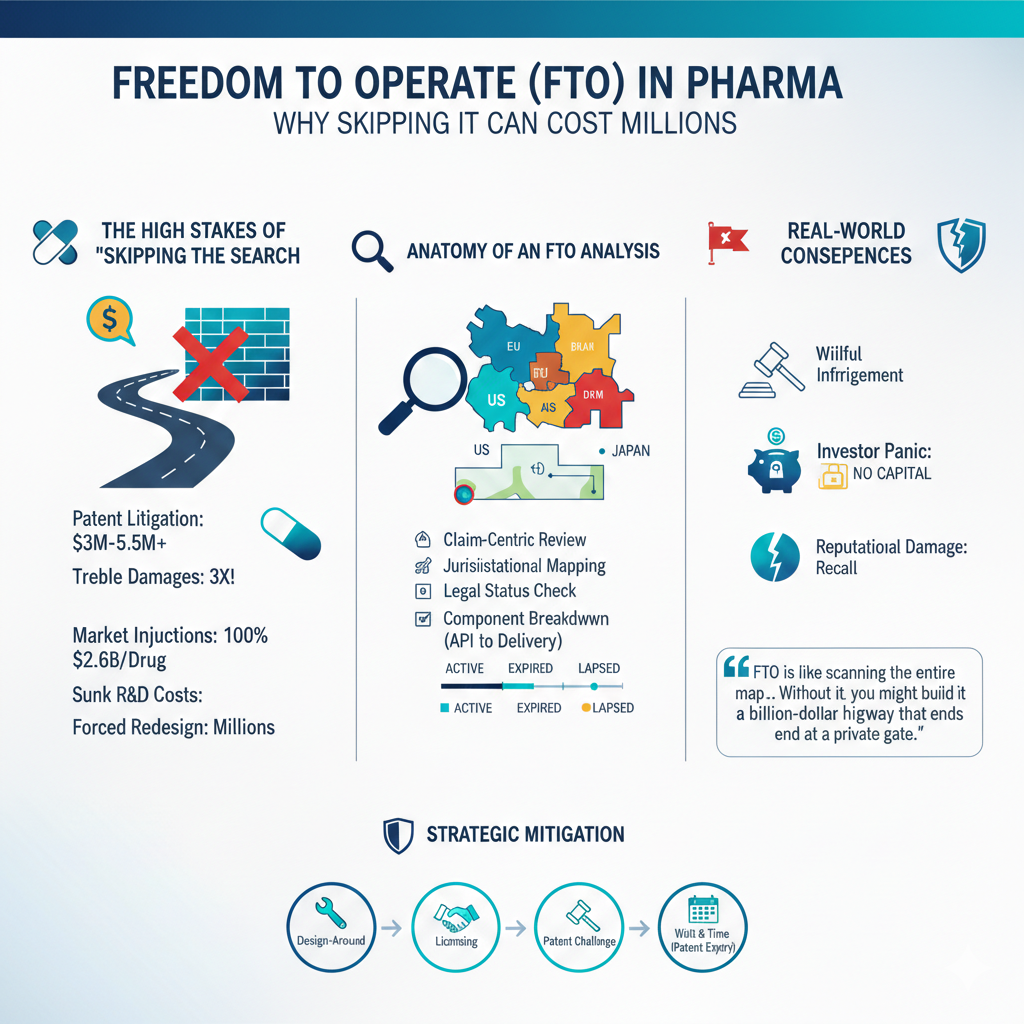
Real Risks of Skipping FTO in Pharma
❌ Product Launch Delays
Unexpected IP barriers can delay regulatory filings or commercialization by years.
❌ Costly Litigation & Settlements
Patent infringement cases in pharma can run into millions of dollars in legal costs and damages.
❌ Forced Product Redesign
Changing formulation or process late in development can mean restarting trials or stability studies.
❌ Lost Investor Confidence
Investors and partners increasingly demand FTO clearance before funding or licensing deals.
How Smart Pharma Teams Integrate FTO into R&D
✔ Conduct market-specific FTO (US, EU, India, etc.)
✔ Combine patent search + legal opinion + technical mapping
✔ Update FTO as patents expire, are abandoned, or newly filed
✔ Align IP teams with R&D and regulatory functions
FTO works best when it is part of decision-making, not a last-minute compliance check.
Key Takeaway
Freedom to Operate is not a legal formality.
It’s a business risk management tool that protects your time, money, and market access.
Skipping FTO may save money today
but it can cost you your entire product tomorrow.