
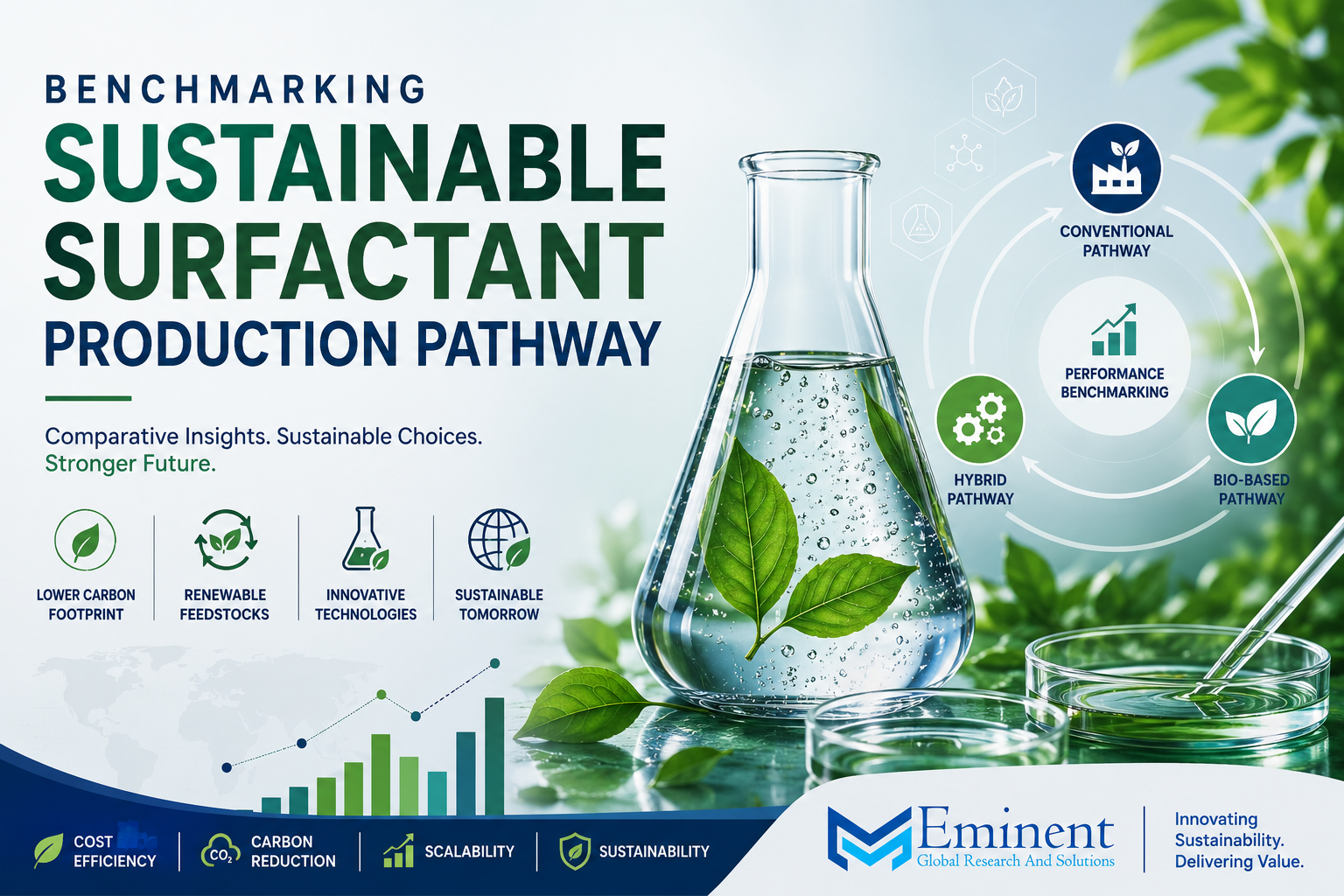
Benchmarking Sustainable Surfactant Production Pathway
As global chemical manufacturers increasingly align with Environmental, Social, and Governance (ESG) initiatives, sustainable surfactant production has emerged as a strategic priority. Conventional petrochemical surfactants continue to dominate the market due to mature infrastructure and lower initial costs; however, increasing environmental regulations, carbon reduction targets, and renewable feedstock innovations are reshaping the industry landscape.
Eminent Global conducted a benchmarking analysis to evaluate sustainable surfactant production pathways against traditional manufacturing models. The objective was to identify pathways capable of balancing cost efficiency, scalability, environmental performance, and long‑term commercial viability.
The study indicates that hybrid and bio-based production models can significantly reduce lifecycle emissions while creating stronger resilience against raw material volatility.
Client Scenario
A multinational specialty chemical manufacturer sought strategic guidance for transitioning portions of its surfactant portfolio toward sustainable alternatives.
The organization faced multiple challenges:
- Heavy dependence on petrochemical feedstocks
- Growing pressure from sustainability regulations
- Increasing customer demand for green ingredients
- Supply chain cost fluctuations
- Limited visibility into emerging production technologies
Leadership required a data-driven framework to determine the most viable transition pathway.
Business Objectives
The project established five key objectives:
- Benchmark conventional versus sustainable pathways
- Quantify environmental impact reduction potential
- Compare production economics
- Assess commercialization readiness
- Develop phased implementation recommendations
Benchmark Findings
1. Cost Competitiveness
Traditional systems maintained lower short-term manufacturing cost advantages. However, hybrid and bio-based systems demonstrated stronger long-term cost resilience due to reduced exposure to petroleum price volatility.
Business Impact: Organizations adopting diversified feedstock strategies improved cost predictability and operational flexibility.
2. Carbon Emission Benchmarking
Lifecycle analysis revealed meaningful reductions in greenhouse gas emissions through renewable feedstock integration.
Observed Outcomes:
- Hybrid systems reduced emissions by approximately 25–35%
- Bio-based pathways achieved reductions exceeding 50%
- Carbon intensity improvements supported ESG reporting objectives
Business Impact: Reduced emissions strengthened sustainability positioning and enhanced regulatory preparedness.
3. Feedstock Diversification Analysis
Petroleum dependency created procurement risk and exposure to global market volatility.
Alternative feedstock options included:
- Plant oils
- Agricultural residue
- Waste biomass
- Fermentation-derived materials
Business Impact: Feedstock diversification improved supply chain resilience and supported circular economy initiatives.
4. Commercial Adoption Outlook
Industry adoption analysis showed accelerated movement toward sustainable surfactants due to:
- Corporate net-zero initiatives
- Consumer preference shifts
- Global regulatory pressure
- Advances in biotechnology
Business Impact: Organizations implementing phased transitions gained competitive differentiation.
Results Summary
| KPI / Benchmark Metric | Conventional Petrochemical Model | Hybrid Production Model | Bio-Based Production Model | Business Impact |
|---|---|---|---|---|
| Relative Production Cost | Low initial cost | Moderate | Higher initial investment | Hybrid and bio-based pathways improve long-term cost resilience despite higher setup costs |
| Lifecycle Carbon Emissions | High | 25–35% lower | 50–55% lower | Supports ESG commitments and sustainability targets |
| Feedstock Sustainability | Low | Medium | High | Renewable sourcing reduces dependence on crude-based inputs |
| Supply Chain Stability | Medium | High | High | Diversified inputs reduce volatility and procurement risk |
| Regulatory Readiness | Medium | High | Very High | Better alignment with environmental regulations and future compliance requirements |
| Technology Maturity | Very High | High | Medium | Conventional methods remain mature, while bio-pathways continue scaling |
| Scalability Potential | High | High | Medium–High | Hybrid models provide easier transition paths for industrial deployment |
| ESG Alignment | Low | Medium | Very High | Improves sustainability reporting and brand positioning |
| Commercial Adoption Readiness | Mature | Growing | Rapidly Emerging | Sustainable solutions show increasing market demand |
| Long-Term Strategic Value | Medium | High | Very High | Sustainable pathways create stronger future competitiveness |
Strategic Recommendation
Phase 1: Short-Term Actions
- Introduce hybrid feedstock integration
- Develop sustainability performance metrics
- Build supplier diversification plans
Phase 2: Mid-Term Transformation
- Expand renewable sourcing networks
- Pilot bio-based production lines
- Create sustainability reporting dashboards
Phase 3: Long-Term Scale-Up
- Deploy circular manufacturing strategies
- Invest in biosurfactant innovation partnerships
- Scale commercial production capabilities
Conclusion
Benchmarking demonstrates that sustainable surfactant production pathways are no longer emerging concepts but viable business strategies. Organizations implementing structured transition programs can simultaneously improve environmental performance, reduce operational risk, and build long-term competitive advantage.
Eminent Global supports organizations through strategic benchmarking, commercialization planning, and international market expansion initiatives designed to accelerate sustainable industrial transformation.
Regulatory acceleration became a key commercialization advantage.
The company aligned its regulatory strategy with:
- FDA pathways in the United States
- MDR compliance in Europe
- GCC healthcare standards in the Middle East
- Digital health frameworks in APAC markets
Accelerated approval pathways and early regulatory engagement significantly reduced launch delays.
Get Full Case Study
Enter deatils to get full case study.