
Why the Future of Biotech May Depend on Repeatable Innovation, Not Just One Successful Drug
Biotechnology companies have traditionally been built around a promising therapeutic candidate, a novel biological target, or a scientific breakthrough with the potential to transform patient care. In this model, success depends heavily on advancing one or a small number of assets through preclinical research, clinical trials, regulatory approval, and commercialization.
However, a different business model is gaining strategic importance: platform biotechnology.
Instead of focusing exclusively on one drug candidate, platform biotech companies develop reusable technologies that can generate multiple therapeutic programs. These platforms may include messenger RNA (mRNA) technologies, gene editing systems, antibody discovery engines, protein engineering, drug delivery technologies, or artificial intelligence (AI)-enabled drug discovery.
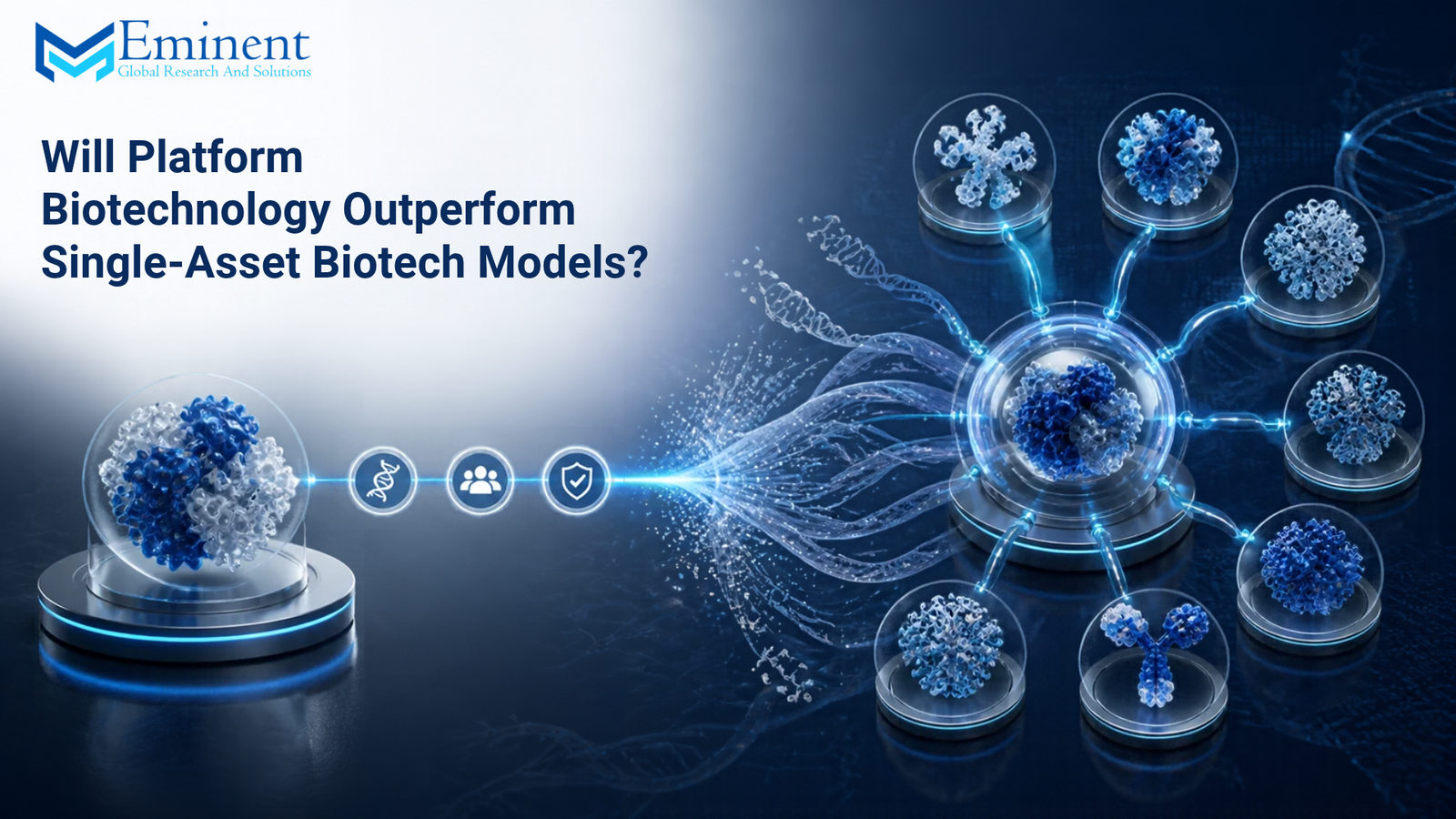
The distinction is significant. A single-asset company primarily seeks to create value by successfully developing a particular medicine. A platform company aims to build a repeatable engine for generating, developing, and potentially commercializing multiple medicines.
But does this make platform biotechnology the superior business model? Not necessarily. The answer depends on scientific validation, capital efficiency, intellectual property, development execution, and the company’s ability to translate technological potential into commercially valuable products.
1. Understanding the Two Business Models
The single-asset biotech model
Single-asset biotechnology companies concentrate resources on one lead therapeutic candidate or a narrow group of related programs. Their investment thesis is relatively straightforward: demonstrate clinical value, achieve meaningful development milestones, secure a licensing agreement, or bring the product to market.
This model offers several advantages. Capital allocation is focused, organizational structures can remain lean, and management can concentrate on the evidence required to advance a clearly defined program.
For investors, the value proposition can also be easier to evaluate. Clinical results, target validation, market size, competitive positioning, and regulatory milestones provide identifiable points at which the company’s prospects can be reassessed.
The weakness is concentration risk. A failed clinical trial, an unexpected safety signal, a change in the standard of care, or a regulatory setback can undermine much of the company’s valuation. If the lead asset fails, the company may have limited alternative sources of value.
The platform biotech model
Platform companies invest in a technology or scientific capability designed to support multiple therapeutic candidates.
For example, a validated molecular engineering platform might generate candidates for several diseases. An AI-enabled discovery system might identify and optimize molecules across multiple targets. A delivery technology could potentially enable different therapeutic payloads to reach specific tissues.
The strategic proposition is that investments in the underlying platform can create value across multiple programs.
A successful program may generate reusable experimental data, improve discovery methods, strengthen intellectual property, and inform subsequent development efforts. Platform companies may also license their technology to pharmaceutical partners, collaborate on research, or develop proprietary medicines.
Research published in the Proceedings of the National Academy of Sciences in 2025 examined how platform technologies can generate value across drug discovery, development, manufacturing, and commercialization—not simply through the success of an individual drug.
The central question, therefore, is whether a company can demonstrate that its platform repeatedly produces better development opportunities.
2. Why Platform Biotechnology Is Attracting Strategic Attention
A. Multiple opportunities for value creation
A single-asset company typically has one principal clinical and commercial opportunity. A platform company may develop several programs, creating multiple potential sources of licensing income, milestone payments, royalties, or product revenue.
This diversification can reduce dependence on any one candidate, provided that the programs are not exposed to the same underlying scientific or technical failure.
The distinction matters for investors and pharmaceutical companies evaluating future growth. A platform with demonstrated repeatability may offer a pipeline-generation capability rather than a single product opportunity.
B. Reusable knowledge and development capabilities
Biotechnology research involves substantial uncertainty. Platforms can potentially reduce repetitive work by applying established methods, validated processes, and accumulated data to subsequent programs.
Depending on the technology, this may improve candidate selection, shorten discovery cycles, support more consistent manufacturing, or help teams make development decisions earlier.
However, reusable infrastructure does not eliminate the biological uncertainty associated with each new therapeutic candidate. Evidence of operational repeatability must be distinguished from evidence of clinical success.
C. More flexible pharmaceutical partnerships
Platform companies can structure partnerships around individual candidates, therapeutic areas, geographic territories, or access to the underlying technology.
This creates options beyond independently funding every program through late-stage development.
A pharmaceutical company might license one candidate, obtain rights to a defined research area, or collaborate with a platform developer to generate additional candidates. Such arrangements can provide the biotech company with upfront payments, development milestones, royalties, and external validation.
The trade-off is that partnership economics may limit future control over intellectual property, development priorities, or commercial rights.
D. Potential resilience after an asset failure
A failed lead candidate can be devastating for a company whose scientific and financial value is concentrated in that program.
A platform company may have additional candidates, alternative indications, or the ability to redesign a molecule using its underlying technology.
Historical analysis by Recon Strategy, published in 2025, found that platform companies in its study demonstrated greater persistence after lead-asset failure than non-platform peers. However, the findings varied by platform type, and technological novelty did not automatically translate into superior lead-asset success.
This is an important distinction: platforms can provide additional opportunities, but they cannot guarantee that those opportunities will succeed.
3. The Hidden Risks Behind the Platform Premium
Platform biotechnology is not inherently less risky. It changes the structure of the risk.
Scientific risk can be correlated
Multiple programs may rely on the same biological assumption, delivery mechanism, computational model, or manufacturing process. If that shared foundation proves ineffective, several programs could fail together.
A portfolio of candidates is not genuinely diversified simply because it contains multiple drug names.
Platform development can consume substantial capital
Building a platform may require specialized scientific teams, computational infrastructure, laboratory systems, analytical capabilities, and manufacturing expertise before it produces a commercially meaningful asset.
A company can spend years improving its technology without establishing that the technology generates differentiated clinical candidates.
Investors should therefore assess capital efficiency and measurable development outputs—not just the number of programs in the pipeline.
Commercial value is not the same as technical performance
A platform can produce technically impressive molecules that fail to address a meaningful clinical need, struggle to compete with established therapies, or lack an attractive reimbursement pathway.
Commercial success still depends on patient outcomes, differentiation, market access, manufacturing economics, and competitive timing.
Intellectual property must protect the right assets
Platform companies need defensible intellectual property around the core technology, its implementation, and potentially the therapeutic candidates it generates.
Freedom to operate, patent scope, ownership of improvements, licensing restrictions, and the ability to protect subsequent discoveries can materially influence long-term value.
A platform that generates candidates but cannot secure commercially meaningful rights may struggle to capture the value it creates.
4. What Investors and Pharmaceutical Companies Should Measure
Evaluating platform biotechnology requires a broader framework than traditional asset-level valuation.
Key indicators include:
Platform reproducibility: Can the technology generate multiple differentiated candidates under comparable conditions?
Clinical translation: Do platform-generated candidates demonstrate acceptable safety and meaningful efficacy?
Development efficiency: Are discovery cycles, candidate-selection decisions, or manufacturing processes improving across programs?
Portfolio diversification: Do candidates differ sufficiently in biology, mechanism, indication, and technical risk?
Intellectual property strength: Does the company control defensible technology and commercially relevant rights?
Partnership traction: Are credible pharmaceutical partners willing to commit funding, milestones, or downstream economics?
Capital efficiency: How much capital is required to generate and advance each development opportunity?
Commercial scalability: Can the platform support products with viable manufacturing, market access, and competitive positioning?
These indicators help distinguish a genuinely repeatable technology from a company whose valuation relies primarily on future promises.
5. Will Platform Biotechnology Outperform Single-Asset Models?
The evidence supports a nuanced conclusion.
Platform models can offer broader opportunities for pipeline creation, partnership revenue, intellectual-property development, and resilience after individual program failures. They may be especially attractive when the underlying technology has demonstrated reproducibility across multiple therapeutic candidates.
Single-asset models, however, can remain highly effective when a company has a well-validated target, a differentiated clinical candidate, a clear regulatory pathway, and a capital-efficient route to a major development milestone.
In some circumstances, a focused single-asset company may deliver a more attractive risk-adjusted return than an early-stage platform with high infrastructure costs and limited clinical validation.
The likely competitive advantage will not belong exclusively to either model. Hybrid strategies may prove more effective: platform companies can prioritize selected proprietary assets while licensing others, and asset-focused companies can use reusable discovery or development capabilities without building an expansive technology organization.
The strategic priority is to match the business model to the maturity of the science, the capital available, the competitive landscape, and the route to commercialization.
6. Strategic Implications for the Biotechnology Industry
For biotechnology executives, the platform-versus-asset decision should begin with the commercial objective rather than the appeal of the technology.
Companies developing platform strategies should identify the applications where their technology offers a measurable advantage, establish evidence of repeatability, and determine which programs to advance internally versus license externally.
Investors should examine whether the platform generates independent value across programs or simply amplifies exposure to one underlying scientific risk.
Pharmaceutical companies should assess platform partnerships not only for the immediate candidate but also for the potential to strengthen their broader research pipeline, fill capability gaps, and access differentiated technologies.
Market intelligence and competitive intelligence can support these decisions by identifying emerging platforms, tracking competing intellectual-property positions, evaluating partnership activity, and mapping underexplored therapeutic opportunities.
Technology scouting can help organizations distinguish mature, commercially relevant platforms from early-stage technologies whose potential remains largely unproven.
Conclusion: The Winner Will Be the Model That Converts Science Into Repeatable Value
Platform biotechnology offers an important alternative to the traditional single-asset business model. Its appeal lies in the possibility of creating multiple development opportunities from a reusable scientific or technological foundation.
But a platform is not a competitive advantage simply because it can be applied to several programs. Its value must be demonstrated through repeatable performance, clinically meaningful outcomes, defensible intellectual property, capital discipline, and commercially viable products.
Single-asset biotechnology will continue to play an important role, particularly when a differentiated candidate has a clear path toward clinical and commercial validation.
Over the coming years, the most competitive biotech companies may be those that combine platform-level capabilities with asset-level accountability: investing in reusable innovation while making disciplined decisions about which products deserve capital.
For decision-makers, the critical question is not simply whether platform biotechnology will outperform single-asset models.
It is this: Which business model can consistently turn scientific innovation into differentiated medicines, sustainable value, and measurable commercial returns?
Eminent Global Research Solutions supports biotechnology and pharmaceutical stakeholders with market intelligence, competitive intelligence, technology scouting, patent intelligence, and commercialization strategy to evaluate emerging opportunities and make informed strategic decisions.
Post a Comment