

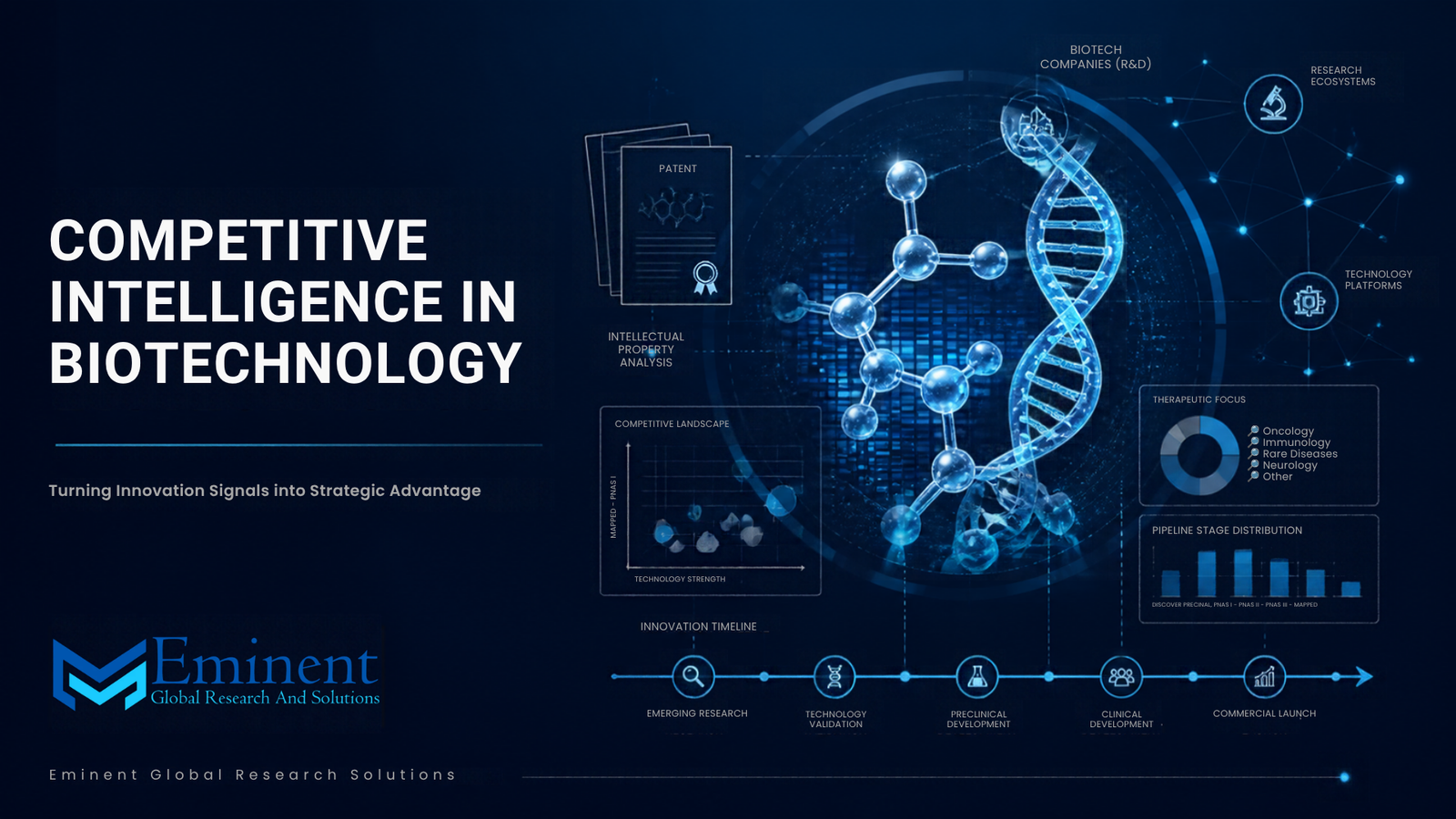
Competitive Intelligence in an Era of Rapid Biotech Innovation
Introduction
Biotechnology is evolving at an extraordinary pace. Advances in gene editing, cell and gene therapies, synthetic biology, AI-driven drug discovery, and next-generation biomanufacturing are reshaping the competitive landscape. Technologies that once remained confined to academic laboratories are increasingly progressing toward clinical development, strategic partnerships, and commercial applications.
For biotechnology companies, this creates both opportunity and uncertainty. A promising technology can attract significant investment, new competitors can emerge from unexpected areas, and intellectual property positions can change the strategic value of an entire research program.
In this environment, scientific innovation alone is not enough. Companies also need a clear understanding of the competitive landscape, emerging technologies, intellectual property activity, and market developments that influence the commercial potential of their innovations.
This is where competitive intelligence becomes a strategic capability rather than simply a research function.
Why Competitive Intelligence Matters More Than Ever
Traditional competitor monitoring often focuses on visible developments, such as product launches, funding announcements, clinical trial milestones, and acquisitions. While these indicators remain important, they provide only a partial view of the competitive environment.
In biotechnology, meaningful changes often begin well before a product reaches the market. A newly published patent application, a research collaboration, a shift in clinical trial design, or the emergence of a new technology platform may signal a future competitive threat or an opportunity for differentiation.
Competitive intelligence helps organizations connect these signals and interpret their strategic implications.
For example, a company developing a gene-editing platform may need to understand not only which competitors are advancing similar technologies, but also which delivery mechanisms are gaining attention, where patent activity is concentrated, which therapeutic applications are attracting investment, and which companies possess complementary capabilities.
The objective is not simply to know what competitors are doing. It is to understand what their activities could mean for the company’s own strategic position.
Five Areas Where Competitive Intelligence Creates Value
1. Emerging Technology and Innovation Monitoring
Biotechnology innovation increasingly occurs across interconnected disciplines. Artificial intelligence, computational biology, gene editing, advanced materials, and manufacturing technologies can converge to create entirely new development opportunities.
Monitoring these developments helps companies identify emerging technologies before they become established industry standards.
Technology intelligence can reveal:
Early-stage platforms gaining scientific or commercial momentum.
New approaches to drug discovery, delivery, and manufacturing.
Research institutions producing commercially relevant breakthroughs.
Potential technology partners or licensing opportunities.
Unexplored applications for existing scientific capabilities.
For R&D leaders, these insights can inform technology scouting, research prioritization, and decisions about whether to develop, license, partner, or acquire a capability.
2. Intellectual Property and Patent Intelligence
Intellectual property is a central strategic asset in biotechnology. Patent filings can provide valuable information about competitors’ research directions, technological priorities, and potential areas of future commercial activity.
However, patent counts alone rarely provide sufficient insight. A meaningful assessment should examine patent claims, ownership, filing jurisdictions, legal status, technology coverage, and relationships between patent families.
Patent landscape analysis can help organizations identify crowded technology areas, potential white spaces, emerging competitors, and opportunities for collaboration or differentiation.
For example, a biotechnology company exploring a new delivery platform may discover that several competitors are concentrating on similar delivery mechanisms while alternative approaches remain comparatively underexplored.
Such findings can inform further research, subject to technical validation and appropriate freedom-to-operate analysis.
It is important to distinguish patent intelligence from legal advice. Competitive intelligence can help identify relevant IP signals, but qualified patent counsel should assess infringement risks, claim interpretation, and freedom to operate.
3. Clinical and Pipeline Benchmarking
For drug developers, competitor pipelines provide critical signals about the direction of therapeutic innovation.
Tracking clinical-stage assets, trial designs, target selection, development timelines, safety findings, and regulatory milestones can help companies assess how their programs compare with competing approaches.
Pipeline benchmarking can reveal whether a therapeutic area is becoming crowded, whether competitors are pursuing different patient populations, and where unmet medical needs may remain insufficiently addressed.
It can also support more informed decisions about development priorities and evidence-generation strategies.
Importantly, clinical milestones should be interpreted in context. A larger pipeline or a higher number of trials does not automatically indicate superior scientific quality or a stronger commercial position.
4. Strategic Partnerships and Competitive Positioning
Biotechnology companies frequently depend on external capabilities to advance their research. Licensing agreements, research collaborations, technology partnerships, and acquisitions can provide access to expertise, intellectual property, manufacturing infrastructure, or commercialization resources.
Competitive intelligence helps organizations identify companies that possess strategically relevant capabilities and understand how partnership activity is changing the market.
By examining collaboration patterns, investment flows, technology portfolios, and geographic expansion, companies can identify potential partners and recognize where competitors may be strengthening their positions.
This is particularly valuable for smaller biotechnology firms that need to prioritize limited resources and establish partnerships that accelerate development without unnecessarily diluting their strategic advantage.
5. Market Opportunity and Commercialization Strategy
Scientific differentiation does not always translate into commercial success.
A technology may demonstrate strong technical performance but encounter manufacturing constraints, reimbursement challenges, regulatory uncertainty, limited market access, or insufficient demand.
Competitive intelligence connects scientific and technological developments with commercial realities.
This includes evaluating competing treatment approaches, potential customer needs, market access conditions, manufacturing capacity, pricing dynamics, and the commercial strategies of established and emerging players.
For biotechnology executives, these insights help answer a fundamental question: does the opportunity justify the investment required to develop and commercialize it?
From Data Collection to Strategic Decisions
One of the biggest challenges in competitive intelligence is the volume and fragmentation of available information.
Scientific publications, patent databases, clinical trial registries, regulatory announcements, company disclosures, conference presentations, funding activity, and partnership announcements each reveal different aspects of the market.
Collecting information from these sources is only the starting point. The real value emerges when evidence is validated, connected, and translated into actionable intelligence.
An effective competitive intelligence process typically involves four stages:
Stage 1: Define the strategic question. Identify the decision the organization needs to make, whether it concerns technology investment, pipeline prioritization, market entry, partnership selection, or IP strategy.
Stage 2: Gather and validate evidence. Integrate relevant scientific, patent, clinical, regulatory, financial, and commercial information from credible sources.
Stage 3: Interpret competitive signals. Assess competitor capabilities, technology trajectories, emerging threats, market gaps, and plausible future scenarios.
Stage 4: Translate insights into action. Provide recommendations that inform R&D roadmaps, investment decisions, partnership strategies, and commercialization planning.
Artificial intelligence can help accelerate information extraction, document screening, classification, and signal detection. However, AI-generated findings still require source verification, expert interpretation, and appropriate safeguards against incomplete or misleading conclusions.
Common Mistakes Companies Should Avoid
Despite its strategic importance, competitive intelligence can lose value when it is treated as a reporting exercise rather than a decision-support capability.
Common mistakes include:
Monitoring competitors without defining the decisions the research should support.
Relying exclusively on public announcements instead of examining underlying scientific and IP evidence.
Treating early-stage research findings as proof of commercial viability.
Confusing patent filing volume with patent quality or enforceable market protection.
Ignoring manufacturing, regulatory, reimbursement, and market-access constraints.
Producing reports that describe developments without explaining their implications.
A stronger approach connects each research activity to a defined business question and distinguishes verified facts from interpretations, assumptions, and uncertainties.
Building a Forward-Looking Competitive Intelligence Capability
Biotechnology companies should consider integrating competitive intelligence into their R&D, IP, business development, and commercial planning processes.
This does not necessarily require a large dedicated team. A focused intelligence program can begin with a clearly defined technology area, a prioritized competitor set, agreed monitoring indicators, and a regular process for reviewing strategic implications.
Over time, organizations can develop structured technology landscapes, competitor profiles, patent maps, pipeline benchmarks, partnership assessments, and early-warning indicators.
The most effective programs also establish clear governance: who receives the intelligence, which decisions it informs, how frequently findings are reviewed, and how the organization measures whether the resulting decisions improve.
Success should not be measured only by the volume of information collected or reports produced. More meaningful measures include earlier identification of relevant opportunities, better-informed R&D prioritization, stronger partner selection, reduced strategic blind spots, and improved commercialization planning.
Conclusion
As biotechnology innovation accelerates, the competitive landscape is becoming more interconnected and difficult to interpret. Companies must evaluate not only what competitors have developed, but also which technologies are gaining momentum, where intellectual property is accumulating, how clinical strategies are evolving, and what conditions will determine commercial success.
Competitive intelligence provides a structured way to make sense of these developments.
When integrated with technology scouting, patent intelligence, market research, and commercialization strategy, it helps biotechnology organizations identify opportunities earlier, evaluate risks more systematically, and allocate resources with greater confidence.
The competitive advantage will not necessarily belong to the company that generates the most data or announces the most innovations. It may belong to the company that interprets the available evidence most effectively and turns that understanding into timely strategic action.
For biotechnology leaders, competitive intelligence is no longer simply about keeping up with competitors. It is about making better decisions before the competitive landscape changes.
Post a Comment