

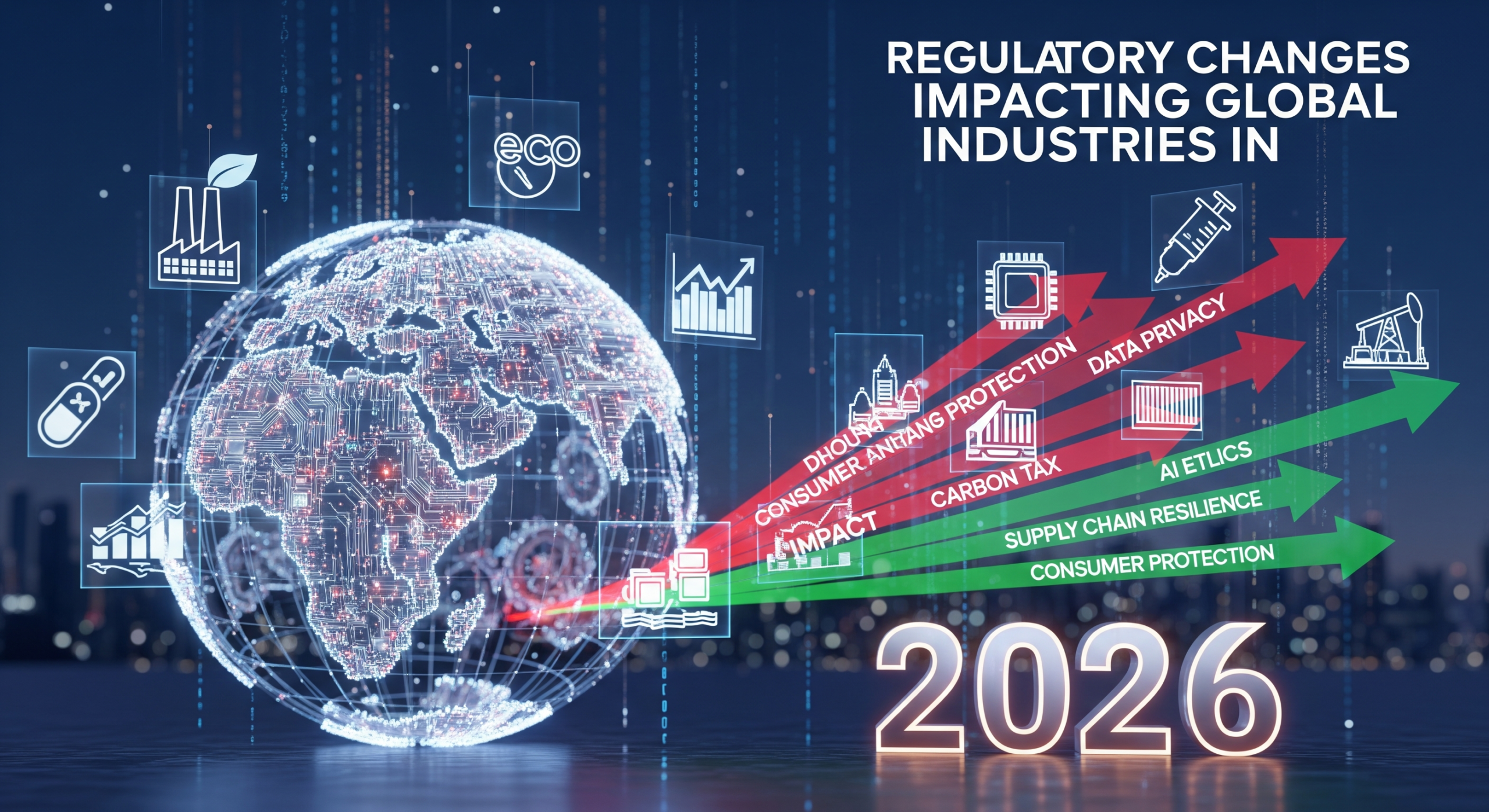
Introduction — Regulation as a Growth Shaper
As industries grapple with rapid technological change, evolving consumer expectations, and climate imperatives, regulation has moved to the forefront of strategic planning. In 2026, regulatory shifts are not just compliance checkboxes — they are catalysts for transformation, deciding where capital flows, how companies compete, and what markets grow fastest.
From data privacy to decarbonization mandates, understanding the regulatory terrain is now essential for leaders across sectors.
1. Climate & ESG Regulation: From Voluntary to Mandatory
Environmental, Social, and Governance (ESG) reporting is transitioning from optional disclosure to binding regulation in multiple jurisdictions. Key trends include:
Mandatory climate risk reporting aligned with global frameworks.
Carbon pricing and emissions caps for heavy emitters.
Supply chain environmental accountability, requiring upstream emissions transparency.
These rules are reshaping strategies in energy, manufacturing, transportation, and finance — pushing firms to embed sustainability into operations rather than treat it as marketing.
Impact Across Industries:
Energy companies must align generation portfolios with carbon caps.
Manufacturers invest in cleaner processes to avoid penalties.
Financial firms adjust risk models for climate exposure.
2. Data Privacy & Digital Regulation: Stricter Controls and Accountability
Data has become a strategic asset — but governments are tightening the rules around its use.
Key Regulatory Developments
Expansion of comprehensive data privacy laws beyond Europe’s GDPR model.
New rules for AI transparency and algorithmic accountability.
Cross-border data flow regulations impacting global supply chains.
Industries from healthcare to fintech are now required to demonstrate governance over personal and operational data, with hefty fines and litigation risks for non-compliance.
Examples of Impact:
Tech platforms must disclose AI decision logic in certain jurisdictions.
Healthcare providers face stricter patient data protection standards.
Financial services must navigate diverse cross-border data regimes.
3. Financial Regulation & Capital Markets Reform
In 2026, financial regulation is evolving to balance innovation with systemic risk control:
Crypto assets and digital finance frameworks are being formalized across jurisdictions.
Stricter AML/KYC standards rollout for fintech and digital banking.
Capital adequacy and risk disclosure updates for banks and asset managers.
These reforms affect global capital flows and investor confidence, requiring strategic compliance planning and technology enhancements.
Impact Across Sectors:
Fintech startups need robust compliance tech from day one.
Traditional banks reevaluate risk frameworks for digital assets.
Investors adjust portfolios based on regulatory clarity.
4. Trade & Supply Chain Regulation
With geopolitical shifts and rising trade nationalism, export controls and supply chain regulations are tightening:
Strategic technology export restrictions targeting semiconductors and AI components.
Localized content requirements affecting global sourcing.
Border carbon adjustments to tax emissions from imported goods.
Industries from automotive to electronics are redesigning supply chains to comply with new trade rules and avoid disruptions.
5. Workforce & Labor Regulation in a Hybrid Era
Workforce regulations are being updated to reflect the new world of hybrid work, AI automation, and global talent mobility:
Worker classification and gig economy protections expanding.
AI in hiring and HR systems subject to bias and transparency rules.
Remote work taxation and social security rules evolving.
Employers are adapting HR policies, compensation structures, and talent acquisition strategies to these shifting norms.
6. Sector Spotlight — Energy & Environmental Policy
Energy transition policies are accelerating regulatory change with direct impact on operations and investment:
Renewable portfolio standards tightening across markets.
Grid modernization mandates requiring advanced energy infrastructure.
Carbon border adjustment mechanisms (CBAM) affecting global trade.
These regulations are reshaping cost structures, capital budgets, and competitive positioning in utilities, resources, and heavy industries.
7. Emerging Tech Regulation — AI, Robotics & IoT
Emerging technologies are now squarely in regulatory crosshairs:
AI safety and ethics frameworks being mandated in tech hubs.
Autonomy standards for robotics and connected vehicles.
Security and interoperability rules for IoT ecosystems.
Companies leading in innovation must balance speed with governance to meet compliance without slowing growth.
8. Consumer Protection & Product Safety Reform
Consumer expectations and digital commerce growth are prompting regulators to tighten protections:
Enhanced e-commerce transparency rules.
Product sustainability labeling requirements.
Stronger recall and liability frameworks.
These changes affect retailers, CPG makers, and platform businesses — forcing more investment in compliance infrastructure.
9. Healthcare & Pharmaceuticals — Regulatory Complexity Intensifies
Healthcare regulation is expanding in response to digital health, pricing pressure, and patient safety priorities:
AI in diagnostics and treatment planning subject to oversight.
Drug approval pathways streamlined yet more rigorous.
Data sharing rules in medical research balancing privacy and innovation.
Providers and life sciences firms are investing in regulatory expertise and digital compliance systems.
Conclusion — Regulatory Change as Strategic Imperative
In 2026, regulation is an active component of strategic planning — not an afterthought. From climate policy to digital governance, companies must build proactive compliance, integrated risk management, and regulatory intelligence into their business models.
The result? Organizations that understand regulatory direction can turn compliance into a competitive advantage, accelerate innovation responsibly, and unlock new markets with confidence.