

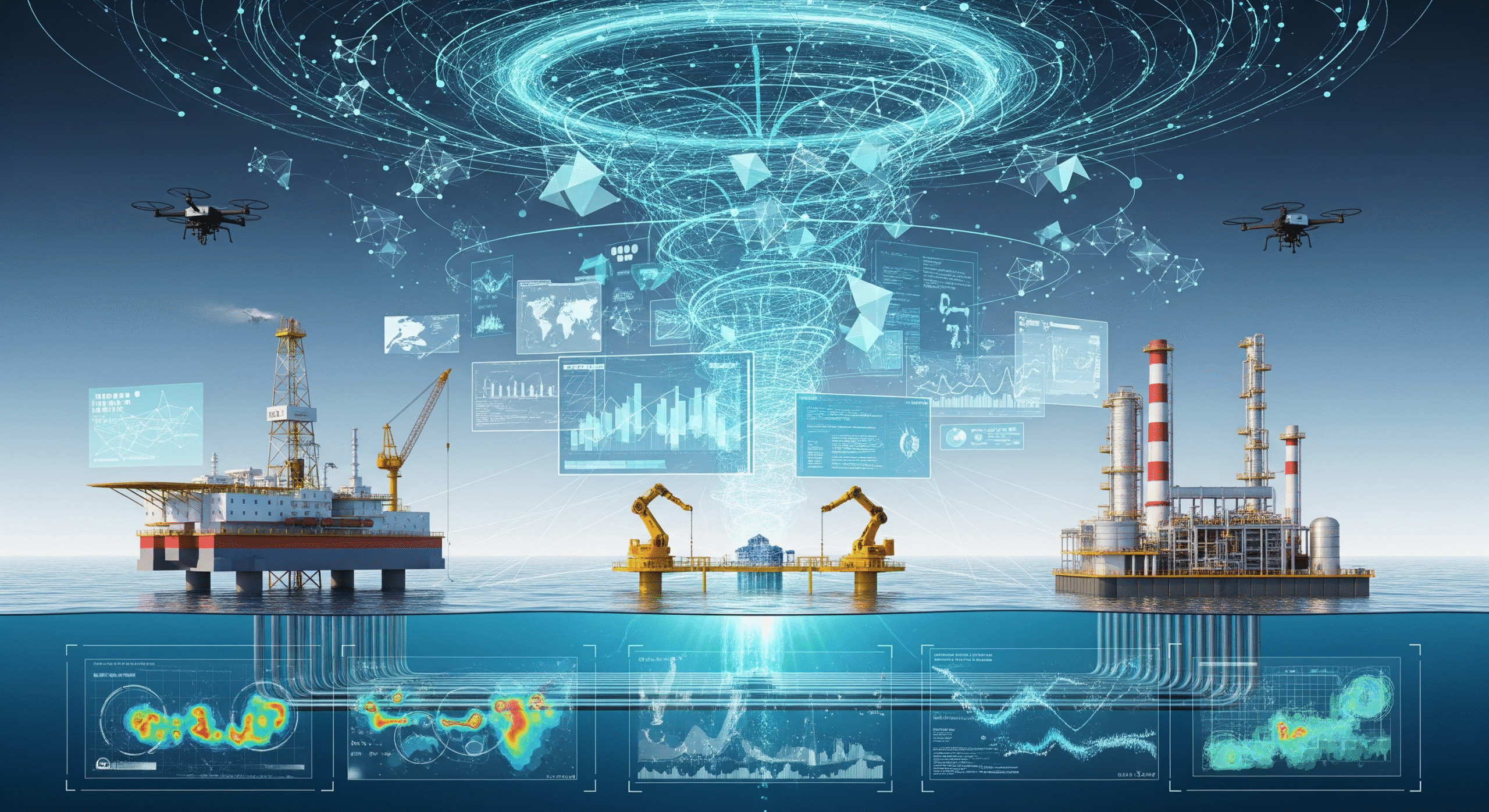
How Digital Transformation is Reshaping the Oil & Gas Sector (2025 Edition)
Introduction
The oil & gas industry is experiencing one of the most significant transformations in its history. As global demand patterns shift, operational costs rise, and environmental pressures intensify, companies are turning to digital technologies to optimize operations, reduce risks, and improve profitability. From upstream exploration to downstream refining, digital transformation is no longer optional—it is a critical enabler of competitiveness.
1. The Drivers Behind Digital Transformation in Oil & Gas
Digital adoption is accelerating due to several converging forces:
✔ Volatile crude prices
Sudden price fluctuations require companies to operate with higher efficiency and leaner budgets.
✔ Increasing operational complexity
Deepwater drilling, aging pipelines, and remote operations demand advanced monitoring solutions.
✔ Sustainability pressure & ESG mandates
Regulators and investors expect transparent carbon tracking, lower emissions, and cleaner operations.
✔ Workforce shortages
Automation and AI fill the gaps created by skill shortages and retiring technical experts.
2. Core Digital Technologies Transforming the Industry
🔹 1. Internet of Things (IoT) & Smart Sensors
Real-time monitoring of pipelines, drilling rigs, and refinery equipment helps:
Predict equipment failures
Reduce downtime
Prevent safety hazards
Optimize flow rates
Example: Smart sensors reduce pipeline monitoring costs by up to 40%.
🔹 2. Artificial Intelligence (AI) & Machine Learning
AI brings data-driven precision to complex operations:
Predictive maintenance
Reservoir modeling
Seismic interpretation
Production optimization
Benefit: Faster decision-making and reduced costly exploration errors.
🔹 3. Digital Twins
A digital twin is a virtual replica of a physical asset (rig, refinery, pipeline). It enables:
Remote monitoring
Simulation of operational scenarios
Risk modeling
Maintenance planning
Companies report up to 20–30% cost savings on maintenance using digital twins.
🔹 4. Automation & Robotics
Robotics and autonomous systems perform dangerous or repetitive tasks:
Drone inspections
Automated drilling systems
Robotic pipeline maintenance
This reduces human exposure to hazardous environments and boosts operational efficiency.
🔹 5. Cloud Computing & Big Data
Oil & gas companies generate massive volumes of data. Cloud platforms help:
Centralize fragmented data
Enable remote collaboration
Improve data security
Support scalable analytics
🔹 6. Blockchain for Supply Chain Integrity
Blockchain helps companies:
Track products across the supply chain
Validate supplier authenticity
Prevent invoice fraud
Improve transparency
3. Impact of Digital Transformation Across the Value Chain
🔸 Upstream (Exploration & Production)
AI-powered seismic analysis
Real-time drilling optimization
IoT-enabled rig performance monitoring
Result: Faster and safer exploration decisions.
🔸 Midstream (Transportation & Storage)
Smart pipelines with leak detection
Automated flow management
Advanced route optimization
Result: Reduced energy loss and enhanced safety.
🔸 Downstream (Refining & Distribution)
Digital twin refineries
Automated quality checks
AI-based demand forecasting
Result: Higher refining margins and better product planning.
4. Benefits of Digital Transformation for Oil & Gas Companies
✔ Reduced operational costs
Better maintenance planning and asset management lead to significant savings.
✔ Improved safety & risk management
Real-time monitoring minimizes accidents and hazardous exposures.
✔ Higher production efficiency
AI-driven optimization increases throughput and precision.
✔ Stronger ESG performance
Accurate emission tracking and energy efficiency enhance sustainability reporting.
✔ Faster decision-making
Digital dashboards and analytics shorten time-to-insight.
5. Challenges Slowing Down Digital Adoption
Despite its potential, the industry faces obstacles:
High upfront investment
Legacy infrastructure
Cybersecurity risks
Resistance to change among workforce
Integration issues across complex assets
Companies that invest in training, cybersecurity, and phased deployment see the fastest ROI.
6. The Future of Digital Transformation in Oil & Gas (2025–2030)
Key trends to watch:
AI-native rigs capable of fully autonomous drilling
Predictive ESG analytics for carbon footprint management
Fully automated refineries with robotics
AR/VR trainings for remote workers
Hydrogen & renewable integration supported by digital modeling
Digital-first companies will lead the next decade of energy transformation.
Conclusion
Digital transformation is reshaping the oil & gas industry at every level—from exploration to distribution. Companies that adopt AI, IoT, cloud, and automation early will enjoy greater efficiency, reduced costs, and stronger ESG performance. As the energy landscape becomes more competitive and environmentally conscious, digital innovation is the path to long-term sustainability.