

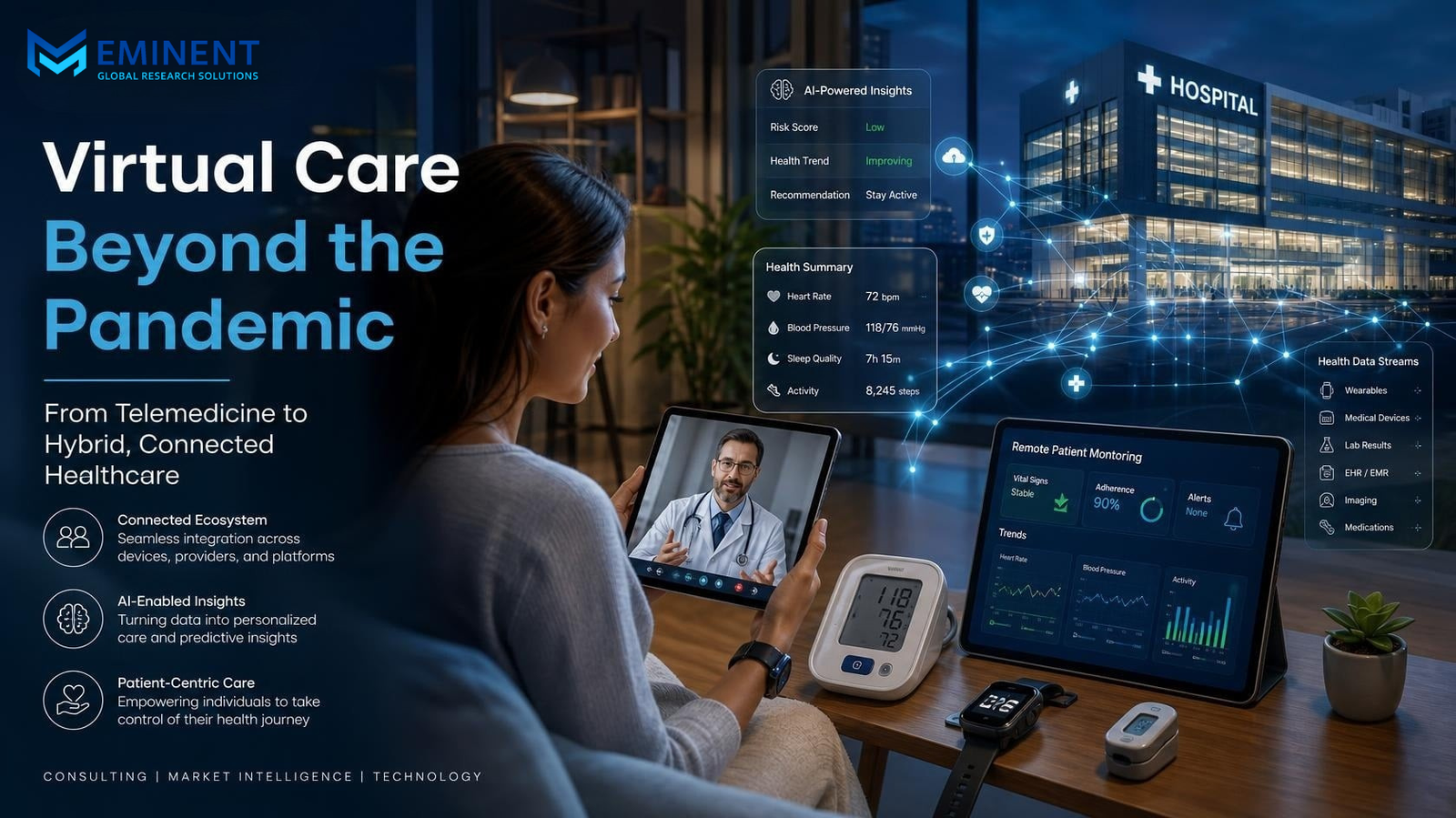
The COVID-19 pandemic fundamentally changed how healthcare is delivered. Within a matter of months, virtual consultations, remote monitoring, telemedicine platforms, and digital patient engagement tools moved from being optional innovations to essential components of healthcare delivery.
But as healthcare systems returned to more traditional operating models, an important question emerged: Will virtual care continue to expand beyond the pandemic, or was its rapid adoption primarily a temporary response to an extraordinary situation?
The evidence points toward a more permanent transformation.
Virtual care is increasingly becoming an integrated component of healthcare rather than a replacement for traditional clinical services. Healthcare providers, technology companies, pharmaceutical organizations, insurers, and patients are discovering that the most valuable model may not be completely virtual healthcare, but a hybrid care ecosystem that combines digital interactions with in-person clinical expertise.
For healthcare organizations, this creates a significant strategic opportunity—but also requires careful consideration of technology infrastructure, clinical workflows, patient engagement, cybersecurity, reimbursement, and regulatory requirements.
From Emergency Solution to Healthcare Infrastructure
During the pandemic, healthcare providers adopted telemedicine primarily to maintain continuity of care while limiting physical interactions.
This rapid deployment proved that many healthcare interactions did not necessarily require a physical visit.
Follow-up consultations, prescription management, mental health services, chronic disease monitoring, specialist consultations, and routine assessments could often be conducted remotely.
The experience changed expectations on both sides.
Patients became more comfortable accessing healthcare digitally, while providers gained experience managing clinical interactions through virtual platforms.
The result was a structural change in healthcare delivery.
Virtual care is now increasingly viewed as part of the healthcare infrastructure rather than simply a pandemic-era solution.
The Rise of Hybrid Healthcare
The future of virtual care is unlikely to be completely digital.
Instead, healthcare is moving toward hybrid models where digital and physical services complement one another.
A patient may initially interact with a healthcare provider through a virtual consultation, complete diagnostic testing at a physical facility, use a wearable device for continuous monitoring, and then return to a virtual consultation for follow-up.
This model can improve convenience while allowing healthcare providers to allocate physical resources more efficiently.
Hybrid care can be particularly valuable for chronic disease management.
Patients with conditions requiring regular monitoring may not need to visit a hospital every time they require clinical oversight. Remote monitoring technologies can collect relevant data while clinicians intervene when results indicate a potential problem.
This transforms healthcare from an episodic model into a more continuous care experience.
Chronic Disease Management Could Become a Major Growth Driver
One of the strongest long-term opportunities for virtual care lies in chronic disease management.
Conditions such as diabetes, cardiovascular disease, respiratory disorders, and hypertension require ongoing monitoring rather than occasional treatment.
Traditional healthcare systems often rely on periodic appointments to assess patient status. Virtual care enables healthcare providers to maintain more frequent interactions without requiring patients to repeatedly travel to medical facilities.
Connected devices can also support remote collection of:
- Blood pressure
- Glucose levels
- Heart rate
- Oxygen saturation
- Weight
- Activity levels
When combined with analytics and clinical decision-support systems, this information can help healthcare providers identify potential changes earlier.
The strategic value is therefore not simply convenience.
Virtual care has the potential to shift healthcare toward continuous monitoring, earlier intervention, and preventive management.
AI Could Accelerate the Next Phase of Virtual Care
Artificial intelligence is likely to become one of the most important technologies supporting the next generation of virtual healthcare.
AI can help healthcare organizations analyze large volumes of patient data, identify patterns, support clinical workflows, and improve patient engagement.
Virtual care platforms may increasingly incorporate AI capabilities such as:
- Automated clinical documentation
- Patient symptom assessment
- Risk prediction
- Personalized health recommendations
- Appointment optimization
- Remote patient monitoring alerts
- Clinical decision support
However, AI should not be viewed simply as a replacement for healthcare professionals.
The greatest opportunity may come from combining AI with human expertise.
By automating administrative and analytical tasks, healthcare professionals can potentially spend more time on complex clinical decisions and patient relationships.
For healthcare organizations, this creates a new strategic question: How can AI and virtual care be integrated into existing clinical workflows without compromising safety, trust, or quality of care?
Patient Expectations Are Changing
Consumer behavior is also influencing the evolution of virtual healthcare.
Patients increasingly expect healthcare to provide the same levels of convenience and digital accessibility they experience in other industries.
Online banking, e-commerce, food delivery, and digital customer service have normalized immediate and remote interactions.
Healthcare is gradually moving in the same direction.
Patients increasingly value:
- Convenient appointment access
- Shorter waiting times
- Digital communication
- Remote follow-ups
- Personalized health information
- Continuous monitoring
This creates an opportunity for healthcare organizations to differentiate themselves through patient experience.
However, convenience alone will not guarantee adoption.
Virtual care platforms must also demonstrate reliability, clinical value, privacy, and ease of use.
Reimbursement and Regulation Remain Critical
Despite the growth of virtual care, commercialization remains dependent on regulatory and reimbursement frameworks.
Healthcare providers need sustainable economic models for virtual services. If reimbursement structures do not adequately compensate providers for digital consultations and remote monitoring, adoption may remain limited despite strong patient demand.
Regulatory requirements also vary significantly across markets.
Organizations operating internationally must navigate different rules related to:
- Telemedicine licensing
- Patient data protection
- Cross-border consultations
- Medical device regulation
- AI governance
- Digital health platforms
Therefore, regulatory strategy must become an integral part of virtual care expansion.
Companies entering new markets should evaluate regulatory requirements alongside technology infrastructure and market demand rather than treating compliance as a later-stage consideration.
Virtual Care Creates New Opportunities for Healthcare Companies
The expansion of virtual healthcare is creating opportunities beyond hospitals and telemedicine providers.
Pharmaceutical companies can integrate digital support programs into patient journeys.
Medical device companies can connect products with remote monitoring platforms.
Insurers can use digital care models to improve member engagement and potentially reduce unnecessary healthcare utilization.
Technology companies can develop infrastructure for remote diagnostics, data analytics, cybersecurity, and patient engagement.
This creates a broader healthcare ecosystem where technology and clinical services increasingly intersect.
For businesses, the opportunity lies in identifying where digital capabilities can solve specific healthcare delivery challenges rather than simply adding technology for its own sake.
The Consulting Opportunity
For healthcare leaders, the key question is no longer whether virtual care will exist after the pandemic.
It is where virtual care creates measurable strategic and economic value.
Organizations evaluating virtual healthcare should consider:
- Patient Segmentation — Which patient populations benefit most from virtual services?
- Clinical Workflow — How can digital care integrate with existing healthcare delivery?
- Technology Infrastructure — Can existing systems support secure, scalable digital interactions?
- Regulatory Strategy — What market-specific requirements must be addressed?
- Reimbursement — Can virtual services generate sustainable economics?
- Patient Engagement — Will patients consistently use the platform?
- Data & Analytics — Can patient data generate actionable clinical insights?
The strongest virtual care strategies will be those that connect technology adoption with measurable clinical and commercial outcomes.
The Future of Virtual Care
Virtual care is unlikely to replace traditional healthcare.
Instead, it is becoming an important layer within a broader healthcare ecosystem.
The next stage of development will likely focus on hybrid care, remote monitoring, AI-assisted healthcare, personalized patient engagement, and continuous disease management.
The pandemic accelerated the adoption of virtual care. The next phase will determine whether healthcare organizations can transform that adoption into sustainable, scalable, and clinically meaningful models.
For healthcare providers, pharmaceutical companies, medical device manufacturers, insurers, and digital health companies, the opportunity is significant.
Virtual care is no longer simply a pandemic legacy. It is becoming part of the future architecture of healthcare.