

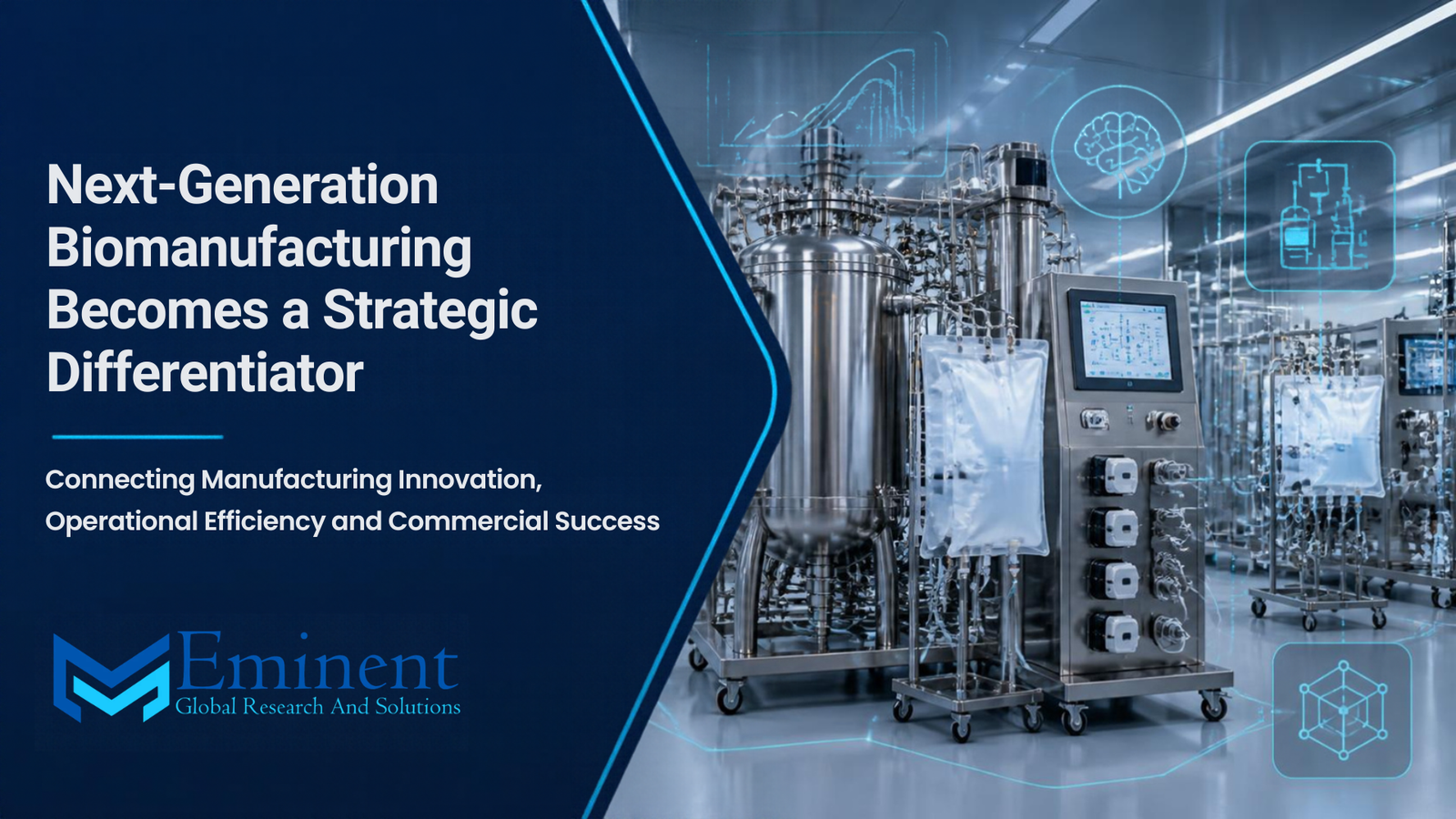
Next-Generation Biomanufacturing Becomes a Strategic Differentiator
Introduction: Manufacturing Is Becoming a Competitive Advantage
Biopharmaceutical innovation is advancing rapidly, driven by progress in monoclonal antibodies, cell and gene therapies, recombinant proteins, RNA-based medicines, and other advanced therapeutic modalities. However, scientific breakthroughs alone do not guarantee commercial success. The ability to manufacture complex biological products consistently, at the required scale, and within commercially viable cost structures is becoming an equally important determinant of competitiveness.
For many years, biomanufacturing was primarily viewed as an operational function responsible for translating research into commercial production. Today, that perspective is changing. Manufacturing capabilities increasingly influence development timelines, product availability, regulatory compliance, capital allocation, and market access.
Next-generation biomanufacturing is therefore emerging as a strategic differentiator. Companies that integrate manufacturing innovation into their research and development strategies may be better positioned to accelerate commercialization, improve supply resilience, and establish defensible competitive advantages.
1. Why Traditional Manufacturing Models Are Under Pressure
Conventional biomanufacturing models often depend on capital-intensive facilities, complex production processes, specialized equipment, and extensive quality-control requirements. Although these systems have supported the growth of biologics, they can present significant challenges when companies introduce newer therapeutic modalities.
Cell and gene therapies, for example, can require highly specialized production processes, sophisticated analytical methods, strict chain-of-identity controls, and carefully managed logistics. Personalized therapies may also involve smaller production volumes and greater variability between individual batches.
At the same time, established biologics manufacturers face pressure to improve productivity, manage operating costs, reduce production bottlenecks, and maintain consistent product quality.
These challenges are encouraging manufacturers to reconsider facility design, production workflows, automation, digital infrastructure, and process development.
The strategic question is no longer simply whether a company has sufficient manufacturing capacity. It is whether that capacity can support its product portfolio, adapt to changing demand, and deliver reliable commercial performance.
2. The Technologies Reshaping Biomanufacturing
Several technological developments are changing how biopharmaceutical products are developed and manufactured.
Single-use technologies and flexible facilities
Single-use bioreactors, disposable fluid-management systems, and modular production environments can reduce certain cleaning and changeover requirements. They may also support flexible production configurations for companies manufacturing multiple products or operating at different scales.
However, their suitability depends on product characteristics, production volumes, supply-chain reliability, material compatibility, and total cost of ownership.
Continuous and intensified bioprocessing
Traditional biologics production often relies on batch or fed-batch processes. Continuous and intensified approaches can improve equipment utilization, increase productivity per unit of facility space, and potentially reduce manufacturing footprints.
Successful implementation requires careful process design, robust monitoring, appropriate control strategies, and regulatory alignment. The commercial benefit depends on the product and process rather than the technology alone.
Automation and advanced process control
Automated systems can reduce manual interventions, improve process consistency, and support more efficient execution of manufacturing procedures. Advanced sensors and process analytical technologies can provide better visibility into critical process parameters and quality attributes.
These capabilities are particularly important when manufacturers must manage complex processes with narrow operating windows.
Artificial intelligence and digital biomanufacturing
AI and machine learning can support process development, anomaly detection, predictive maintenance, process optimization, and analysis of complex manufacturing data.
Digital twins and advanced process models may help teams evaluate production scenarios and understand how changes in operating conditions affect performance.
Nevertheless, AI adoption requires reliable data, appropriate model validation, cybersecurity, and clear governance. In regulated environments, digital tools must support—not undermine—documented process control and quality oversight.
Advanced manufacturing for cell and gene therapies
Cell and gene therapy manufacturing presents distinctive challenges, including limited production capacity, variable biological starting materials, complex analytical requirements, and high costs.
Emerging approaches such as closed processing systems, automated cell processing, improved vector production, and more efficient analytical workflows aim to address these constraints.
For developers, the objective is to create manufacturing processes that are reproducible, scalable where appropriate, and economically sustainable.
3. Manufacturing Can Influence Commercialization Timelines
Manufacturing decisions made early in development can have consequences long after a candidate advances into clinical testing.
A process that performs well at laboratory scale may behave differently in larger equipment or under commercial production conditions. Changes in raw materials, equipment, production scale, or process parameters may require additional comparability assessments and supporting evidence.
Late-stage manufacturing changes can therefore introduce technical uncertainty, consume capital, and potentially delay regulatory submissions or product launches.
A more integrated approach connects process development, analytical development, quality assurance, regulatory strategy, and commercial planning from the beginning.
Companies can assess manufacturing feasibility alongside target product profiles, clinical development milestones, and market opportunities. This helps identify scale-up risks before they become expensive obstacles.
Manufacturing readiness should consequently be treated as a development and commercialization priority rather than a problem reserved for late-stage operations teams.
4. Cost Efficiency and Supply-Chain Resilience
Biomanufacturing economics extend beyond the cost of operating a production facility. They include raw materials, specialized labor, equipment utilization, batch failure, quality testing, logistics, inventory, and the cost of maintaining redundant capacity.
Next-generation manufacturing can improve these economics through better yields, shorter processing times, fewer deviations, improved facility utilization, and more predictable production planning.
Yet technology investment does not automatically produce lower costs. New equipment, software, facility modifications, workforce training, and validation can require substantial upfront investment.
A rigorous assessment should therefore compare the total cost of ownership of alternative manufacturing models, including implementation costs, utilization assumptions, supply risks, and expected product demand.
Supply-chain resilience is equally important. Dependence on a limited number of suppliers for critical raw materials, specialized components, or contract manufacturing services can expose companies to disruptions.
Flexible capacity, qualified alternative suppliers, strategic manufacturing partnerships, and improved production visibility can help reduce these vulnerabilities.
The strongest manufacturing strategy balances efficiency with reliability rather than optimizing one at the expense of the other.
5. Regulatory Compliance and Quality by Design
Innovation in manufacturing must operate within rigorous quality and regulatory frameworks.
Biopharmaceutical manufacturers need to demonstrate that their processes consistently produce products meeting predefined quality requirements. This includes appropriate process controls, validated analytical methods, reliable documentation, and effective management of deviations and changes.
Quality by Design provides a framework for developing products and processes through systematic understanding of critical quality attributes, critical process parameters, and sources of variability.
Advanced monitoring and automation can strengthen this approach when supported by scientifically justified controls and appropriate data integrity practices.
Manufacturers adopting novel technologies must also consider how their process design, control strategy, validation evidence, and quality systems will support regulatory review.
Regulatory requirements vary by product, jurisdiction, and manufacturing context. Early engagement between manufacturing, quality, and regulatory teams can help identify potential gaps before they affect development or launch plans.
6. The Strategic Role of CDMOs and Manufacturing Partnerships
Contract development and manufacturing organizations (CDMOs) play an important role in expanding access to specialized capabilities.
For emerging biotechnology companies, outsourcing can reduce the need for immediate investment in manufacturing infrastructure and provide access to experienced technical teams, established quality systems, and specialized equipment.
For larger pharmaceutical companies, external partners can provide additional capacity, access to new technologies, or geographic diversification.
However, outsourcing does not eliminate manufacturing risk. Companies must evaluate a partner’s technical capabilities, available capacity, quality performance, regulatory history, intellectual property protections, data systems, and ability to support future commercial demand.
The lowest-cost provider may not offer the best long-term value if it cannot support process transfer, technology upgrades, reliable supply, or increasing production volumes.
Strategic partnerships are most effective when manufacturing requirements, responsibilities, technology-transfer plans, and contingency arrangements are clearly defined.
7. A Strategic Framework for Biomanufacturing Investment
Organizations seeking to strengthen manufacturing competitiveness should evaluate five areas.
1. Technology readiness: Determine which technologies address a demonstrated process limitation and which remain experimental or unsuitable for the intended product.
2. Process and scale-up risk: Assess process robustness, variability, analytical readiness, technology transfer, and the potential consequences of late-stage changes.
3. Manufacturing economics: Compare capital requirements, operating costs, expected utilization, yield improvement, and cost per usable dose or batch.
4. Regulatory and quality readiness: Evaluate validation requirements, data integrity, change control, process monitoring, and product-specific regulatory expectations.
5. Strategic fit: Align manufacturing choices with the development pipeline, projected demand, geographic priorities, intellectual property strategy, and commercialization objectives.
Market intelligence, technology scouting, competitive benchmarking, and supplier landscape analysis can strengthen these decisions by revealing emerging capabilities, investment patterns, potential partners, and areas of technological differentiation.
Conclusion: Manufacturing Strategy Must Evolve With Innovation Strategy
Next-generation biomanufacturing is becoming more than an operational improvement agenda. It is a strategic capability that can influence whether biopharmaceutical innovation reaches patients efficiently, reliably, and at a sustainable cost.
Automation, flexible facilities, continuous processing, AI-enabled analytics, and advanced cell and gene therapy manufacturing offer important opportunities. Their value, however, depends on the specific product, process, regulatory environment, and commercial objective.
Companies that evaluate these technologies through an integrated lens—combining scientific feasibility, manufacturing economics, regulatory readiness, supply-chain resilience, and market demand—will be better equipped to make informed investment decisions.
For biopharmaceutical leaders, the priority is clear: manufacturing strategy should be developed alongside R&D and commercialization strategy, not after them.
How is your organization evaluating next-generation biomanufacturing as a source of competitive advantage?
Eminent Global Research Solutions supports strategic decision-making through market intelligence, technology scouting, competitive intelligence, IP intelligence, and commercialization-focused research.