

In-Vivo Gene Editing Emerges as a New Direction for Cell & Gene Therapy
Introduction: A Shift in the Gene Therapy Paradigm
Gene editing is entering a new phase in which researchers are increasingly exploring ways to modify genetic material directly inside a patient’s body. Known as in-vivo gene editing, this approach could change how certain genetic diseases are treated and potentially reshape the broader cell and gene therapy (CGT) landscape.
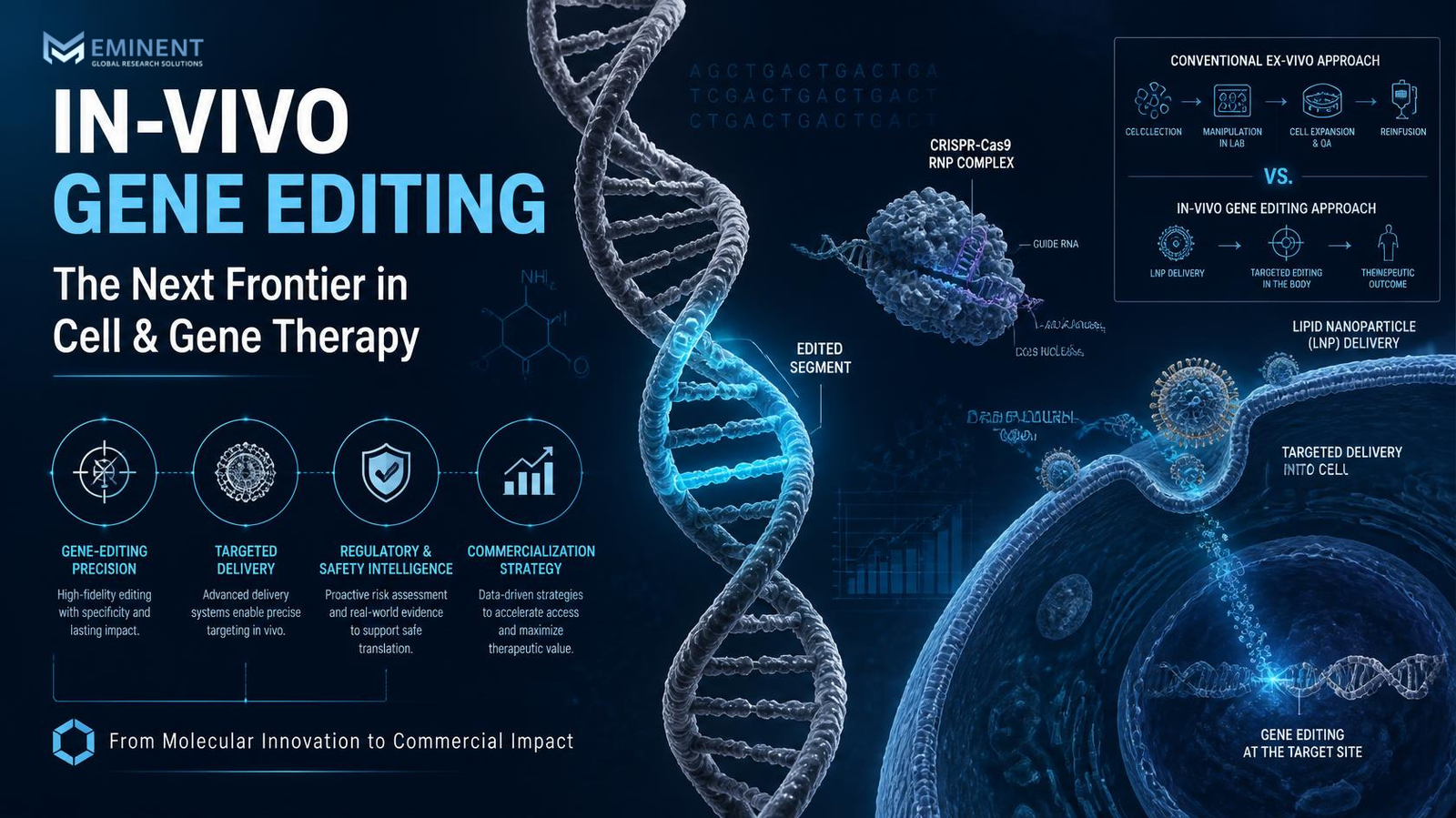
Traditional ex-vivo approaches generally involve collecting a patient’s cells, modifying them in a controlled laboratory environment, and returning the modified cells to the patient. While this strategy has delivered important advances, it can require complex manufacturing processes, specialized facilities, conditioning regimens, and intensive patient management.
In-vivo gene editing follows a different model. Instead of modifying cells outside the body, therapeutic editing machinery is delivered directly to target tissues or cells. If the treatment reaches the appropriate cells and edits the intended genetic sequence safely and effectively, it may address the underlying cause of certain diseases without requiring the same cell collection and manufacturing workflow.
The opportunity is significant, but the technology remains complex. Delivery efficiency, editing precision, immune responses, off-target effects, durability, manufacturing consistency, and long-term safety will determine which approaches ultimately become clinically and commercially viable.
For biotechnology companies, pharmaceutical developers, investors, and research organizations, the emerging opportunity extends beyond scientific innovation. It involves understanding where the technology is progressing, which delivery platforms are gaining traction, and what barriers could prevent promising candidates from reaching patients.
1. Understanding In-Vivo Gene Editing
In-vivo gene editing involves delivering molecular tools into a patient’s body to modify genetic material within selected cells. Depending on the therapeutic objective, researchers may seek to disrupt a disease-causing gene, correct a pathogenic variant, or introduce a targeted genetic change that restores or improves biological function.
Several technologies are being investigated across this field:
CRISPR-Cas systems: Programmable tools that can target specific DNA sequences and introduce genetic changes.
Base editing: Techniques that can change individual DNA bases without necessarily creating the double-strand DNA breaks associated with conventional CRISPR-Cas9 editing.
Prime editing: A more versatile approach designed to introduce selected DNA substitutions, insertions, or deletions, although delivery and efficiency remain important challenges.
RNA-targeting approaches: Technologies that modify RNA rather than permanently editing genomic DNA. These are relevant to the broader gene-editing ecosystem but should not be confused with permanent DNA editing.
The therapeutic potential of each technology depends on the disease, the target tissue, the required editing outcome, and the delivery system.
For example, editing cells in the liver may be more accessible to certain delivery platforms than reaching cells across the brain or other protected tissues. Similarly, diseases that can be addressed by modifying a relatively accessible cell population may present a different development challenge from disorders requiring precise editing across multiple organs.
Consequently, the competitive advantage will not necessarily belong to the company with the most sophisticated editing enzyme. It may belong to the developer that best integrates the editing system, delivery vehicle, therapeutic target, manufacturing process, and clinical development strategy.
2. Why In-Vivo Gene Editing Is Attracting Attention
Potential to simplify treatment workflows
Ex-vivo therapies can involve cell collection, transportation, specialized processing, quality testing, and reinfusion. In-vivo approaches may reduce the need for some of these steps because the genetic modification occurs within the patient.
However, this does not automatically make an in-vivo therapy simple to manufacture or administer. Delivery systems, formulation requirements, dosing protocols, and clinical monitoring can remain demanding.
Potential for broader patient access
Complex ex-vivo manufacturing can limit treatment availability, particularly when patients must travel to specialist centers or wait for individualized products to be prepared.
An in-vivo therapy that can be manufactured in batches and administered through a standardized clinical procedure could offer a different access model. Realizing that opportunity will depend on treatment safety, dosing practicality, infrastructure, reimbursement, and the ability to reach the relevant patient population.
Opportunities beyond conventional gene addition
Many established gene therapies focus on delivering a functional genetic sequence. Gene editing creates additional possibilities, including disrupting harmful gene activity or making targeted changes to existing genetic material.
This expands the range of therapeutic strategies researchers can investigate. Nevertheless, not every genetic disorder is suitable for editing, and a technically successful edit does not automatically translate into a clinically meaningful benefit.
A potential new approach to selected chronic diseases
Some investigational programs are exploring whether a single administration could produce a durable biological effect. This is an important development objective, but durability must be demonstrated through clinical follow-up.
Long-lasting genetic changes also raise the importance of understanding delayed adverse effects, unintended edits, and the implications of an intervention that may be difficult or impossible to reverse.
3. Delivery Technology: The Critical Enabler
One of the most important challenges in in-vivo gene editing is delivering the editing machinery to the correct cells at a sufficient concentration while minimizing exposure to unintended tissues.
Three broad delivery strategies are receiving significant research attention.
Lipid nanoparticles (LNPs) can encapsulate and transport nucleic acids or related molecular components. Their use in other therapeutic settings has helped establish a delivery platform that researchers can adapt and optimize. However, tissue distribution, endosomal escape, repeat dosing, and immune responses remain important considerations.
Adeno-associated viral (AAV) vectors can deliver genetic material to selected tissues and have a substantial history in gene therapy development. Their limitations may include packaging capacity, pre-existing immunity, immune responses, and challenges associated with redosing. The suitability of AAV depends on the particular editing system and therapeutic design.
Emerging non-viral delivery systems are being investigated to improve tissue targeting, editing efficiency, tolerability, and manufacturing flexibility. These approaches may create new opportunities, but many remain at an early stage of development.
For developers, delivery technology is not simply a formulation decision. It influences target selection, dosing, safety, manufacturing economics, intellectual property positioning, and the potential to expand a platform across multiple indications.
4. Clinical Translation: Scientific Promise Versus Development Risk
The transition from laboratory research to clinical application requires evidence that editing occurs where intended, produces the desired biological effect, and maintains an acceptable safety profile.
Several factors deserve particular attention.
On-target and off-target activity: Developers must assess whether editing produces the intended change and whether unintended genomic alterations occur. The consequences may vary by target, tissue, editing mechanism, and duration of exposure.
Immune responses: Both delivery vehicles and editing components may trigger immune reactions. These can affect tolerability, efficacy, or the feasibility of repeat administration.
Durability and biological consequences: A measurable edit does not necessarily establish long-term therapeutic benefit. Clinical studies must examine the relationship between editing, disease biomarkers, functional outcomes, and durability.
Patient selection: Genetic variants, disease stage, tissue accessibility, and baseline clinical characteristics can influence eligibility and treatment response.
Long-term monitoring: Depending on the product and its risk profile, developers may need extended follow-up to assess delayed adverse events and the persistence of treatment effects.
These requirements have implications for clinical trial design, regulatory engagement, data collection, and the overall cost and timeline of development.
5. The Regulatory and Manufacturing Landscape
Regulatory expectations for gene-editing therapies extend beyond demonstrating a plausible mechanism of action. Developers must establish product quality, characterize the editing system, evaluate off-target activity, assess immunogenicity, and provide evidence supporting clinical safety and efficacy.
Manufacturing consistency is particularly important. Small differences in the composition, potency, purity, or performance of a delivery system can affect how a product behaves in the body.
For products using complex biological components, developers may need robust analytical methods to characterize critical quality attributes and demonstrate consistency between batches.
Regulatory strategies should therefore be integrated early into development planning. Early engagement can help companies identify evidence gaps, determine appropriate nonclinical studies, and align analytical development with anticipated clinical and manufacturing requirements.
Requirements differ across jurisdictions and product categories. Companies pursuing international development should assess the applicable guidance and expectations of each relevant regulatory authority rather than assuming a single global pathway.
6. Commercial Implications: Where Will Competitive Advantage Emerge?
The commercial potential of in-vivo gene editing will depend on more than clinical efficacy. Developers must consider treatment affordability, patient identification, healthcare infrastructure, reimbursement, and the long-term value delivered to patients and healthcare systems.
Several strategic questions are becoming increasingly important:
Can the therapy offer a meaningful advantage over existing treatments or ex-vivo alternatives?
How large is the addressable patient population, and how reliably can eligible patients be identified?
Does the delivery platform support development across multiple indications?
Can manufacturing capacity scale without compromising quality?
What evidence will payers require to justify a potentially high upfront treatment cost?
Can the company protect its technology through defensible intellectual property and platform differentiation?
A platform with promising editing performance may still face commercial challenges if its delivery system is expensive, its target population is difficult to identify, or its clinical benefit is insufficient to justify the treatment burden.
Conversely, a technology that combines reliable delivery, an appropriate target, strong clinical evidence, and a scalable manufacturing model may have opportunities to create value across multiple programs.
7. How Market and Technology Intelligence Can Support Strategic Decisions
The rapid evolution of in-vivo gene editing makes it difficult for companies to evaluate opportunities through scientific publications or clinical trial announcements alone. A structured intelligence approach can help decision-makers distinguish emerging signals from durable competitive advantages.
Technology landscape assessment can compare editing modalities, delivery platforms, target tissues, disease areas, development stages, and technical limitations.
Competitive intelligence can track pipeline progression, clinical milestones, partnerships, licensing agreements, financing, and potential competitor differentiation.
Patent intelligence can examine freedom-to-operate considerations, patent families, delivery technologies, editing components, target-specific claims, and areas where intellectual property may create barriers to entry.
Regulatory intelligence can identify evolving expectations for nonclinical safety, genomic characterization, manufacturing controls, clinical evidence, and long-term follow-up.
Commercial opportunity assessment can evaluate patient populations, competing therapies, treatment pathways, reimbursement constraints, market access, and the potential economics of alternative treatment models.
Integrating these perspectives can help organizations prioritize programs, identify potential partners, assess acquisition opportunities, and allocate R&D resources more effectively.
Conclusion: From Editing Capability to Therapeutic and Commercial Value
In-vivo gene editing represents an important direction in the evolution of cell and gene therapy. By enabling genetic modification within the body, it may create new therapeutic options and change aspects of treatment delivery, manufacturing, and patient access.
However, the path from promising molecular technology to an approved, scalable therapy remains demanding. Delivery precision, safety, durability, manufacturing consistency, clinical evidence, and commercial viability will determine the pace and breadth of adoption.
For pharmaceutical and biotechnology organizations, the strategic priority is to understand not only which technologies are advancing, but also why particular platforms may succeed, where the critical barriers remain, and how intellectual property, regulatory requirements, and market economics influence development decisions.
At Eminent Global Research Solutions, technology intelligence, competitive landscape assessment, patent intelligence, and market research can help organizations evaluate these emerging opportunities and make better-informed decisions across the innovation lifecycle.
The central question is no longer simply whether genetic material can be edited inside the body. It is which approaches can translate that capability into safe, effective, accessible, and commercially sustainable therapies.