

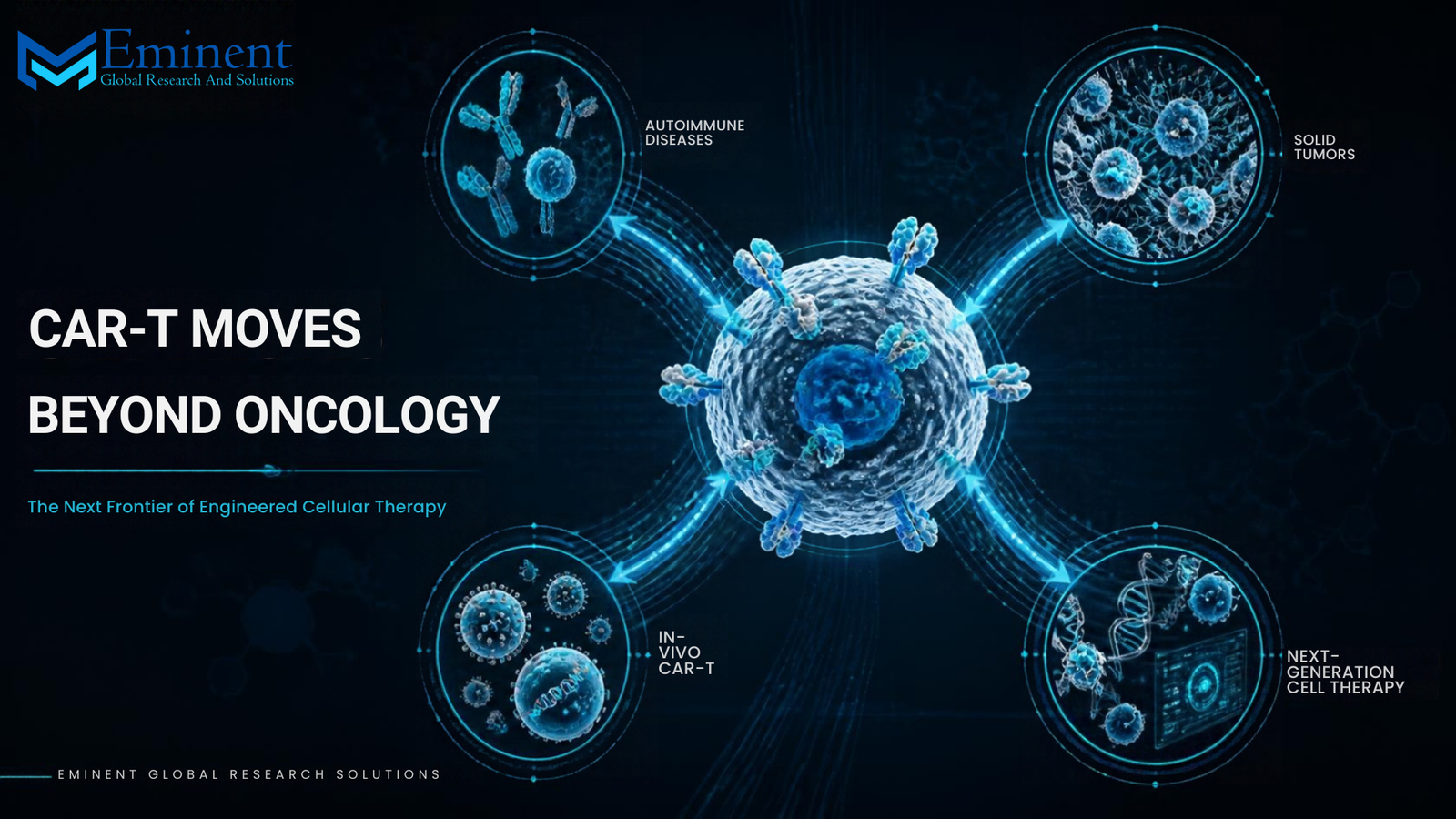
CAR-T Moves Beyond Oncology: Could Immune Reset Become the Next Frontier?
By Eminent Global Research Solutions
Chimeric antigen receptor T-cell (CAR-T) therapy has transformed the treatment landscape for several blood cancers. But the next chapter of CAR-T may not be defined by oncology alone.
Researchers are increasingly investigating whether the same cellular-engineering principles used to eliminate malignant B cells can be applied to autoimmune diseases and other non-malignant conditions. In 2026, this is becoming one of the most closely watched developments in advanced cell therapy.
A growing body of clinical research is exploring CAR-T approaches in conditions including systemic lupus erythematosus (SLE), systemic sclerosis, inflammatory myopathies and multiple sclerosis. Early studies have reported deep clinical responses in some heavily pretreated patients, although the field remains predominantly investigational and early-stage.
The strategic question is no longer simply whether CAR-T can kill cancer cells.
It is whether engineered immune cells can selectively reset dysfunctional immune systems.
From Cancer Elimination to Immune-System Reset
The fundamental appeal of CAR-T is its ability to give T cells a synthetic receptor that recognizes a selected cellular target.
In oncology, this concept has been particularly powerful against certain hematological malignancies because target antigens such as CD19 and BCMA can be exploited relatively effectively.
Autoimmune disease presents a different problem.
Instead of eliminating cancer cells, researchers are attempting to eliminate or control pathogenic immune-cell populations, particularly B cells that contribute to the production of disease-driving autoantibodies.
This creates an intriguing therapeutic hypothesis:
What if CAR-T could remove the immune cells responsible for autoimmune disease and allow the immune system to rebuild in a healthier state?
Early clinical observations with CD19-directed CAR-T have generated significant interest in this approach. A 2026 review describes CAR-T as moving beyond proof of concept in autoimmune diseases, while emphasizing that the clinical-development landscape remains immature and concentrated in early-phase studies.
The distinction is important.
CAR-T for autoimmune disease is not yet an established replacement for conventional treatment. Rather, it represents an emerging therapeutic platform whose long-term durability, safety, patient selection and optimal targets are still being investigated.
Why Autoimmune Disease Is an Attractive Target
Many autoimmune diseases are driven by complex interactions between immune cells, inflammatory signaling and autoantibodies.
Conventional therapies often work by suppressing parts of the immune system.
CAR-T offers a fundamentally different proposition: targeted cellular depletion followed by immune reconstitution.
The potential advantages could include:
- Deep depletion of pathogenic B-cell populations
- Potentially durable responses
- Reduction in dependence on chronic immunosuppressive therapy
- Greater biological precision than broad immune suppression
- Possibility of addressing disease mechanisms rather than symptoms alone
Research summarized in recent reviews has reported clinical remission signals in diseases such as lupus, systemic sclerosis and inflammatory myopathies. Yale researchers are also investigating CAR-T in autoimmune diseases including lupus, multiple sclerosis and scleroderma.
This creates an important strategic distinction between traditional biologics and engineered cell therapies.
A biologic may need to be administered repeatedly to maintain disease control. A successful CAR-T treatment could potentially produce a much longer-lasting biological effect.
That possibility is one of the reasons pharmaceutical and biotechnology companies are watching the field closely.
But CAR-T for Autoimmune Disease Is Not Simply “CAR-T for Cancer”
The biology, development pathway and commercial model could be substantially different.
In oncology, patients receiving CAR-T often have advanced or refractory disease where the potential benefit may justify substantial treatment complexity and risk.
Autoimmune diseases are different.
Many patients live for years or decades with their condition. Some respond adequately to existing therapies.
Consequently, the risk-benefit threshold is different.
Developers will need to demonstrate not just efficacy, but also:
- Long-term safety
- Durable disease control
- Appropriate patient selection
- Reduced treatment burden
- Acceptable manufacturing complexity
- Manageable immune-related toxicities
- Clear advantages over existing biologics and small molecules
This could become one of the defining challenges for the commercial development of autoimmune CAR-T.
The Solid-Tumor Opportunity Remains Another Frontier
“Beyond oncology” should not be interpreted as meaning CAR-T is leaving cancer behind.
Another major frontier is the effort to extend CAR-T into solid tumors.
Here, the challenge is fundamentally different.
Solid tumors often lack highly specific antigens, while heterogeneous antigen expression can allow tumor cells to escape treatment. CAR-T cells must also penetrate the tumor, survive in an immunosuppressive tumor microenvironment and maintain functional activity.
Researchers are therefore investigating:
- Multi-antigen CARs
- Logic-gated CAR designs
- Armored CAR-T cells
- Improved trafficking mechanisms
- Regional/local delivery
- Tumor-microenvironment modulation
- Safety switches
- In-vivo CAR-T generation
Recent 2026 research highlights the growing emphasis on engineering CAR-T cells to overcome antigen heterogeneity, trafficking barriers, metabolic suppression and immune inhibition.
This suggests that the future of CAR-T may not be one technology.
It may become a platform of programmable cellular therapies adapted to different biological environments.
The Technology Is Also Evolving
The next generation of CAR-T development is increasingly focused on improving the characteristics of the cell itself.
Researchers are exploring how CAR architecture, co-stimulatory domains, metabolic fitness and cellular persistence affect therapeutic performance. Recent work has emphasized metabolism as an important determinant of CAR-T-cell fitness and durability.
At the same time, researchers are exploring in-vivo CAR-T approaches, which could potentially reduce some of the logistical complexity associated with collecting, genetically modifying and reinfusing a patient’s cells.
If successful, these approaches could change the economics and accessibility of cell therapy.
The strategic objective therefore extends beyond creating a more powerful CAR-T cell.
It is about creating a more scalable, controllable and commercially viable cellular-therapy platform.
What This Means for Pharma and Biotech
The expansion of CAR-T creates several important strategic questions for industry.
1. Target intelligence becomes critical
Companies will need to identify disease-driving cellular populations and determine whether they provide sufficiently selective therapeutic targets.
2. IP landscapes will become increasingly complex
CAR architecture, target antigens, manufacturing processes, delivery technologies and next-generation engineering approaches can all create potential IP considerations.
3. Regulatory strategy will become more nuanced
A CAR-T product designed for an autoimmune population may face a very different clinical and regulatory development strategy than one designed for patients with refractory cancer.
4. Manufacturing economics could determine adoption
Autologous cell therapy remains operationally complex. Technologies that simplify manufacturing or enable more scalable approaches could have significant competitive advantages.
5. Patient selection may become a commercial differentiator
The ability to identify which patients are most likely to benefit could become as important as the CAR-T construct itself.
From Therapeutic Modality to Strategic Platform
The most important development may therefore be conceptual.
CAR-T is evolving from a cancer treatment modality toward a broader cellular-engineering platform.
Its potential applications are being explored across:
Hematologic malignancies → Solid tumors → Autoimmune diseases → Other immune-mediated conditions
But the commercial opportunity will depend on more than scientific breakthroughs.
Success will require alignment across target discovery, cell engineering, clinical development, regulatory strategy, manufacturing, IP, market access and commercialization.
For life sciences companies, this makes CAR-T a technology area worth monitoring not only through clinical-trial announcements, but also through patent activity, licensing transactions, emerging targets, regulatory developments, competitor pipelines and manufacturing innovation.
The question for the industry is no longer simply:
“Where can CAR-T work?”
It is becoming:
“Where can programmable cellular therapy create a fundamentally better therapeutic model?”
That question could define the next phase of the cell-therapy market.
Strategic Takeaway for Eminent Global Research Solutions
For pharma and biotech companies, the emerging CAR-T landscape creates opportunities for technology scouting, patent landscape analysis, competitive intelligence, regulatory intelligence and commercialization strategy.
Companies entering this space should evaluate not only the clinical pipeline, but also:
- Emerging therapeutic targets
- Competing CAR architectures
- Next-generation engineering technologies
- Solid-tumor approaches
- Autoimmune disease pipelines
- In-vivo CAR-T platforms
- Manufacturing innovations
- Licensing and partnership activity
- Patent white spaces
- Regulatory pathways
- Market-access implications
The next competitive advantage in CAR-T may not come from simply developing another CAR-T therapy. It may come from identifying the right biological problem before the rest of the market does.