

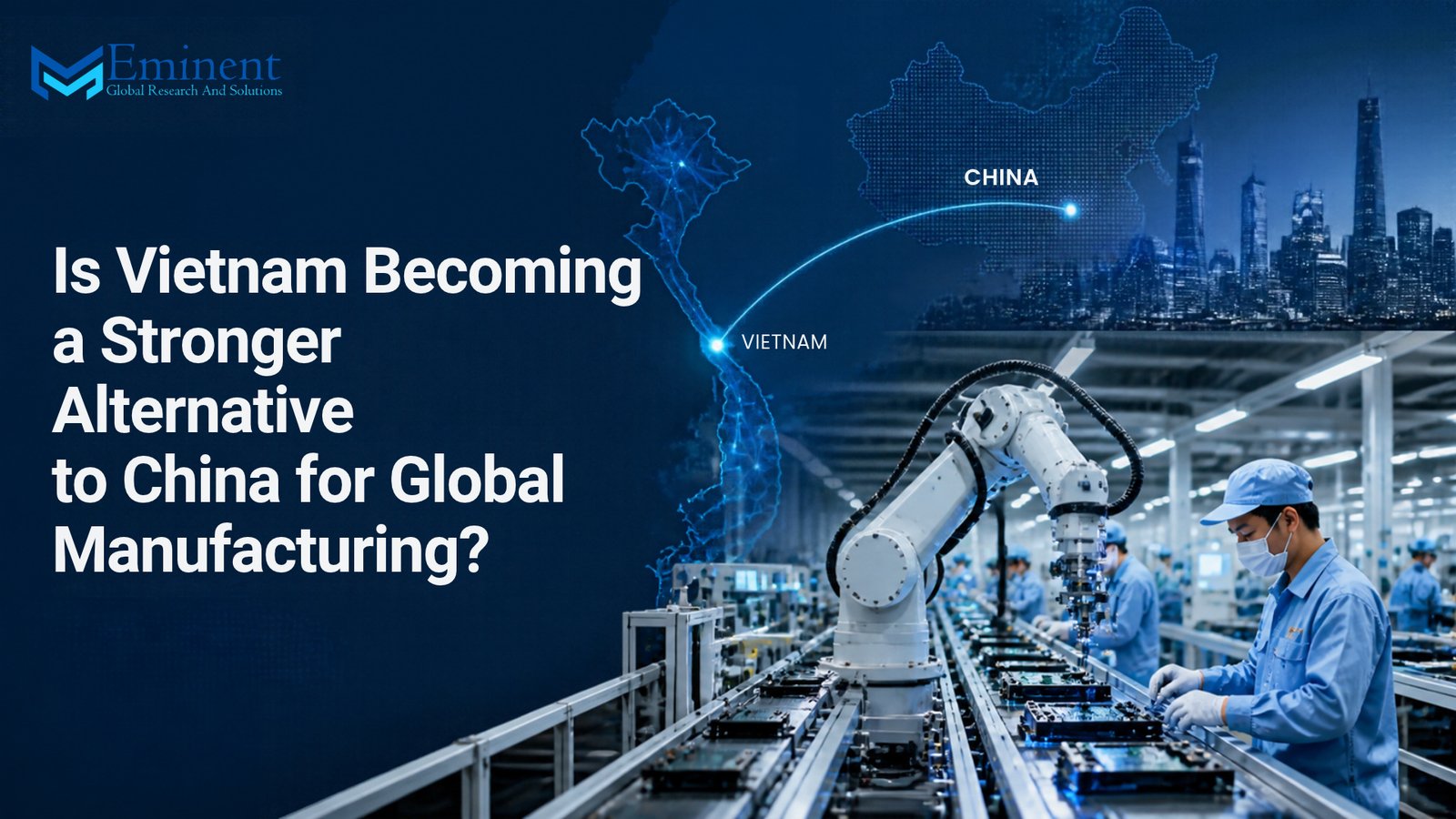
Is Vietnam Becoming a Stronger Alternative to China for Global Manufacturing?
Published Date: 17 November 2026
Category: Manufacturing & Industrial | Global Supply Chain
Introduction
Global manufacturing is undergoing a major transformation as companies reconsider where they produce goods, source components and manage supply chains. Rising production costs, geopolitical tensions, trade restrictions and supply-chain disruptions have encouraged manufacturers to diversify their operations beyond China.
Vietnam has emerged as one of the major destinations attracting this investment. Its competitive manufacturing costs, expanding industrial infrastructure, international trade agreements and proximity to China make it an attractive location for global businesses.
Through the growing adoption of the China Plus One strategy, companies are increasingly considering Vietnam for electronics, textiles, footwear, machinery and other manufacturing activities. However, an important question remains: Can Vietnam become a genuine alternative to China, or will it continue to operate as a complementary manufacturing hub?
Why Are Manufacturers Looking Beyond China?
China has developed one of the world’s most extensive manufacturing ecosystems, supported by established supplier networks, advanced infrastructure, skilled workers and large-scale production capabilities.
However, several factors are encouraging international companies to diversify their manufacturing operations:
- Geopolitical tensions: Trade disputes and changing international trade policies have increased uncertainty for businesses.
- Rising production costs: Labour, operating and compliance costs have encouraged manufacturers to evaluate alternative locations.
- Supply-chain diversification: Companies want to reduce dependence on a single manufacturing country.
- Market access: International trade agreements and regional economic partnerships are influencing investment decisions.
- Business resilience: Manufacturers are building additional production locations to reduce the impact of unexpected disruptions.
These developments have strengthened Vietnam’s position as a potential destination for companies seeking manufacturing flexibility.
Vietnam’s Growing Manufacturing Investment
Vietnam has attracted significant foreign investment, particularly in electronics, industrial production and export-oriented manufacturing.
According to investment figures reported for the first half of 2026, Vietnam received approximately US$34.65 billion in registered foreign investment, representing a 61% year-on-year increase. Manufacturing attracted approximately US$18.47 billion in registered investment during the period.
Disbursed foreign investment also increased, reaching US$13.03 billion in the first six months of 2026. The processing and manufacturing industry accounted for US$10.76 billion of that amount.
These developments demonstrate the continued importance of manufacturing in Vietnam’s economic expansion.
The country is also attracting investment in semiconductor-related activities, electronics production, precision manufacturing and industrial infrastructure. This is gradually strengthening its position within international production networks.
Which Industries Are Benefiting from Vietnam’s Manufacturing Growth?
1. Electronics and Semiconductor Manufacturing
Electronics is among Vietnam’s most important manufacturing sectors. International companies are using the country for electronics assembly, component production and technology-related manufacturing activities.
Growing demand for artificial intelligence infrastructure, consumer electronics and digital devices is creating additional opportunities for suppliers and industrial manufacturers.
However, Vietnam still depends on imported components, machinery and specialised technologies for many production activities. Moving towards higher-value manufacturing will require stronger domestic capabilities.
2. Textiles, Apparel and Footwear
Vietnam has established itself as an important manufacturing destination for textiles, garments, footwear and consumer products.
International brands are diversifying their sourcing strategies to improve production flexibility and reduce dependence on individual markets.
The country’s established export network and manufacturing workforce provide advantages in these industries. However, competition from other Asian manufacturing economies remains significant.
3. Machinery and Industrial Equipment
The expansion of manufacturing facilities is increasing demand for industrial machinery, automation systems, factory equipment and precision engineering.
This creates opportunities for local and international suppliers involved in manufacturing equipment, maintenance services, industrial automation and production technologies.
4. Automotive and Supporting Industries
Vietnam’s automotive ecosystem is developing, supported by growing interest in electric vehicles, automotive components and supporting manufacturing activities.
The expansion of this sector could create opportunities for component suppliers, battery-related businesses, electronics manufacturers and industrial technology providers.
However, developing a competitive automotive supply chain will require stronger local supplier networks and advanced manufacturing capabilities.
China Plus One Strategy: Vietnam’s Biggest Opportunity
The China Plus One strategy involves maintaining manufacturing operations in China while developing additional production locations in other countries.
Vietnam has become an important beneficiary of this approach because of its geographical proximity to China, competitive production costs and integration into international trade networks.
Research published by the US Federal Reserve in July 2026 found that Vietnam’s exports to the United States had expanded substantially following the 2018–2019 US-China tariff increases. It also found that both Chinese-owned and other foreign-invested companies had shifted some production activities to Vietnam.
However, this shift does not necessarily mean companies have completely replaced their Chinese supply chains. Many manufacturers continue to import intermediate goods and production inputs from China.
This suggests that Vietnam is becoming an additional manufacturing base rather than an independent replacement for China’s industrial ecosystem.
Vietnam vs China: Manufacturing Competitiveness
Vietnam and China offer different advantages to international manufacturers.
| Factor | Vietnam | China |
|---|---|---|
| Production costs | Generally competitive | Higher in many manufacturing locations |
| Supplier ecosystem | Developing | Extensive and established |
| Manufacturing scale | Smaller industrial base | Large-scale production capacity |
| Infrastructure | Expanding | Highly developed |
| Technology capabilities | Improving | Advanced across many industries |
| Supply-chain integration | Increasing | Deeply integrated |
| Market access | Extensive trade agreements | Large domestic and export markets |
China continues to maintain advantages in large-scale production, advanced industrial infrastructure, supplier availability and technological capabilities.
Vietnam, on the other hand, offers an attractive option for businesses seeking geographical diversification, competitive production costs and access to international markets.
The most suitable manufacturing location therefore depends on the company’s product requirements, sourcing strategy, production volume and long-term investment objectives.
Challenges Facing Vietnam’s Manufacturing Industry
Despite its growing investment attractiveness, Vietnam faces several challenges that could influence its ability to become a stronger alternative to China.
1. Dependence on Imported Components
One of the biggest limitations is the country’s dependence on imported raw materials, machinery and intermediate goods.
Recent economic analysis indicates that China remains a major source of Vietnam’s imports. This demonstrates that manufacturing relocation does not necessarily eliminate dependence on Chinese suppliers.
2. Limited Domestic Value Addition
Foreign-invested companies contribute a substantial share of Vietnam’s exports, while many domestic manufacturers remain concentrated in assembly, processing and supporting activities.
Strengthening local suppliers and increasing domestic technological capabilities will be important for Vietnam to capture more value from manufacturing investment.
3. Infrastructure and Logistics Requirements
Manufacturing expansion requires reliable electricity, transportation networks, industrial land, ports and logistics services.
Continued investment in infrastructure will be necessary to support larger production volumes and improve supply-chain efficiency.
4. Skilled Labour and Technology Development
Advanced manufacturing requires specialised engineering knowledge, technical training and skilled workers.
Vietnam will need to expand its technical workforce and improve research and development capabilities to attract more complex manufacturing operations.
5. International Trade and Compliance Risks
Vietnam’s increasing importance as an export destination also exposes it to changing trade policies, rules of origin and stricter international compliance requirements.
Manufacturers must ensure that products genuinely meet applicable origin requirements and international standards.
What Does This Mean for Global Manufacturers?
Vietnam’s manufacturing expansion is creating opportunities across multiple industries and supply-chain segments.
International businesses may benefit from:
- Establishing additional manufacturing facilities in Southeast Asia.
- Diversifying production locations and supplier networks.
- Developing partnerships with Vietnamese industrial suppliers.
- Expanding electronics and component manufacturing.
- Investing in industrial automation and production technologies.
- Improving supply-chain resilience through regional sourcing strategies.
For manufacturers, Vietnam represents an opportunity to build a more diversified production network rather than simply transfer all operations from China.
Eminent’s Perspective
At Eminent Global Research Solutions, we believe Vietnam’s growing manufacturing position reflects a broader transformation in global supply-chain strategies.
The country’s competitive production environment, increasing foreign investment and expanding industrial capabilities are attracting international manufacturers. However, its long-term competitiveness will depend on more than investment announcements and factory expansion.
Strengthening domestic supplier networks, improving infrastructure, developing skilled labour and increasing local value addition will be essential for Vietnam to move towards higher-value manufacturing.
For international businesses, the most effective strategy may involve combining China’s established industrial ecosystem with Vietnam’s growing manufacturing capabilities. Such an approach can provide greater flexibility, improve sourcing diversification and reduce exposure to concentrated supply-chain risks.
Conclusion
Vietnam is becoming a stronger alternative for selected manufacturing activities, particularly in electronics, textiles, footwear and export-oriented production.
However, replacing China across the entire manufacturing ecosystem remains difficult because China continues to offer greater production scale, advanced infrastructure, specialised suppliers and deeper industrial integration.
Vietnam’s opportunity lies in strengthening its position as a complementary manufacturing hub while gradually developing higher-value industrial capabilities.
Ultimately, the future of global manufacturing may not be defined by a complete shift away from China, but by a more diversified production network in which Vietnam plays an increasingly important role.
Post a Comment