

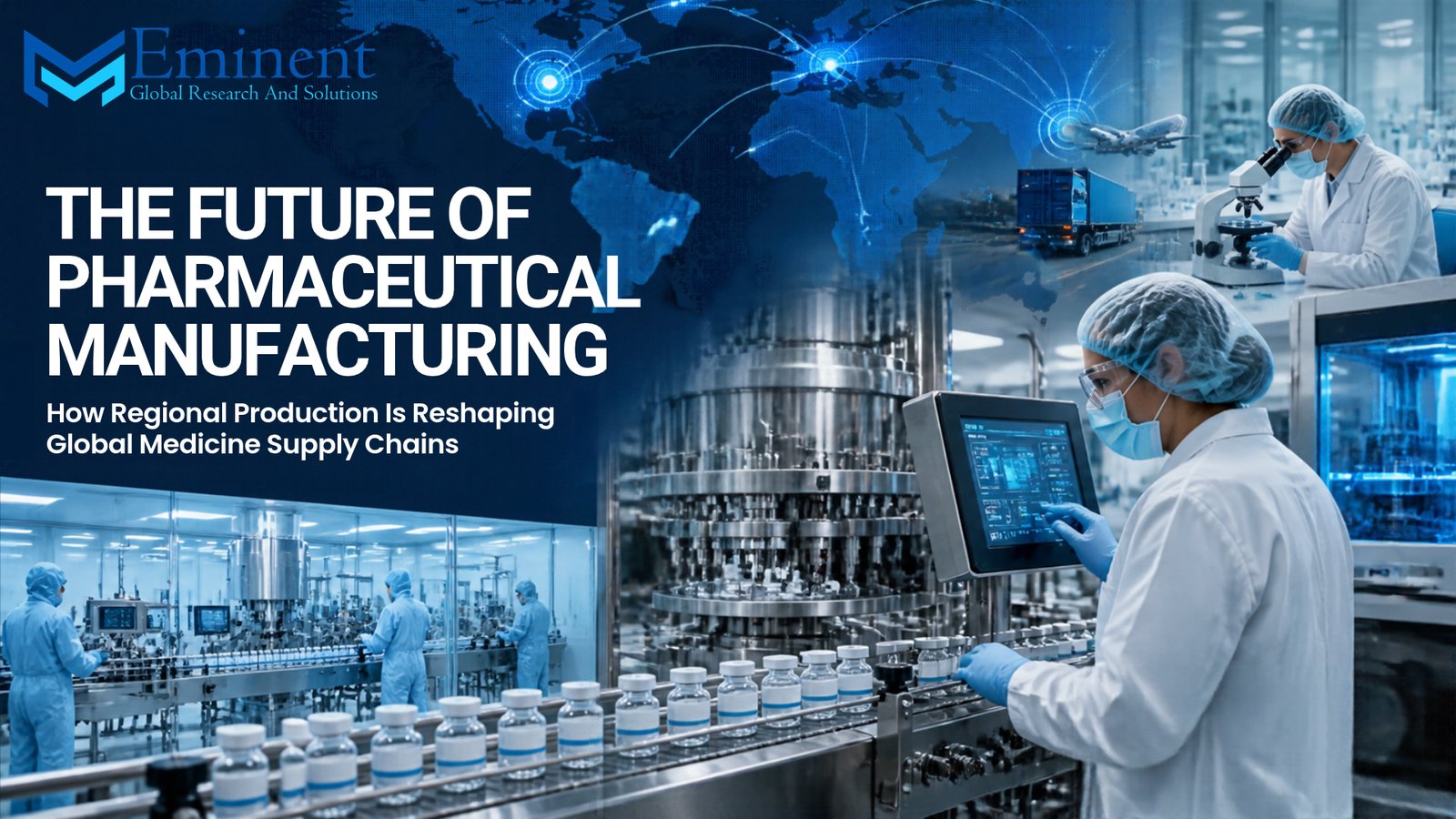
Is Pharmaceutical Manufacturing Becoming More Regionally Independent?
Published Date: 28 November 2026
Category: Pharmaceuticals | Manufacturing & Industrial | Global Supply Chain
Introduction
The global pharmaceutical industry is entering a period of significant structural change. For decades, pharmaceutical companies have relied on internationally distributed manufacturing networks to produce active pharmaceutical ingredients (APIs), process medicines, manufacture finished products and supply healthcare markets worldwide. This global model helped companies control production costs, access specialised expertise and benefit from established manufacturing centres.
However, recent geopolitical tensions, trade policy changes, supply disruptions and growing concerns about medicine availability are encouraging governments and pharmaceutical companies to reconsider their dependence on distant manufacturing locations.
As a result, regional pharmaceutical production is gaining importance. Countries are introducing incentives, investing in domestic manufacturing facilities and encouraging companies to establish production closer to major healthcare markets.
This does not necessarily mean that pharmaceutical manufacturing will become fully independent within individual countries. Instead, the industry appears to be moving towards a more geographically diversified model in which regional production capabilities work alongside international partnerships.
Why Pharmaceutical Manufacturing Is Becoming More Regional
The shift towards regional manufacturing is being influenced by several economic, political and operational factors.
1. Reducing Dependence on International Suppliers
Many pharmaceutical supply chains depend on a limited number of countries for APIs, chemical intermediates and specialised manufacturing inputs. When production is concentrated geographically, disruptions in one location can affect medicine availability across several markets.
Companies are therefore exploring additional manufacturing locations and alternative suppliers. Regional production can provide greater control over essential manufacturing processes and reduce exposure to disruptions in individual markets.
2. Changing Trade Policies and Tariff Pressures
Government trade policies are becoming an important factor in pharmaceutical investment decisions. Tariffs, import restrictions and domestic-production incentives can influence where companies manufacture medicines and source ingredients.
In the United States, policy changes introduced in 2026 have increased pressure on pharmaceutical companies to expand domestic manufacturing. Meanwhile, India and European countries are also pursuing policies intended to strengthen local pharmaceutical production.
These developments are encouraging companies to evaluate manufacturing locations not only on production costs but also on market access, regulatory conditions and long-term policy stability.
3. Improving Medicine Supply Security
The availability of essential medicines has become a major concern for governments and healthcare systems. Disruptions involving antibiotics, generic medicines, injectable drugs and other critical products can create pressure on hospitals and healthcare providers.
Regional manufacturing capacity can help governments improve supply preparedness and reduce dependence on a small number of overseas production centres.
However, building additional facilities is only part of the solution. Companies must also secure reliable access to raw materials, qualified suppliers, skilled employees and quality-control infrastructure.
4. Strengthening Domestic Pharmaceutical Industries
Several countries view pharmaceutical manufacturing as a strategic industry that can support economic growth, employment, research and healthcare security.
Investment in domestic production can encourage technology transfer, develop specialised manufacturing capabilities and strengthen relationships between pharmaceutical companies, research institutions and healthcare organisations.
This is particularly relevant for emerging markets seeking to move beyond basic medicine production towards higher-value APIs, biologics and specialised pharmaceutical products.
Regional Developments Reshaping Pharmaceutical Manufacturing
The regionalisation trend is taking different forms across major pharmaceutical markets.
United States: Encouraging Domestic Production
The United States is placing greater emphasis on strengthening its domestic pharmaceutical manufacturing base. Trade-policy changes and regulatory initiatives are encouraging companies to reconsider the location of production facilities and their dependence on overseas suppliers.
The FDA’s PreCheck Pilot Program is also intended to support the development of domestic pharmaceutical manufacturing facilities by improving the regulatory engagement process.
For pharmaceutical companies, expanding US production may improve access to the domestic market and reduce certain trade-related risks. However, higher operating costs and continued dependence on imported ingredients remain important considerations.
European Union: Building Greater Pharmaceutical Security
European countries are working to strengthen their ability to manufacture essential medicines and pharmaceutical ingredients within the region.
The proposed Critical Medicines Act reflects the EU’s wider objective of improving medicine availability, supporting local production and reducing excessive dependence on external suppliers.
The region already has established pharmaceutical manufacturing infrastructure, research capabilities and regulatory expertise. Further investment could strengthen production capacity for critical medicines, APIs and specialised treatments.
India: Expanding Its Role in Global Pharmaceutical Production
India remains an important pharmaceutical manufacturing and export hub, particularly in generic medicines and formulations. Its established production ecosystem, technical workforce and cost competitiveness provide a strong foundation for further expansion.
Government initiatives supporting domestic API manufacturing are also intended to reduce dependence on imported pharmaceutical ingredients and strengthen the country’s upstream manufacturing capabilities.
At the same time, India’s pharmaceutical industry continues to face challenges involving imported starting materials, manufacturing technology, quality compliance and the need for greater investment in advanced production facilities.
China: Maintaining an Important Role in Pharmaceutical Supply Chains
China continues to play a significant role in global pharmaceutical manufacturing, particularly in chemical intermediates, APIs and specialised production inputs.
Although other regions are attempting to diversify their supply sources, replacing China’s existing manufacturing scale and supplier ecosystem will take considerable time and investment.
Consequently, regionalisation is more likely to change the distribution of pharmaceutical production than eliminate China’s role in international supply chains.
The Growing Importance of Regional Contract Manufacturing
Contract development and manufacturing organisations (CDMOs) are becoming increasingly important as pharmaceutical companies look for flexible ways to expand their regional presence.
Establishing a new pharmaceutical manufacturing facility requires substantial capital, technical expertise, regulatory approvals and time. Working with established regional manufacturing partners can provide an alternative to building every capability internally.
CDMOs can support:
- Active pharmaceutical ingredient development and manufacturing.
- Drug formulation and finished-dose production.
- Biologics and specialised pharmaceutical manufacturing.
- Quality testing and regulatory compliance.
- Commercial-scale production and technology transfer.
Regional CDMO networks can help pharmaceutical companies access additional manufacturing capacity while maintaining operational flexibility across different markets.
This model may become particularly valuable for companies that want to diversify production without duplicating their entire manufacturing infrastructure.
Challenges Slowing the Regionalisation Process
Despite increasing investment, developing independent regional pharmaceutical ecosystems is a complex process.
High Capital Investment
Pharmaceutical manufacturing facilities require specialised equipment, controlled environments, quality systems and continuous operational investment. Establishing new production capacity can involve significant financial commitments.
Dependence on Imported Raw Materials
Moving finished-medicine production closer to consumers does not automatically eliminate dependence on overseas suppliers. A regional facility may still rely on imported APIs, chemical intermediates, specialised equipment and packaging materials.
Regulatory Complexity
Pharmaceutical products must comply with strict manufacturing and quality standards. Companies expanding across countries must manage different regulatory requirements, inspections, documentation procedures and product approvals.
Shortage of Specialised Skills
Advanced pharmaceutical manufacturing requires expertise in chemical engineering, biotechnology, process validation, quality assurance and regulatory affairs. Some emerging manufacturing regions may need additional investment in workforce development.
Maintaining Cost Competitiveness
Domestic and regional production can improve supply security, but it may also increase manufacturing costs. Companies must balance resilience with affordability, particularly in generic medicines and other price-sensitive product categories.
Technology’s Role in Regional Pharmaceutical Manufacturing
Technology will be essential to making regional pharmaceutical production competitive and reliable.
Continuous Manufacturing: Continuous production processes can improve operational efficiency, reduce certain production bottlenecks and support more consistent manufacturing quality.
Automation and Robotics: Automated production systems can improve precision, reduce manual intervention and support consistent operations in controlled manufacturing environments.
Digital Quality Management: Digital documentation, process monitoring and electronic quality systems can help companies maintain compliance and identify production issues more efficiently.
Advanced Analytical Technologies: Modern testing and monitoring systems can strengthen quality control, support process validation and improve visibility across production stages.
Supply Chain Visibility: Digital tracking and supplier-monitoring systems can help companies understand the origin of ingredients, monitor inventory and identify potential supply disruptions.
These technologies can help regional manufacturing facilities achieve higher productivity and meet the quality expectations of international pharmaceutical markets.
Business Opportunities Emerging from Pharmaceutical Regionalisation
The transition towards regional pharmaceutical manufacturing is creating opportunities across several areas of the industry.
- API manufacturing: Companies with reliable production capabilities may benefit from growing demand for alternative regional sources of pharmaceutical ingredients.
- CDMO expansion: Established contract manufacturers can attract new partnerships as pharmaceutical companies diversify production locations.
- Manufacturing equipment: Demand may increase for specialised processing machinery, automation systems, cleanroom equipment and quality-testing technologies.
- Pharmaceutical logistics: Regional production networks will require reliable temperature-controlled transportation, warehousing and distribution infrastructure.
- Regulatory and quality services: Companies may require additional support with compliance, validation, audits and international product approvals.
- Industrial investment: Regions offering skilled labour, reliable infrastructure and supportive policies may attract new pharmaceutical manufacturing projects.
For investors and industry participants, understanding these developments can help identify emerging markets, manufacturing requirements and potential areas of long-term industrial growth.
Future Outlook: A More Diversified Pharmaceutical Manufacturing Network
Over the coming years, pharmaceutical manufacturing is likely to become more geographically distributed. Governments will continue to focus on essential medicine security, while companies will evaluate regional production as part of their wider business and risk-management strategies.
However, complete manufacturing independence is unlikely to be practical for most pharmaceutical markets. The production of medicines involves interconnected stages, specialised technologies, complex ingredients and international regulatory requirements.
A more realistic outcome is a hybrid manufacturing structure in which domestic facilities, regional production centres and established global suppliers operate together.
Companies with multiple qualified manufacturing locations, reliable ingredient sourcing and strong regional partnerships may be better positioned to manage uncertainty and maintain consistent medicine supplies.
The long-term competitive advantage will depend not simply on where medicines are manufactured, but on how effectively companies coordinate production, quality, technology and supplier relationships across different regions.
Conclusion
Pharmaceutical manufacturing is becoming more regionally independent, but the transformation is not a complete move away from global production networks. Instead, the industry is gradually developing a more diversified structure that combines domestic manufacturing, regional partnerships and international supply relationships.
For governments, this transition offers an opportunity to strengthen medicine security and develop local industrial capabilities. For pharmaceutical companies, it creates new decisions around investment, production costs, regulatory compliance and supply chain design.
At Eminent Global Research Solutions, we examine these developments through industry research, market analysis and strategic insights. Understanding regional manufacturing investments, pharmaceutical supply chain dependencies and emerging production technologies can help businesses identify opportunities and make informed decisions in an evolving global healthcare industry.
Post a Comment