

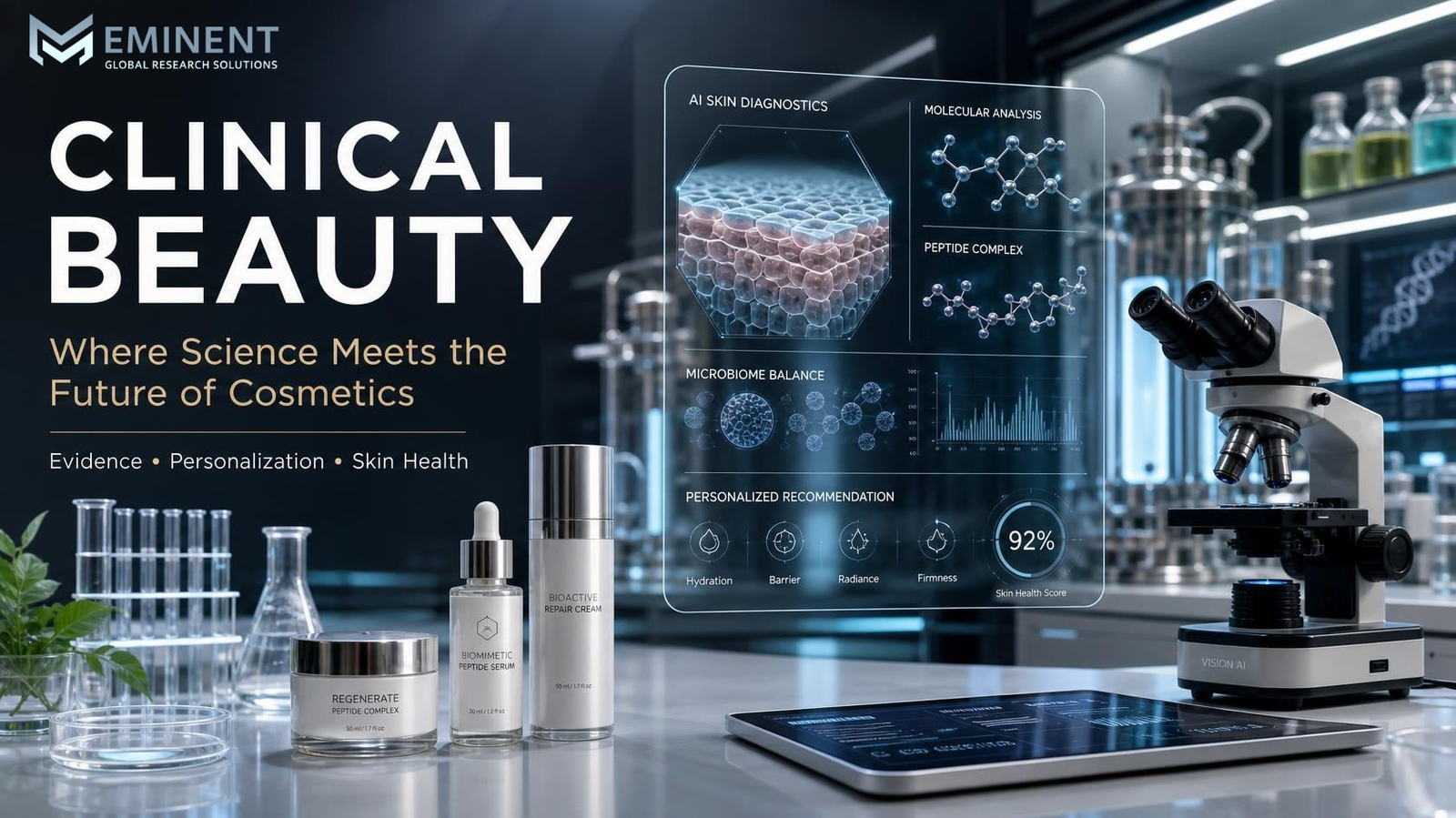
The global beauty industry is undergoing a fundamental transformation. For decades, cosmetics companies competed primarily through branding, sensory experience, packaging, celebrity endorsements, and ingredient storytelling. Today, a new competitive dimension is emerging: clinical credibility.
Consumers are increasingly looking beyond traditional cosmetic claims and asking more sophisticated questions: Does the product actually work? Is there scientific evidence behind the formulation? Can results be measured? Is the product personalized to individual skin or hair needs?
This shift is accelerating the rise of clinical beauty—a category positioned at the intersection of cosmetics, dermatology, biotechnology, diagnostics, and consumer healthcare.
Clinical beauty does not necessarily mean that every beauty product becomes a medical product. Instead, it represents a broader movement toward evidence-based formulations, clinically tested ingredients, personalized recommendations, and measurable outcomes.
For beauty companies, this creates a significant strategic opportunity. Brands that successfully combine scientific validation with compelling consumer experiences may be able to command premium pricing, strengthen consumer trust, and create longer-term relationships with customers.
From Cosmetic Claims to Evidence-Based Beauty
Traditional beauty marketing has historically relied heavily on emotional positioning.
Consumers were encouraged to associate products with concepts such as youth, confidence, attractiveness, luxury, and lifestyle. While these factors remain important, scientific credibility is becoming an increasingly powerful component of purchasing decisions.
Consumers now have access to extensive information about ingredients, clinical studies, dermatological research, and product reviews. Social media and digital platforms have also made it easier for consumers to compare products and question unsupported claims.
This has created a more demanding marketplace.
Beauty companies increasingly need to demonstrate the science behind their products through:
- Clinical testing
- Dermatological studies
- Ingredient efficacy research
- Biomarker analysis
- Consumer outcome measurements
- Scientific partnerships
The result is a gradual transition from “beauty marketing” to “beauty backed by evidence.”
Why Clinical Beauty Is Gaining Momentum
Several structural trends are contributing to the growth of clinical beauty.
1. Consumers Are Becoming More Science-Literate
Today’s consumers are increasingly familiar with active ingredients such as retinoids, peptides, ceramides, niacinamide, antioxidants, probiotics, and growth-factor technologies.
They are no longer simply buying a product because it promises to make them “look younger.” They want to understand how the formulation works.
This creates an opportunity for brands to educate consumers and build credibility through transparent scientific communication.
2. Healthcare and Beauty Are Converging
The traditional boundaries between cosmetics, dermatology, wellness, and healthcare are becoming increasingly blurred.
Consumers may now use dermatologist-recommended skincare, clinical-grade treatments, supplements, wearable devices, and personalized beauty products as part of one broader wellness routine.
This convergence is creating new categories around:
- Skin health
- Healthy aging
- Preventive skincare
- Scalp health
- Microbiome care
- Personalized beauty
- Dermatology-inspired cosmetics
The commercial opportunity extends well beyond conventional cosmetics.
3. Biotechnology Is Accelerating Innovation
Biotechnology is becoming one of the most important technologies influencing beauty product development.
Advances in fermentation, synthetic biology, microbiome research, peptide engineering, cell science, and biomaterials are enabling companies to develop new classes of cosmetic ingredients.
This can potentially improve formulation performance while also supporting sustainability and supply-chain resilience.
The result is a beauty industry increasingly influenced by technologies traditionally associated with pharmaceuticals and life sciences.
Personalization Could Become the Next Competitive Frontier
Clinical beauty is also closely connected to personalization.
Traditional skincare products are designed around broad consumer categories such as dry skin, oily skin, sensitive skin, or mature skin. However, advances in digital diagnostics and artificial intelligence are creating opportunities for much more individualized recommendations.
Future beauty ecosystems could combine:
Skin diagnostics → Biological data → AI analysis → Personalized formulation → Continuous monitoring
Consumers could potentially receive recommendations based on factors such as skin condition, environmental exposure, lifestyle, age, microbiome characteristics, and individual response to ingredients.
This creates a fundamentally different relationship between consumer and beauty brand.
Instead of purchasing a product once, consumers could become participants in an ongoing skin health ecosystem.
For companies, this could create recurring revenue opportunities through subscriptions, personalized product replenishment, diagnostic services, and digital engagement platforms.
Premiumization Through Scientific Credibility
Clinical beauty also creates an opportunity for premiumization.
Consumers may be willing to pay more when a product combines recognizable ingredients with credible scientific evidence and measurable performance.
Premium beauty companies can differentiate themselves through:
- Proprietary technologies
- Clinical studies
- Dermatology partnerships
- Biotechnology-derived ingredients
- Personalized diagnostics
- Long-term efficacy data
However, premium pricing must be supported by genuine value.
Simply adding scientific language to packaging will not be enough. Consumers are becoming increasingly skeptical of exaggerated claims and “science-washing.”
The brands that succeed will be those that translate complex scientific research into credible, understandable, and measurable consumer benefits.
The Importance of Regulatory and Scientific Strategy
As clinical beauty grows, regulatory strategy will become increasingly important.
The closer a product moves toward therapeutic positioning, the more carefully companies must consider claims, evidence requirements, labeling, advertising, and market-specific regulations.
This creates an important strategic distinction between:
Cosmetic positioning → Skin health positioning → Therapeutic positioning
Companies need to understand where their products sit within this spectrum and develop appropriate regulatory and commercialization strategies.
For global beauty companies, this becomes even more complex because regulatory frameworks differ across markets.
Organizations entering clinical beauty therefore need to integrate scientific research, regulatory intelligence, product development, and commercialization planning from the beginning rather than treating regulatory strategy as a final-stage activity.
What Does This Mean for Beauty Companies?
The rise of clinical beauty could reshape the competitive landscape.
Traditional brand equity will remain important, but it may no longer be sufficient.
Future market leaders could be companies capable of combining:
Brand + Science + Data + Personalization + Clinical Evidence
This creates opportunities for partnerships between beauty companies and:
- Biotechnology companies
- Pharmaceutical organizations
- Dermatology networks
- Academic institutions
- Diagnostic technology companies
- AI and digital health companies
Such partnerships can provide access to scientific capabilities that traditional beauty companies may not possess internally.
For emerging brands, this could also lower barriers to differentiation. A smaller company with strong scientific positioning and a compelling clinical proposition may compete effectively against much larger established brands.
The Strategic Opportunity for the Industry
Clinical beauty is not simply another product trend. It represents a potential restructuring of how beauty products are researched, developed, marketed, and commercialized.
The biggest opportunity may lie in moving from transactional beauty to long-term consumer health relationships.
Brands that can demonstrate measurable improvements, personalize recommendations, and continuously engage consumers could build significantly stronger customer relationships.
For investors and corporate strategy teams, this also creates new opportunities to evaluate companies based on scientific IP, clinical capabilities, proprietary technologies, data assets, and partnerships—not simply brand recognition.
Conclusion
Clinical beauty is emerging as one of the most important intersections between cosmetics, healthcare, biotechnology, and consumer wellness.
The industry is moving toward a model where consumers expect more than attractive packaging and compelling claims. They increasingly want evidence, efficacy, personalization, and transparency.
For beauty companies, the strategic question is no longer simply how to create the next successful cosmetic product.
It is how to build a credible, science-backed platform for long-term consumer skin and wellness needs.
The companies that successfully combine scientific innovation with consumer experience may define the next generation of beauty market leaders.
At Eminent Global Research Solutions, we see this convergence as a strategic opportunity for companies to evaluate emerging technologies, competitive landscapes, commercialization pathways, regulatory considerations, and new market opportunities across the evolving beauty and personal care ecosystem.