

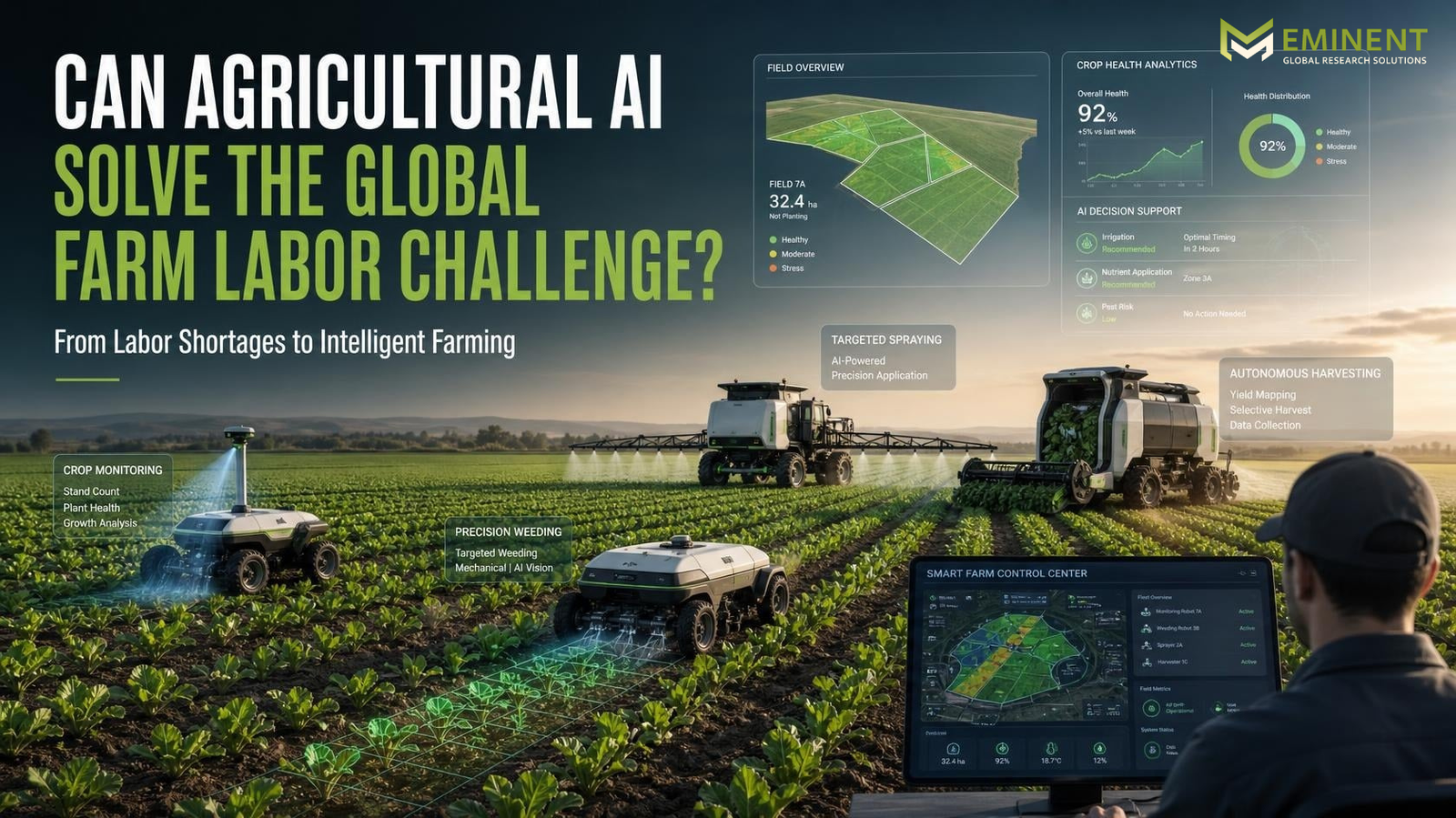
Agriculture is facing a paradox.
The world needs to produce more food, yet many farming regions are struggling to find enough workers to operate farms efficiently. Aging agricultural workforces, rural-to-urban migration, seasonal labor shortages, rising wages, and increasingly demanding working conditions are creating structural challenges for farmers and agribusinesses.
At the same time, artificial intelligence, robotics, computer vision, autonomous machinery, and precision agriculture are advancing rapidly.
This raises an important strategic question:
Can Agricultural AI Solve the Global Farm Labor Challenge?
The answer may not be as simple as replacing farm workers with machines. Instead, the larger opportunity lies in using AI to transform how agricultural labor is deployed—automating repetitive tasks, improving worker productivity, reducing physical workloads, and enabling fewer employees to manage larger and more complex operations.
For agribusinesses, this could represent one of the most important technology-driven transformations in agriculture over the next decade.
The Growing Farm Labor Challenge
Agricultural labor shortages are not limited to one geography.
Developed agricultural markets have experienced increasing difficulty attracting workers for physically demanding and seasonal jobs. At the same time, emerging economies are experiencing rapid urbanization, changing employment preferences, and migration away from agricultural communities.
This creates several challenges for farmers:
- Higher labor costs
- Difficulty recruiting seasonal workers
- Unpredictable workforce availability
- Reduced operational flexibility
- Delays in harvesting and field operations
- Increased dependence on contractors
- Pressure to automate repetitive activities
For crops that require intensive manual intervention, these challenges can directly affect profitability.
Harvesting, weeding, crop monitoring, sorting, spraying, pruning, and planting are among the activities where automation could potentially deliver significant value.
However, agricultural environments are far more complicated than controlled industrial factories. Fields contain uneven terrain, changing weather conditions, variable crops, pests, weeds, soil differences, and unpredictable biological conditions.
This is where AI becomes particularly important.
AI Is Moving Agriculture Beyond Traditional Automation
Traditional agricultural machinery primarily followed predefined instructions. AI-powered agricultural systems can increasingly interpret their environment and adapt their actions accordingly.
Computer vision can identify individual plants, distinguish crops from weeds, detect signs of disease, and assess plant maturity.
Machine learning can analyze historical and real-time agricultural data to improve decisions around irrigation, fertilization, pest management, and harvesting.
Robotics can then convert these insights into physical action.
The combination creates a powerful model:
Sense → Analyze → Decide → Act
Instead of simply automating a machine, agricultural AI enables machines to make increasingly intelligent decisions within the farming environment.
This distinction is strategically important.
The future of agricultural automation is unlikely to be defined only by larger tractors or faster harvesting equipment. It will increasingly depend on intelligent machines capable of understanding agricultural conditions at the plant, row, and field level.
Where Agricultural AI Can Have the Biggest Impact
Not every agricultural task will be automated at the same speed.
The strongest opportunities are likely to emerge in repetitive, labor-intensive activities where the economic value of automation is clearly measurable.
1. Weed Management
AI-powered robots equipped with computer vision can identify weeds among crops and perform targeted removal or treatment.
Instead of treating an entire field uniformly, farmers can apply interventions only where they are needed.
This can potentially reduce labor requirements while also lowering chemical usage.
2. Crop Monitoring
Farmers traditionally depend on workers to inspect fields for signs of disease, nutrient deficiencies, pests, and crop stress.
AI-enabled cameras, drones, sensors, and autonomous machines can continuously monitor large areas and identify potential problems earlier.
This shifts agriculture from periodic manual inspection toward continuous digital monitoring.
3. Harvesting
Harvesting remains one of the most challenging areas for agricultural robotics because crops vary significantly in size, shape, maturity, and location.
However, advances in computer vision, robotic manipulation, and machine learning are improving the ability of machines to identify and harvest suitable crops.
Commercial success in automated harvesting could significantly reduce seasonal labor dependency in high-value crops.
4. Precision Spraying
AI-powered systems can identify individual weeds or plants and deliver targeted treatments.
This reduces the need for workers to manually inspect and treat large areas while improving input efficiency.
5. Autonomous Machinery
Autonomous tractors and agricultural vehicles can perform tasks such as planting, cultivation, spraying, and transportation with limited human intervention.
One operator could potentially supervise multiple machines, significantly increasing workforce productivity.
The Goal Should Be Labor Augmentation, Not Simply Labor Replacement
One of the most important strategic considerations is how agribusinesses approach automation.
The objective should not necessarily be to eliminate agricultural jobs.
Instead, AI can help augment human capabilities.
A single agricultural worker equipped with intelligent machinery could potentially manage operations that previously required several workers.
This changes the economics of labor.
Workers can increasingly transition from repetitive physical activities toward higher-value responsibilities such as:
- Machine supervision
- Equipment maintenance
- Data interpretation
- Crop planning
- Quality management
- Farm technology management
This creates a new agricultural workforce combining traditional farming expertise with digital and technical capabilities.
The future farmer may increasingly function as an operator, analyst, and technology manager—not simply a manual worker.
The Economics of Agricultural AI
Despite its potential, agricultural AI is not automatically profitable.
The business case depends heavily on farm size, crop type, labor costs, equipment utilization, and technology maturity.
Agribusinesses need to evaluate the total cost of ownership, including:
- Hardware investment
- Software subscriptions
- Connectivity
- Maintenance
- Employee training
- System integration
- Downtime
- Data management
For large-scale farms facing persistent labor shortages, automation may deliver compelling returns.
For smaller farms, however, purchasing expensive autonomous equipment may not be economically viable.
This creates opportunities for alternative business models such as Robotics-as-a-Service, equipment leasing, shared machinery platforms, and technology partnerships.
These models could make advanced agricultural AI accessible to a broader range of farmers.
Data Will Become a Strategic Agricultural Asset
AI is only as effective as the data supporting it.
Agricultural AI systems require enormous quantities of information about crops, soil, weather, field conditions, pests, diseases, and historical production.
As more farms adopt digital technologies, agricultural data could become one of the industry’s most valuable strategic assets.
This creates new questions around:
- Data ownership
- Data privacy
- Interoperability
- Platform dependence
- Cybersecurity
- Data monetization
Agribusinesses should therefore evaluate not only the capabilities of agricultural AI systems but also how the underlying data ecosystem is structured.
Companies that build strong data capabilities may gain advantages beyond automation.
What Should Agribusiness Leaders Do?
The most effective strategy may not be immediate full-scale automation.
Instead, agribusinesses should identify their most labor-intensive and economically significant processes and evaluate where AI can deliver measurable improvements.
A practical approach could include:
1. Identify labor-intensive operations
Determine which activities create the greatest workforce bottlenecks.
2. Evaluate automation readiness
Assess whether current AI and robotics technologies can reliably perform those tasks.
3. Run targeted pilots
Test technology in controlled field environments before making large capital investments.
4. Measure ROI
Track labor savings, productivity, yield impact, downtime, input reduction, and operational reliability.
5. Build workforce capabilities
Train employees to operate, supervise, and maintain AI-enabled systems.
6. Scale selectively
Expand technologies that demonstrate measurable commercial value.
The Future of Farming Will Be Human + Machine
Agricultural AI is unlikely to completely eliminate the need for human workers.
Instead, it has the potential to fundamentally change the relationship between people, machines, and agricultural operations.
The most successful farms of the future may combine experienced agricultural professionals with autonomous equipment, intelligent software, robotics, sensors, and predictive analytics.
For agribusinesses, the strategic question is therefore not simply:
“Will AI replace farm workers?”
The more important question is:
“How much more productive can each agricultural worker become with AI?”
That shift in perspective could unlock a much larger opportunity.
Agricultural AI has the potential to address labor shortages while simultaneously improving productivity, resource efficiency, and operational resilience.
For Eminent Global Research Solutions, this represents a significant area of strategic opportunity across agribusiness, AgTech, robotics, biotechnology, and precision agriculture.
The next agricultural revolution may not be about replacing farmers.
It may be about giving every farmer intelligent machines capable of doing more.