

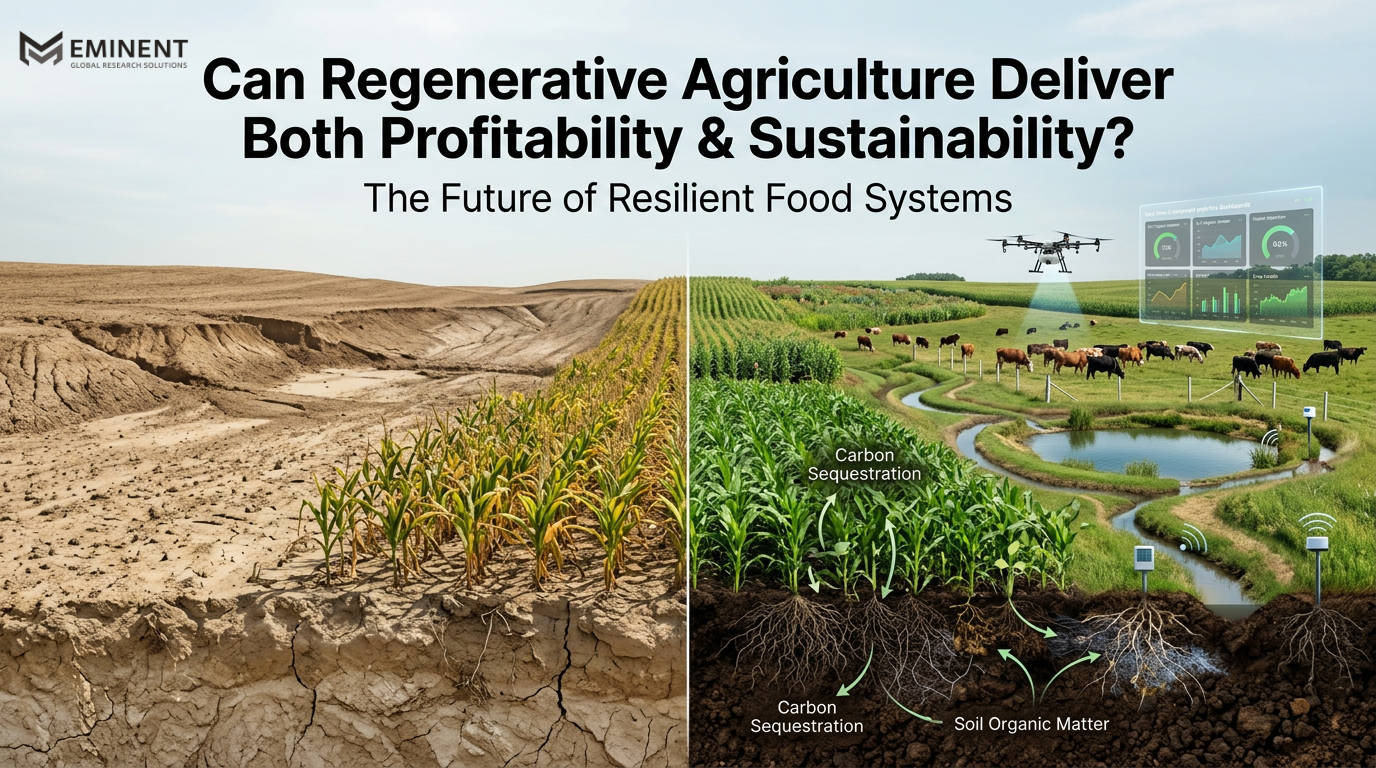
The Growing Debate Around the Future of Agriculture
Agriculture is facing unprecedented pressure. Farmers are expected to increase food production for a growing global population while simultaneously addressing environmental concerns such as soil degradation, water scarcity, biodiversity loss, and greenhouse gas emissions.
For decades, conventional agricultural practices focused primarily on maximizing yield and productivity. While these methods significantly increased food production, they have also contributed to long-term challenges including declining soil health, increased dependence on synthetic inputs, and reduced ecosystem resilience.
As a result, regenerative agriculture has emerged as one of the most discussed concepts in modern agribusiness.
However, a critical question remains:
Can regenerative agriculture deliver both environmental sustainability and economic profitability?
For farmers, agribusinesses, food manufacturers, and investors, the answer could shape the future of global food systems.
Understanding Regenerative Agriculture
Regenerative agriculture is a farming approach designed to restore and improve natural ecosystems while maintaining productive agricultural operations.
Unlike traditional sustainability initiatives that focus on minimizing harm, regenerative agriculture seeks to actively improve soil health, biodiversity, water retention, and ecosystem functionality.
Common regenerative practices include:
- Cover cropping
- Reduced tillage or no-till farming
- Crop rotation
- Agroforestry
- Precision nutrient management
- Integrated livestock grazing
- Carbon sequestration initiatives
- Soil health monitoring
The primary objective is to create agricultural systems that become more productive and resilient over time rather than gradually depleting natural resources.
Why Soil Health Has Become a Strategic Priority
Soil is increasingly recognized as one of agriculture’s most valuable assets.
Healthy soils improve:
- Water retention
- Nutrient availability
- Crop resilience
- Carbon storage
- Biodiversity
Unfortunately, years of intensive farming have degraded large portions of agricultural land globally.
Poor soil health often results in:
- Higher fertilizer requirements
- Increased irrigation demand
- Greater vulnerability to climate stress
- Lower long-term productivity
Regenerative agriculture aims to reverse this trend by rebuilding soil organic matter and supporting natural biological processes.
For agribusinesses, healthier soils can contribute to more stable production systems and reduced operational risks over the long term.
The Business Case for Regenerative Agriculture
While sustainability benefits are often emphasized, adoption ultimately depends on economic viability.
Farmers must balance environmental goals with profitability requirements.
Fortunately, regenerative agriculture offers several potential financial advantages.
Reduced Input Costs
One of the most immediate economic benefits comes from lower dependency on external inputs.
As soil health improves, farms may reduce expenditures on:
- Synthetic fertilizers
- Pesticides
- Herbicides
- Irrigation
Over time, these savings can significantly improve operating margins.
Increased Resilience
Climate volatility has become a major concern for agricultural producers.
Regenerative systems often demonstrate:
- Better drought tolerance
- Improved flood resilience
- Enhanced crop stability
Greater resilience can reduce financial losses associated with extreme weather events and production variability.
Premium Market Opportunities
Consumer demand for sustainably produced food continues to grow.
Many retailers, food manufacturers, and consumer brands are actively seeking regenerative supply chains to support sustainability commitments.
This creates opportunities for:
- Premium pricing
- Preferred supplier relationships
- Long-term procurement contracts
Companies capable of verifying regenerative practices may gain access to higher-value markets.
Corporate Interest Is Accelerating
Global food companies are increasingly investing in regenerative agriculture programs.
Leading organizations are working directly with farmers to support adoption through:
- Financial incentives
- Technical assistance
- Carbon programs
- Supply chain partnerships
The motivation is clear.
Companies face growing pressure from:
- Investors
- Consumers
- Regulators
- Sustainability frameworks
Supporting regenerative agriculture helps organizations strengthen environmental performance while securing long-term raw material supplies.
This trend is transforming regenerative agriculture from a niche farming practice into a strategic supply chain initiative.
The Role of Technology
Technology is making regenerative agriculture more scalable and measurable.
Modern tools include:
- Satellite monitoring
- Precision agriculture systems
- Soil analytics platforms
- AI-driven crop management
- Carbon measurement technologies
- Digital farm management systems
These innovations help farmers quantify outcomes and optimize regenerative practices more effectively.
The integration of technology is also improving transparency for food companies seeking to verify sustainability claims across complex supply chains.
Challenges to Adoption
Despite its potential, regenerative agriculture faces several barriers.
Transition Costs
Moving from conventional to regenerative systems often requires upfront investment.
Farmers may experience:
- New equipment requirements
- Training expenses
- Temporary yield fluctuations
- Additional management complexity
Without financial support, adoption can be challenging.
Measurement and Standardization
There is currently no universally accepted definition of regenerative agriculture.
Organizations often use different metrics and certification frameworks.
This creates challenges in:
- Comparing results
- Verifying claims
- Measuring impact consistently
Industry-wide standards will likely become increasingly important as adoption expands.
Time Horizon
Many regenerative benefits emerge over multiple growing seasons rather than immediately.
This long-term return profile can discourage adoption among producers focused on short-term financial performance.
Successful implementation often requires patience and strategic planning.
The Consulting Perspective
From a strategic perspective, regenerative agriculture should not be viewed solely as an environmental initiative.
It represents a business transformation opportunity.
Organizations that successfully integrate regenerative practices into their operations may benefit from:
- Improved supply chain resilience
- Enhanced sustainability performance
- Reduced operational risks
- Stronger brand positioning
- New revenue opportunities
- Greater investor confidence
The companies most likely to succeed will combine regenerative farming principles with advanced technology, data analytics, and strong commercial partnerships.
Looking Ahead
The future of agriculture will require solutions that address both economic and environmental challenges simultaneously.
Regenerative agriculture offers one of the most promising pathways toward achieving this balance.
While adoption barriers remain, growing corporate investment, technological innovation, and consumer demand are accelerating momentum.
The question may no longer be whether regenerative agriculture can deliver sustainability.
The more important question is whether agribusinesses can afford to ignore it.
For farmers, food manufacturers, investors, and policymakers, regenerative agriculture represents an opportunity to build agricultural systems that are not only productive today but also resilient for future generations.
As global agriculture evolves, profitability and sustainability may increasingly become complementary objectives rather than competing priorities.