

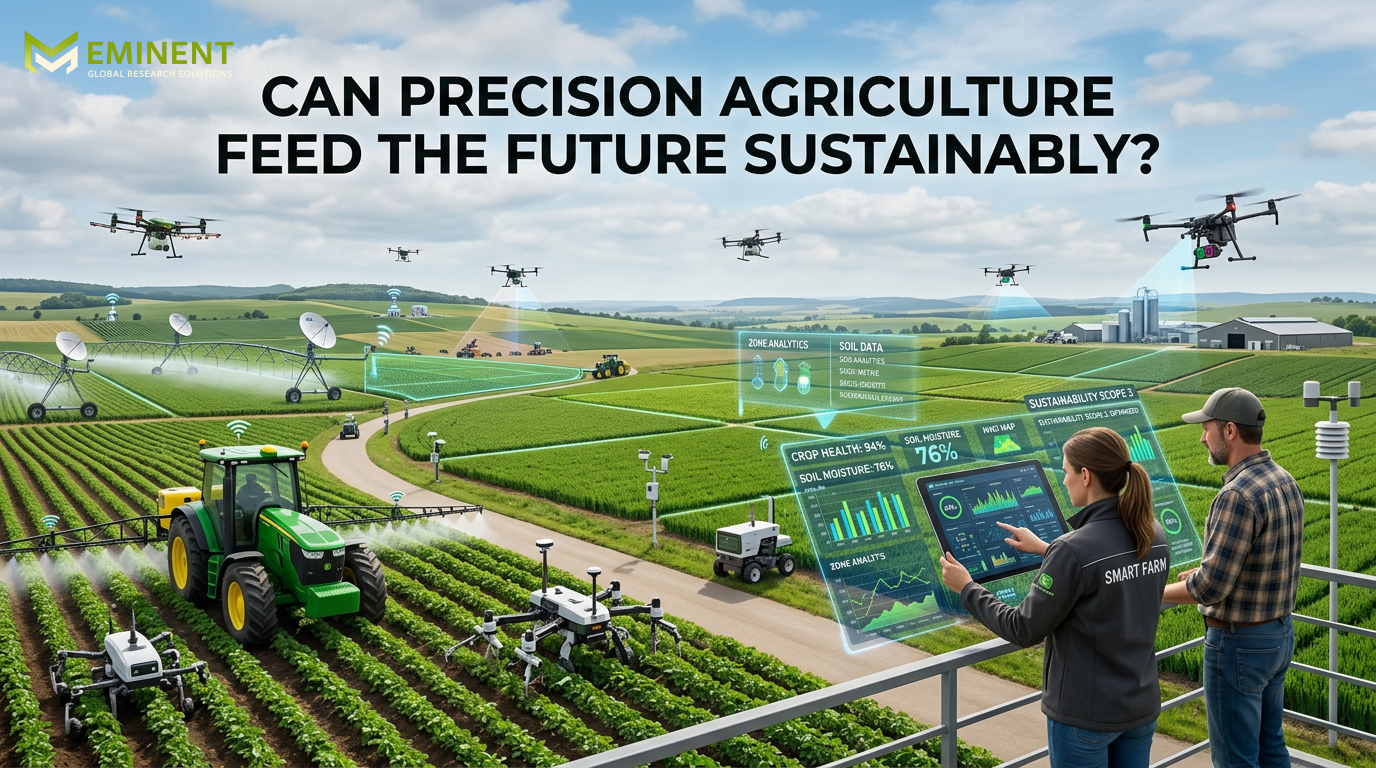
The Global Food Challenge
The world’s population is expected to continue growing over the coming decades, placing unprecedented pressure on agricultural systems. At the same time, farmers face mounting challenges including climate change, water scarcity, labor shortages, soil degradation, and increasing input costs. Producing more food with fewer resources is no longer simply an operational goal it has become a global necessity.
Against this backdrop, precision agriculture is emerging as one of the most promising solutions for sustainable food production. By leveraging technologies such as artificial intelligence (AI), satellite imagery, sensors, robotics, drones, and data analytics, precision agriculture enables farmers to make more informed decisions, optimize resource use, and improve productivity.
The question facing agribusiness leaders, policymakers, and investors is no longer whether precision agriculture works, but whether it can scale quickly enough to help feed a growing global population sustainably.
What Is Precision Agriculture?
Precision agriculture refers to the use of advanced technologies and data-driven insights to manage farming operations with greater accuracy and efficiency.
Rather than treating entire fields uniformly, precision agriculture allows farmers to analyze variations in soil conditions, crop health, moisture levels, pest activity, and nutrient requirements at a highly localized level.
This enables targeted interventions such as:
- Variable-rate fertilizer application
- Precision irrigation
- AI-powered crop monitoring
- Automated weed control
- Yield prediction and forecasting
- Real-time field management
By applying resources only where and when they are needed, farmers can improve productivity while reducing waste.
Why Precision Agriculture Matters
Global agriculture must balance two competing priorities: increasing food production while minimizing environmental impact.
Traditional farming practices often rely on broad applications of fertilizers, pesticides, and water resources. While effective in some cases, these methods can lead to inefficiencies, higher costs, and environmental challenges.
Precision agriculture addresses these issues by improving resource allocation and operational efficiency.
Key benefits include:
Increased Crop Yields
Data-driven farming allows producers to identify crop stress, nutrient deficiencies, and disease outbreaks earlier than traditional methods. Early intervention can significantly improve crop performance and overall yield.
Improved Resource Efficiency
Precision technologies help optimize the use of:
- Water
- Fertilizers
- Pesticides
- Fuel
- Labor
This reduces unnecessary inputs while maintaining or improving productivity.
Environmental Sustainability
Reduced chemical application and more efficient water usage contribute to lower environmental impact. Precision agriculture also supports sustainable farming practices by minimizing runoff, protecting soil health, and reducing greenhouse gas emissions.
Enhanced Decision-Making
Farmers can access real-time insights through connected devices and analytics platforms, enabling faster and more informed operational decisions.
The Role of Artificial Intelligence and Automation
Artificial intelligence is becoming a critical driver of precision agriculture adoption.
Modern AI systems can analyze massive amounts of agricultural data collected from:
- Satellites
- Drones
- Field sensors
- Weather stations
- Farm equipment
These systems can identify patterns that would be impossible to detect manually, helping farmers optimize planting schedules, predict disease risks, and maximize yields.
Meanwhile, agricultural robotics are increasingly capable of performing labor-intensive tasks such as:
- Weeding
- Harvesting
- Crop monitoring
- Field scouting
As labor shortages continue to affect farming operations globally, automation may become essential for maintaining agricultural productivity.
The integration of AI and robotics is transforming precision agriculture from a decision-support tool into an increasingly autonomous farming ecosystem.
Addressing Sustainability Challenges
One of the strongest arguments for precision agriculture is its ability to support sustainability objectives.
Agriculture accounts for a significant share of global freshwater usage and environmental resource consumption. As climate change increases pressure on agricultural systems, efficient resource management becomes increasingly important.
Precision agriculture can help address sustainability challenges through:
Water Conservation
Smart irrigation systems use sensors and weather data to apply water precisely where needed, reducing waste and improving drought resilience.
Reduced Chemical Usage
AI-powered weed detection and targeted pesticide application minimize chemical use while maintaining crop protection.
Soil Health Management
Advanced monitoring technologies enable farmers to better understand soil conditions and implement practices that preserve long-term fertility.
Lower Carbon Footprint
Optimized machinery use, reduced input requirements, and improved operational efficiency can contribute to lower agricultural emissions.
These capabilities align closely with growing sustainability expectations from consumers, regulators, and investors.
Barriers to Widespread Adoption
Despite its potential, precision agriculture faces several adoption challenges.
High Initial Investment
Advanced equipment, sensors, software platforms, and connectivity infrastructure often require significant upfront capital.
Smaller farms may face financial barriers that limit technology adoption.
Digital Skills Gap
Successful implementation requires knowledge of data analytics, digital tools, and technology management.
Training and workforce development remain critical priorities.
Connectivity Limitations
Many rural agricultural regions still lack reliable internet infrastructure necessary for advanced precision farming systems.
Data Integration Challenges
Farmers often use multiple technologies and equipment platforms that may not integrate seamlessly.
Improved interoperability will be essential for maximizing value.
Addressing these barriers will require collaboration among technology providers, governments, agribusinesses, and financial institutions.
The Future of Food Production
Precision agriculture is not a standalone solution to global food security challenges. However, it represents one of the most powerful tools available for improving agricultural productivity while supporting sustainability goals.
As technologies become more affordable and accessible, adoption is expected to accelerate across both developed and emerging markets.
Future innovations may include:
- Autonomous farming fleets
- Predictive AI-driven crop management
- Digital twin farming systems
- Advanced biotechnology integration
- Climate-adaptive agricultural platforms
Together, these advancements could significantly improve the resilience and efficiency of global food production systems.
Conclusion
Feeding a growing global population sustainably will require transformative changes across the agricultural value chain. Precision agriculture offers a pathway to produce more food while using fewer resources, reducing environmental impact, and improving farm profitability.
For agribusinesses, technology providers, and policymakers, the opportunity lies in accelerating adoption, overcoming implementation barriers, and building the digital infrastructure needed to support the next generation of farming.
The future of agriculture will likely be increasingly data-driven, automated, and sustainable and precision agriculture may be one of the most important enablers of that transformation.