
AI Enters Cosmetic Safety and Adverse-Event Monitoring: From Reactive Reporting to Predictive Cosmetovigilance
The cosmetics industry is entering a new phase of safety management. As product portfolios become more complex, consumer expectations rise, and regulatory oversight expands, cosmetic companies are facing a growing need to identify, classify, investigate, and respond to adverse events more efficiently.
Artificial intelligence (AI) is emerging as a potentially important technology in this transformation.
The opportunity is not simply about automating adverse-event reporting. The larger opportunity is to use AI to connect fragmented safety information, identify patterns across large datasets, prioritize potential signals, and support faster human decision-making.
This is particularly relevant in the United States following the Modernization of Cosmetics Regulation Act of 2022 (MoCRA). Under MoCRA, responsible persons must report serious adverse events associated with cosmetic products to the FDA within 15 business days, with follow-up information also subject to a 15-business-day reporting requirement. U.S. Food and Drug Administration
Why Cosmetic Safety Monitoring Is Becoming More Complex
Cosmetic adverse events can originate from many different sources.
Consumer complaints, customer-service interactions, healthcare professionals, social media discussions, product reviews, regulatory databases, internal quality systems, and post-market surveillance programs can all contain potentially useful safety information.
The challenge is that these sources are often unstructured.
A consumer might describe irritation as “burning,” “redness,” “sensitivity,” or “my skin feels damaged.” Another may report hair loss, swelling, itching, or a change in skin appearance without using standardized medical terminology.
For a global cosmetics company managing hundreds or thousands of products, manually reviewing every potential signal can become resource-intensive.
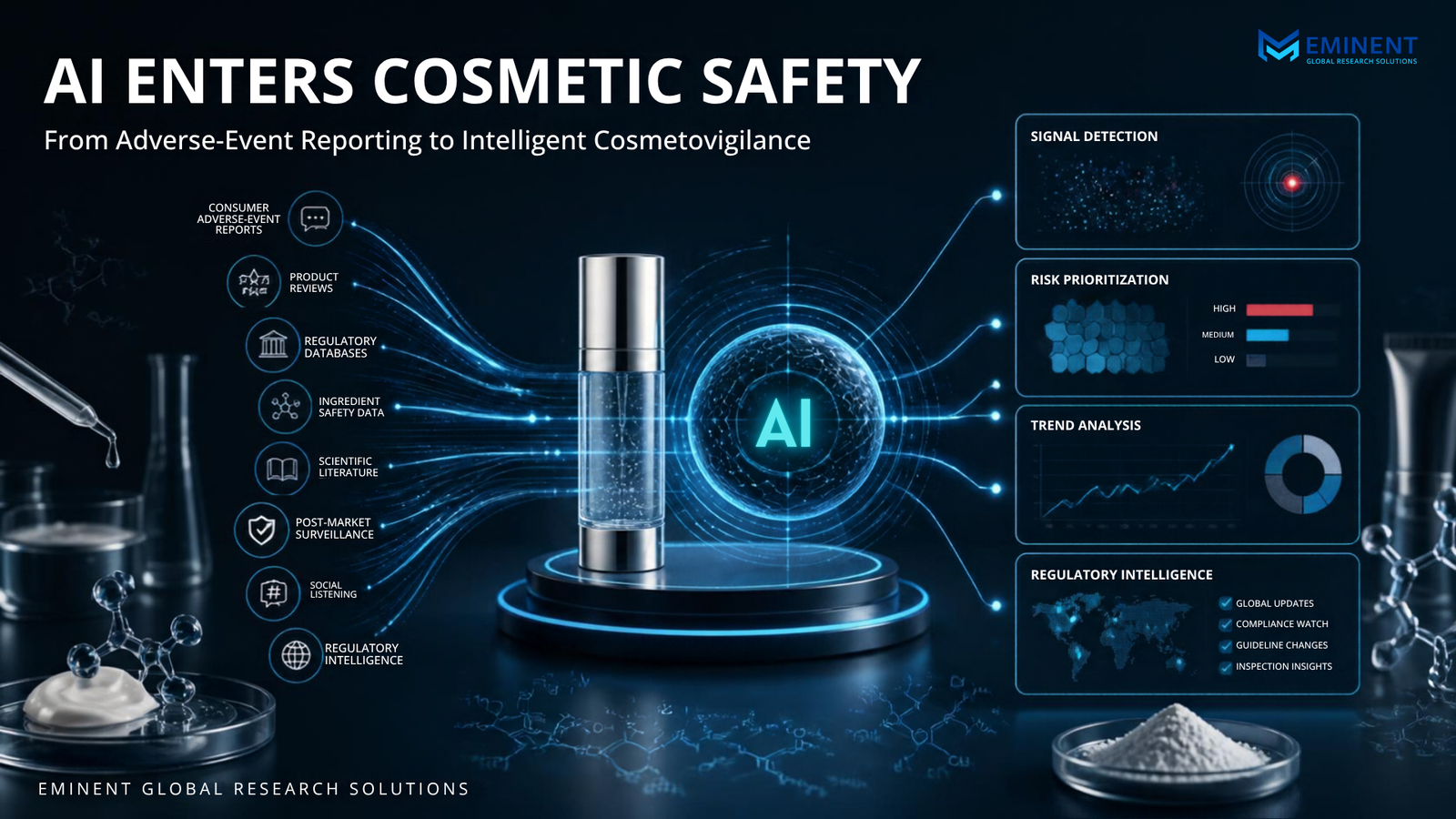
This creates an opportunity for AI-enabled systems to assist with data extraction, classification, deduplication, terminology normalization, trend detection, and signal prioritization.
From Adverse-Event Reporting to AI-Assisted Cosmetovigilance
Traditional safety monitoring is often reactive: an adverse event is received, assessed, documented, and reported when applicable.
AI could help move parts of this process toward continuous surveillance.
A sufficiently designed system could ingest information from multiple authorized sources and help identify:
- Repeated adverse-event descriptions
- Product-specific complaint patterns
- Ingredient-associated signals
- Geographic clusters
- Changes in event frequency
- Similar complaints across different product lines
- Emerging patterns involving particular formulations or packaging
- Potential relationships between product categories and reported reactions
Importantly, AI should not automatically determine that a product or ingredient caused an adverse event.
Instead, it can function as a signal-detection and prioritization layer, helping qualified safety, regulatory, medical, and quality professionals decide which signals require further investigation.
This distinction is critical.
FDA Is Already Moving Toward More Integrated Safety Intelligence
The regulatory environment itself is becoming increasingly data-driven.
In 2025, FDA launched a public dashboard for cosmetic adverse-event data, allowing users to query and download cosmetic adverse-event information. In 2026, FDA announced the implementation of the Adverse Event Monitoring System (AEMS), intended to consolidate multiple adverse-event reporting systems across FDA-regulated product categories, including cosmetics. FDA says AEMS will incorporate enhanced analytics as well as AI-based redaction and digitization tools.
This development is strategically important for cosmetics companies.
It signals a broader movement toward structured, integrated, machine-readable safety intelligence.
For companies, the implication is not simply that regulators will have better technology. It also means that internal safety systems may increasingly need to produce higher-quality, structured information capable of supporting sophisticated surveillance and analysis.
Social Listening Could Become Part of the Safety Intelligence Layer
One particularly interesting area is the relationship between social listening and formal cosmetovigilance.
Consumers frequently discuss cosmetic reactions online. Terms such as “burning,” “rash,” “breakout,” “swelling,” “hair fall,” and “allergic reaction” may appear in product reviews, social posts, forums, or customer communications.
These sources should not automatically be treated as validated adverse-event reports.
However, AI can potentially help identify recurring language patterns and route potentially relevant information to human reviewers.
For example, if hundreds of consumers independently describe a similar reaction after using a particular product or product category, an AI system could flag the pattern for investigation.
This creates a potential transition from:
Complaint → Manual Review → Investigation
toward:
Multi-Source Data → AI Signal Detection → Human Assessment → Investigation → Regulatory/Quality Action
The objective is not to replace human judgment. It is to make human judgment more targeted.
The Technology Is Only as Good as the Data
AI-enabled safety monitoring also introduces significant challenges.
Poor-quality data can produce poor-quality signals.
Consumer reports may contain incomplete information. Product names can vary. Ingredient terminology can be inconsistent. Duplicate reports can distort apparent frequency. Social media information may lack sufficient context to establish causality.
There is also the risk of algorithmic bias.
If an AI system is trained primarily on certain languages, markets, product categories, or historical reporting patterns, it may perform differently across populations or geographies.
Therefore, cosmetics companies considering AI-enabled safety surveillance need to evaluate:
Data quality → Model performance → Human validation → Auditability → Regulatory compliance
rather than simply asking whether an AI platform can identify adverse events.
AI Could Strengthen Regulatory Intelligence
There is another strategic opportunity: connecting cosmetovigilance with regulatory intelligence.
A company could potentially combine internal adverse-event information with publicly available regulatory data, safety literature, enforcement activity, ingredient developments, and changing regulatory requirements.
This could create a broader Cosmetic Safety Intelligence Platform.
Such a platform could help organizations answer questions such as:
- Are adverse-event patterns changing?
- Which product categories require additional monitoring?
- Are certain ingredients attracting increased regulatory attention?
- Are similar safety signals emerging in other markets?
- Has a competitor experienced a comparable safety issue?
- Could a new regulatory development affect a product portfolio?
- Where should safety or regulatory teams focus investigative resources?
The strategic value therefore extends beyond compliance.
What This Means for Cosmetic Companies
For cosmetics businesses, AI-enabled adverse-event monitoring should be viewed as part of a broader transformation in post-market surveillance.
The strongest approach is unlikely to be simply purchasing an AI tool.
Companies need to establish an operating model around it.
That includes:
- Data architecture — connecting relevant internal and external data sources.
- Signal taxonomy — defining consistent categories for adverse events and complaints.
- AI governance — establishing validation, oversight, and escalation procedures.
- Human review — ensuring qualified professionals remain responsible for safety assessment.
- Regulatory alignment — mapping workflows against applicable reporting requirements.
- Continuous monitoring — tracking emerging signals rather than relying only on periodic reviews.
- Auditability — maintaining traceable evidence of how safety decisions were reached.
The Strategic Opportunity
The next generation of cosmetic safety management could therefore move beyond simply answering:
“What adverse events have been reported?”
The more valuable question may become:
“What emerging safety patterns should we investigate next?”
That shift—from retrospective reporting toward intelligent signal detection—could change how cosmetics companies approach post-market surveillance.
AI will not eliminate the need for toxicologists, safety assessors, regulatory professionals, or medical experts.
Instead, its greatest value may come from helping those professionals process more information, identify patterns earlier, and concentrate their expertise where it matters most.
For companies operating across multiple markets and rapidly expanding product portfolios, that could make AI-enabled cosmetovigilance an increasingly important component of regulatory, quality, and product strategy.
How Eminent Global Research Solutions Can Support
At Eminent Global Research Solutions, AI-enabled cosmetic safety monitoring can be approached as a broader regulatory intelligence, market intelligence, and technology intelligence opportunity.
Our work can support organizations in mapping emerging technologies, monitoring regulatory developments, analyzing competitive safety landscapes, assessing ingredient and product trends, identifying emerging white spaces, and translating complex intelligence into actionable strategic insights.
The future of cosmetic safety may not be defined simply by how quickly companies respond to adverse events.
It may increasingly be defined by how intelligently they detect the signals before those events become larger strategic risks.