

Industry: Pharmaceuticals | Biotechnology | Regulatory Intelligence | Drug Development
The U.S. Food and Drug Administration (FDA) has taken another significant step toward modernizing nonclinical drug development by updating its regulations to formally recognize a broader range of testing approaches beyond traditional animal studies.
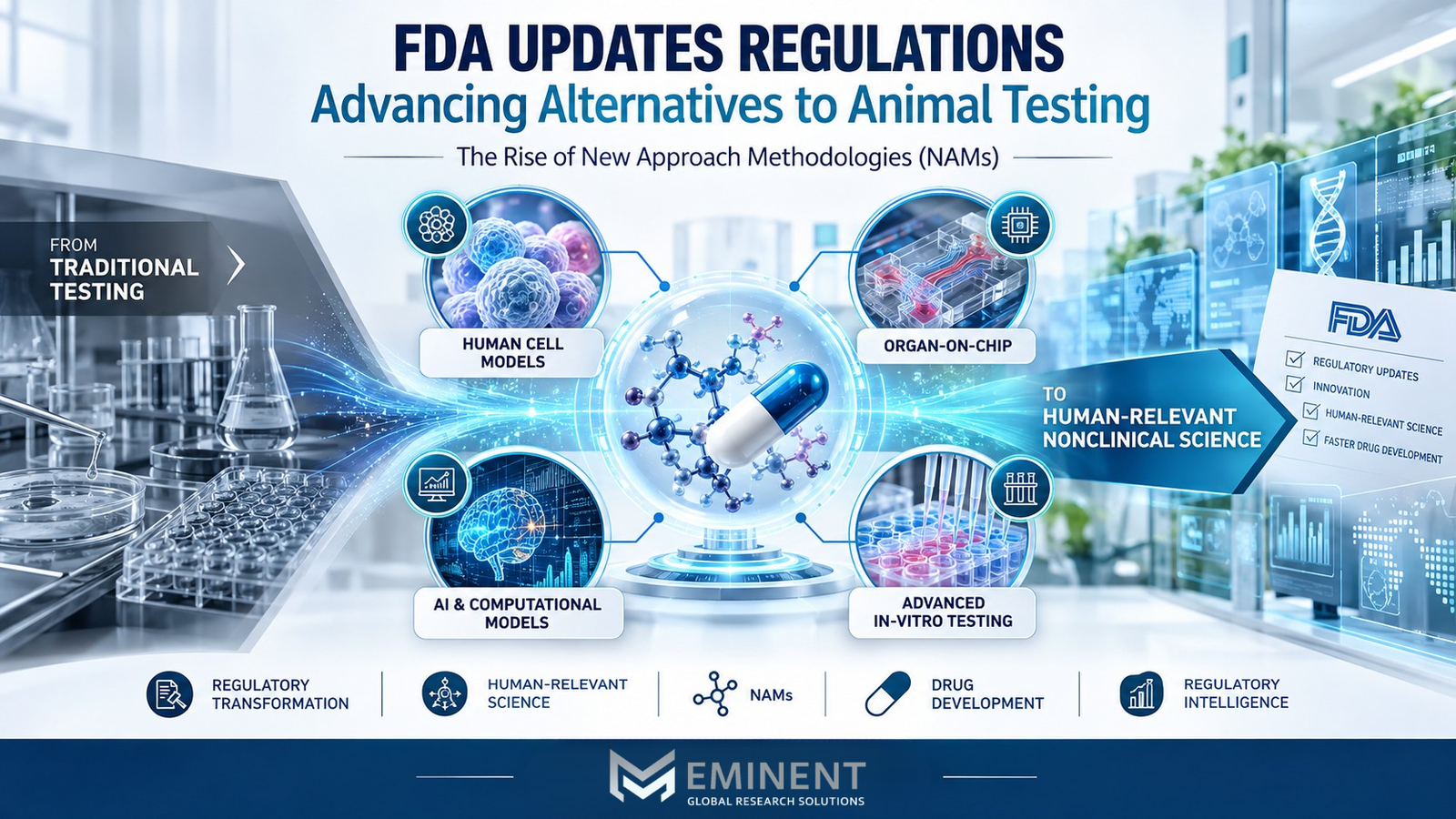
On September 21, 2026, the FDA issued a direct final rule clarifying that scientifically appropriate non-animal methods can be used to generate safety information for drugs and biological products before they are tested in humans. The rule recognizes technologies such as human-cell-based systems, organ-on-chip platforms, computer models and other New Approach Methodologies (NAMs) as potential components of nonclinical development. U.S. Food and Drug Administration
Importantly, the change does not prohibit animal studies, eliminate existing evidentiary standards, or require drug developers to replace animal studies with a particular technology. Instead, it removes regulatory language that could imply animal testing is the only acceptable approach and creates greater flexibility around scientifically appropriate nonclinical strategies.
For pharmaceutical and biotechnology companies, the development has implications that extend beyond animal welfare. It could influence R&D strategy, regulatory planning, technology scouting, clinical development timelines, cost structures and competitive positioning.
A Shift From “Animal Testing” to “Nonclinical Testing”
Historically, animal studies have played a central role in evaluating drug safety before first-in-human trials.
However, advances in biology, computational science and human-relevant experimental systems have created new possibilities for generating nonclinical evidence.
The FDA’s updated terminology replaces references such as “animal tests” and “animal studies” with broader “nonclinical tests” and “nonclinical studies.” This aligns the regulatory framework with the broader concept recognized under the Federal Food, Drug, and Cosmetic Act following the Food and Drug Omnibus Reform Act of 2022.
The practical significance is important: the regulatory framework can accommodate multiple scientifically valid approaches rather than implicitly centering development around a single testing model.
That creates an opportunity for sponsors to think about nonclinical strategy more strategically.
What Are New Approach Methodologies?
New Approach Methodologies (NAMs) encompass a broad range of technologies and approaches designed to improve the human relevance of nonclinical testing.
Examples include:
- Human-cell-based assays
- 3D tissue models
- Organ-on-chip systems
- In-vitro toxicity platforms
- In-silico computational models
- AI-enabled prediction models
- Quantitative systems pharmacology
- Mechanistic modeling
- Integrated weight-of-evidence approaches
The FDA’s March 2026 draft guidance provides a framework for considering how NAMs can be validated and incorporated into drug-development submissions. The agency emphasizes scientific principles around study design, validation and reporting rather than prescribing a single technology.
The FDA has also created a NAMs database containing practical examples from publicly available FDA review materials, allowing developers to examine instances in which alternative methodologies have appeared in regulatory applications. However, the agency explicitly states that these examples are illustrative and do not constitute blanket approval of a particular method for future submissions.
Why This Matters for Pharmaceutical R&D
The shift could have consequences across the drug-development lifecycle.
1. Earlier technology decisions become more important
Companies developing novel therapeutics may increasingly need to determine which nonclinical technologies are scientifically appropriate before initiating major studies.
This makes technology scouting relevant not only to discovery but also to regulatory development.
A company that identifies a validated human-relevant model early could potentially integrate it into its development strategy rather than treating alternative testing as an afterthought.
2. Regulatory strategy becomes more complex
Greater flexibility does not necessarily mean simpler regulatory submissions.
NAMs must still be appropriate for the specific product, endpoint and regulatory question. The FDA continues to evaluate whether proposed nonclinical evidence is scientifically adequate.
Therefore, companies will need to understand:
Technology → Validation → Regulatory relevance → Evidence package → Submission strategy
The ability to connect these elements may become an important component of regulatory intelligence.
3. The competitive landscape could change
Companies developing proprietary organ-on-chip platforms, computational toxicology tools, AI models and advanced human-cell systems could become increasingly important partners or acquisition targets.
This creates potential opportunities for:
- Technology scouting
- Patent landscaping
- Competitive intelligence
- Licensing analysis
- Partnership identification
- M&A due diligence
For life-sciences companies, the question may increasingly shift from “Which drug technologies are emerging?” to “Which technologies can improve the probability and efficiency of successful development?”
Oncology Provides an Early Example
The FDA’s broader initiative is already affecting specific therapeutic areas.
In May 2026, the agency released draft guidance addressing streamlined nonclinical safety studies for certain oncology pharmaceuticals. The proposed approaches include situations where animal testing may be reduced, a single relevant species may be sufficient, or alternative evidence may support safety assessment.
This illustrates an important point: the transition toward NAMs is unlikely to happen uniformly across all therapeutic areas.
Different modalities may require different combinations of:
- Traditional toxicology
- Human-relevant models
- Computational evidence
- Pharmacology data
- Mechanistic understanding
- Weight-of-evidence assessments
The strategic challenge for sponsors will therefore be determining where alternative approaches genuinely add regulatory and scientific value.
The Remaining Challenge: Validation
The FDA’s regulatory change should not be interpreted as meaning that animal testing has suddenly become unnecessary.
The agency itself notes that alternative methods are not yet validated for every testing scenario and that biological complexity can make it difficult for individual models to reproduce all aspects of human physiology.
This creates a critical issue for the industry:
Scientific innovation must be accompanied by regulatory validation.
A sophisticated technology may demonstrate strong scientific potential but still require substantial validation before it can become broadly useful in regulatory decision-making.
For developers, this makes early engagement with regulatory authorities particularly important.
What Pharma and Biotech Companies Should Consider
The regulatory evolution creates several strategic questions for R&D and regulatory teams.
Technology Strategy:
Which emerging NAMs are relevant to the company’s pipeline?
Regulatory Intelligence:
Where is the FDA already accepting or evaluating alternative approaches?
IP Intelligence:
Who owns the key technologies, patents and platforms supporting these methodologies?
Competitive Intelligence:
Which competitors are incorporating NAMs into development programs?
Commercialization Strategy:
Could faster or more efficient development change the commercial potential of certain assets?
Partnership Strategy:
Which technology providers, biotech companies or academic groups could provide capabilities internally unavailable to the organization?
These questions connect regulatory developments with broader technology and market intelligence.
From Regulatory Change to Strategic Opportunity
The FDA’s September 2026 rule is best understood as part of a broader transformation in how nonclinical evidence may be generated.
Earlier in 2026, the agency reported progress under its roadmap for reducing animal testing, including initiatives involving NAMs, streamlined nonclinical programs and new mechanisms for evaluating innovative methods.
The September rule adds an important regulatory dimension by explicitly broadening the terminology and framework around nonclinical testing.
For pharmaceutical and biotechnology companies, the opportunity is not simply to reduce animal studies.
It is to build more scientifically integrated development strategies in which human-relevant biology, computational models, advanced in-vitro systems and traditional approaches can be evaluated based on the specific scientific question.
That could make regulatory intelligence, technology scouting, IP landscaping and commercialization strategy increasingly interconnected.
The companies that systematically monitor this transition may be better positioned to identify emerging technologies, potential partnerships and new development models as the regulatory environment evolves.
The future of nonclinical development may not be defined by one replacement for animal testing. It may be defined by a more flexible evidence ecosystem.
Eminent Global Research Solutions helps pharma and life-sciences organizations evaluate emerging technologies, regulatory developments, IP landscapes, competitive intelligence and commercialization opportunities.