

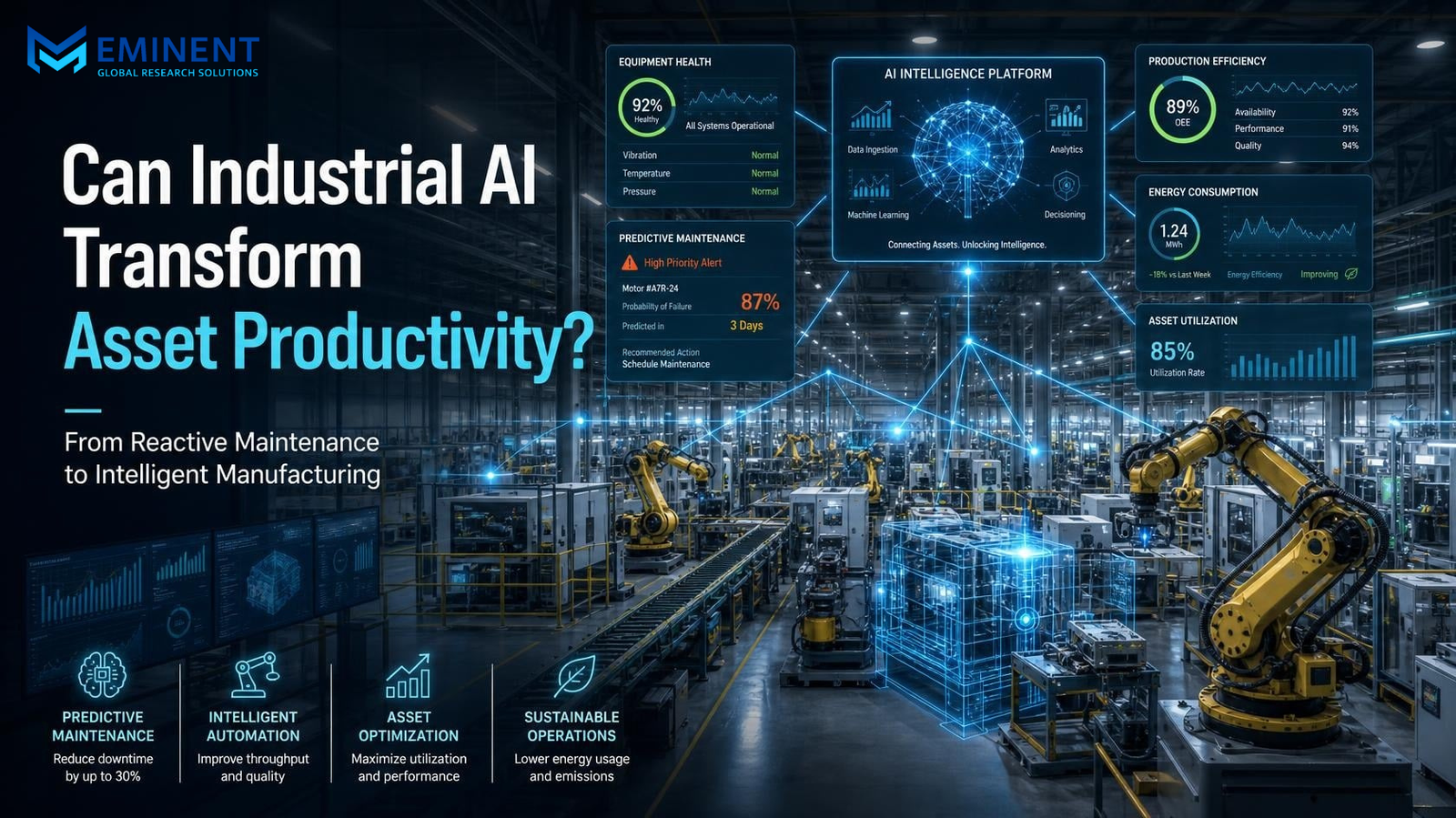
Manufacturing is entering a new phase of digital transformation. For decades, companies invested in automation, enterprise software, industrial sensors, and connected machinery to improve productivity. Yet many manufacturing organizations still operate with fragmented data, reactive maintenance processes, and limited visibility into the true performance of their industrial assets.
Industrial Artificial Intelligence (AI) is changing that equation.
By combining machine learning, industrial IoT, computer vision, predictive analytics, digital twins, and real-time operational data, Industrial AI can transform how factories monitor, maintain, and optimize equipment.
The opportunity extends far beyond reducing machine downtime. When deployed effectively, Industrial AI can improve asset utilization, production planning, quality, energy efficiency, maintenance productivity, and overall manufacturing economics.
For global manufacturers, the strategic question is therefore no longer whether AI can be used inside factories. The more important question is whether organizations can scale Industrial AI across their asset base and convert technological capabilities into measurable business value.
From Automation to Intelligent Manufacturing
Traditional industrial automation focuses primarily on predefined processes.
Machines are programmed to perform specific tasks repeatedly and consistently. This approach has delivered enormous productivity improvements, but conventional automation has limitations. It generally responds to predefined conditions rather than dynamically learning from changing operational environments.
Industrial AI introduces a more adaptive layer.
AI systems can analyze large volumes of operational information from machines, sensors, production lines, maintenance systems, and quality-control processes. Instead of simply executing instructions, these systems can identify patterns, detect anomalies, predict potential failures, and recommend operational adjustments.
This creates the possibility of moving from:
Reactive manufacturing → Predictive manufacturing → Intelligent manufacturing
The difference is strategically significant.
A factory that reacts after equipment failure has already incurred downtime. A factory that predicts equipment degradation can potentially intervene before failure occurs.
Asset Productivity Is the Bigger Opportunity
Manufacturers often focus on equipment utilization, but asset productivity is a broader concept.
It encompasses how effectively machinery, production lines, energy systems, facilities, and human resources contribute to output and profitability.
Industrial AI can potentially improve several dimensions simultaneously:
- Equipment availability
- Overall equipment effectiveness
- Maintenance efficiency
- Production throughput
- Product quality
- Energy consumption
- Material utilization
- Production scheduling
For example, an AI system analyzing vibration, temperature, pressure, and historical maintenance data could identify early indicators of equipment degradation.
Instead of following a rigid maintenance schedule or waiting for a breakdown, maintenance teams can prioritize interventions based on actual asset condition.
This can reduce unnecessary maintenance while improving equipment reliability.
The result is not simply lower maintenance costs. It can also increase production availability and improve return on expensive industrial assets.
Predictive Maintenance Becomes More Intelligent
Predictive maintenance is one of the most established Industrial AI applications.
However, the technology is evolving beyond basic alerts.
Modern AI systems can analyze multiple variables simultaneously and identify relationships that may not be obvious to human operators.
For complex manufacturing environments, this creates opportunities to predict:
- Component failure
- Equipment degradation
- Production anomalies
- Quality deviations
- Energy inefficiencies
- Process instability
The commercial value can be substantial.
A single unexpected failure in a high-value production environment can disrupt production schedules, create supply shortages, increase overtime costs, and potentially damage customer relationships.
Preventing even a small number of critical failures can therefore generate significant financial returns.
AI Can Improve More Than Maintenance
One of the biggest misconceptions about Industrial AI is that its primary purpose is predictive maintenance.
In reality, AI can influence almost every stage of manufacturing operations.
Production Optimization
AI can analyze production data to identify bottlenecks and recommend adjustments to improve throughput.
Quality Management
Computer vision and machine learning can identify defects earlier and potentially reduce scrap and rework.
Energy Optimization
AI can identify patterns in energy consumption and recommend changes to reduce unnecessary usage without compromising production.
Supply Chain Coordination
AI can connect production requirements with inventory, demand, and supplier information to improve planning.
Workforce Productivity
AI-enabled decision-support systems can provide operators and maintenance teams with real-time insights, reducing the time required to diagnose operational problems.
This makes Industrial AI a cross-functional technology rather than a standalone maintenance tool.
The Data Challenge
Despite its potential, Industrial AI cannot succeed without reliable data.
Many manufacturing organizations operate legacy equipment that was never designed to generate modern digital data. Different plants may also use different machines, software platforms, communication protocols, and maintenance systems.
This creates significant data fragmentation.
Before implementing sophisticated AI systems, manufacturers may need to address:
- Sensor coverage
- Data quality
- Data standardization
- Connectivity
- Legacy equipment integration
- Cybersecurity
- Data governance
This is why successful Industrial AI programs usually begin with an assessment of the existing digital infrastructure.
The objective should not be to deploy AI everywhere immediately.
Instead, organizations should identify assets and processes where AI can generate measurable value and then develop a scalable architecture around those use cases.
From Pilot Projects to Enterprise Scale
Many manufacturers have already experimented with AI through isolated pilot programs.
The bigger challenge is scaling successful pilots across multiple factories, regions, and asset categories.
A solution that works in one facility may not automatically work in another because of differences in equipment, operating conditions, workforce capabilities, or data availability.
Manufacturers therefore need a structured scaling strategy.
A practical approach could involve:
1. Identify high-value assets
Prioritize equipment where downtime or inefficiency has significant financial consequences.
2. Establish measurable KPIs
Define success through metrics such as downtime reduction, throughput improvement, maintenance cost reduction, or energy savings.
3. Develop a scalable data architecture
Ensure that information from different machines and facilities can be integrated effectively.
4. Build workforce capabilities
Train engineers, operators, and maintenance professionals to work alongside AI systems.
5. Scale proven use cases
Expand successful solutions across plants only after demonstrating measurable business value.
This approach can help manufacturers avoid large technology investments without clear commercial outcomes.
The Human Factor Remains Critical
Industrial AI does not eliminate the importance of human expertise.
Experienced engineers and operators possess contextual knowledge that may not exist within historical datasets.
The strongest manufacturing environments will therefore combine human expertise with machine intelligence.
AI can identify patterns and provide recommendations, while experienced professionals validate those insights and make operational decisions.
This human-AI collaboration can be particularly valuable in complex industrial environments where safety, quality, and production continuity are critical.
Workforce transformation will consequently become an important part of Industrial AI strategy.
Companies will need employees who understand both manufacturing operations and digital technologies.
Industrial AI and the Competitive Manufacturing Landscape
As global manufacturing becomes increasingly competitive, productivity improvements can directly influence market positioning.
Companies able to produce more efficiently, maintain higher equipment availability, reduce waste, and respond faster to changing demand may achieve meaningful advantages over competitors.
Industrial AI can therefore move from being an IT initiative to becoming a core business strategy.
The most advanced manufacturers may eventually operate highly connected production environments where machines continuously communicate with AI systems, digital twins simulate operational scenarios, and decision-support platforms optimize production in real time.
This creates the foundation for the next generation of intelligent factories.
What Manufacturers Should Do Now
Organizations considering Industrial AI should avoid approaching the technology simply as another digital transformation project.
The starting point should be business value.
Manufacturers should ask:
Where are our largest productivity losses?
Which assets create the greatest financial risk when they fail?
Where can better data improve operational decisions?
Which AI use cases can generate measurable ROI within a reasonable timeframe?
Do we have the workforce and infrastructure required to scale these solutions?
Answering these questions can help companies prioritize investments based on business impact rather than technological excitement.
The Future of Asset Productivity
Industrial AI has the potential to fundamentally change how manufacturers think about productivity.
The future factory will not simply contain automated machines. It will increasingly consist of intelligent, connected assets capable of generating data, learning from operational patterns, and supporting continuous optimization.
For global manufacturers, this creates an opportunity to transform asset productivity from a periodic improvement initiative into a continuous intelligence-driven process.
The organizations that succeed will likely be those that combine AI technology, industrial expertise, data infrastructure, workforce development, and commercialization discipline.
Industrial AI is therefore not simply about making factories smarter.
It is about making industrial assets work harder, operate more reliably, and generate greater economic value.
For manufacturers competing in an increasingly complex global market, that could become one of the most important sources of competitive advantage over the next decade.