

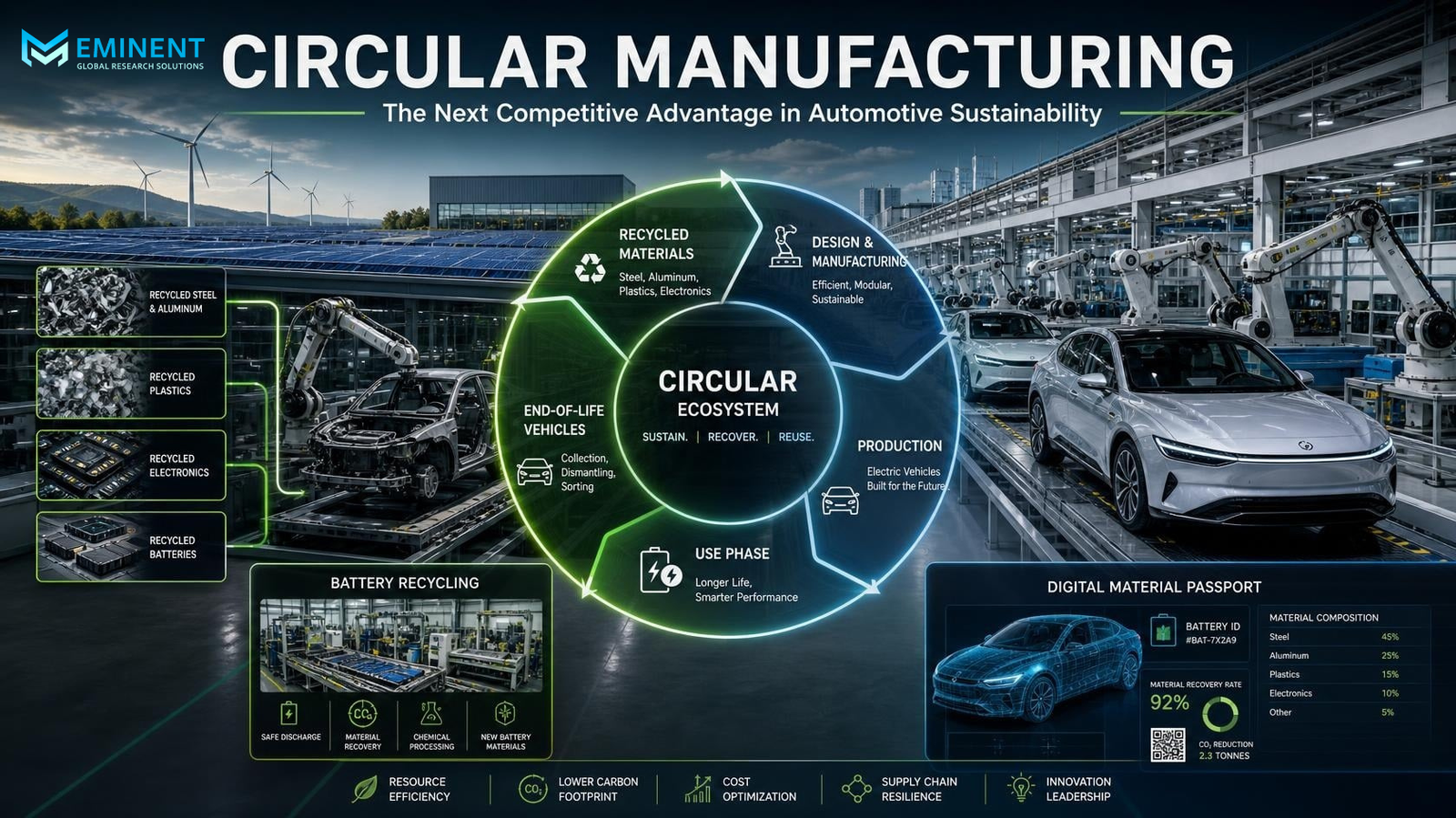
The automotive industry is undergoing a fundamental transformation. Electrification, connected vehicles, autonomous technologies, and software-defined architectures are changing how vehicles are designed and manufactured. Yet another transformation is becoming increasingly important: the shift from linear manufacturing toward circular manufacturing.
For decades, the automotive value chain has largely followed a linear model extract raw materials, manufacture components, assemble vehicles, sell them, and eventually dispose of or recycle them. As pressure increases around carbon emissions, resource scarcity, waste generation, and supply-chain resilience, this model is becoming increasingly difficult to sustain.
Circular manufacturing offers an alternative. Instead of treating vehicles and their components as products with an eventual end-of-life, manufacturers can design systems where materials, components, and resources remain in productive use for as long as possible.
For automakers, this is not simply an environmental initiative. Circularity could become a strategic opportunity to reduce costs, strengthen supply chains, improve resource security, and create new sources of commercial value.
From Linear Production to Circular Manufacturing
Traditional automotive manufacturing depends on enormous volumes of raw materials, including steel, aluminum, plastics, copper, lithium, nickel, cobalt, and other specialty materials.
As global vehicle production increases and electric vehicles require additional critical minerals, concerns surrounding resource availability and material costs are becoming more significant.
Circular manufacturing seeks to address this challenge by keeping materials within the economic system rather than continuously extracting new resources.
This can involve:
Designing vehicles for easier disassembly
Increasing the use of recycled materials
Remanufacturing components
Reusing vehicle parts
Recycling batteries and electronic components
Extending vehicle lifecycles
Recovering valuable materials at end-of-life
The objective is not simply to recycle more. It is to redesign the entire product lifecycle so that waste becomes a potential resource.
Why Circularity Matters for Automakers
The strategic importance of circular manufacturing extends beyond sustainability reporting.
Automakers are increasingly exposed to fluctuations in commodity prices, geopolitical risks, supply-chain disruptions, and shortages of critical materials. A more circular production model could provide an additional source of materials and reduce dependence on virgin resources.
For example, recovering valuable materials from end-of-life vehicles and batteries can create secondary supply streams that complement traditional mining and raw-material procurement.
This could become particularly important for electric vehicles.
EV batteries contain valuable materials that require significant resources to extract and process. As the number of EVs on the road increases, battery recycling and second-life applications could become increasingly important components of the automotive ecosystem.
Circularity therefore has the potential to become a supply-chain resilience strategy as much as an environmental strategy.
Designing Vehicles for Circularity
One of the most important changes must happen at the product-development stage.
Vehicles traditionally are not always designed with disassembly, repair, remanufacturing, or material recovery as primary objectives. Circular manufacturing requires engineers to consider the entire lifecycle of a vehicle before production begins.
This means asking different questions during product development:
Can components be easily removed and replaced?
Can materials be separated efficiently at the end of the vehicle’s life?
Can batteries be repaired, repurposed, or recycled?
Can individual modules be remanufactured rather than discarded?
Can recycled materials meet required performance and safety standards?
These questions shift sustainability from an end-of-life activity into an engineering and product-development discipline.
Digital technologies can support this transformation. Digital twins, product lifecycle management platforms, AI, advanced material databases, and traceability systems can help manufacturers understand where materials are used and how components can be recovered.
The Battery Opportunity
Battery circularity is likely to become one of the most strategically important areas for electric vehicle manufacturers.
As EV adoption grows, the industry will eventually face increasing volumes of used batteries. Instead of treating these batteries as waste, manufacturers can develop systems for reuse, refurbishment, second-life applications, and material recovery.
Some batteries may no longer be suitable for demanding automotive applications but could potentially support stationary energy storage applications.
Other batteries can be processed to recover valuable materials for future battery production.
This creates the possibility of a more circular battery ecosystem:
Raw materials → Battery manufacturing → EV use → Second-life applications → Material recovery → New battery production
Such systems could reduce material waste while improving long-term resource efficiency.
However, achieving this requires investment in collection networks, battery diagnostics, recycling infrastructure, safety systems, and specialized processing capabilities.
Circular Manufacturing Can Create New Business Models
Circularity can also change how automakers generate revenue.
Traditional automotive economics are primarily based on selling new vehicles and replacement parts. Circular business models introduce additional opportunities.
These could include:
Vehicle refurbishment
Component remanufacturing
Battery-as-a-service models
Certified used components
Battery second-life services
Recycling partnerships
Subscription-based mobility models
Remanufactured components, for example, can provide customers with lower-cost alternatives while allowing manufacturers to capture additional value from existing materials.
This creates a shift from a product-centric model toward a lifecycle-centric business model.
The automakers that understand this transition early may be able to develop new revenue streams while simultaneously reducing environmental impact.
The Role of Supply Chain Partnerships
Circular automotive manufacturing cannot be achieved by automakers alone.
It requires collaboration across the entire ecosystem, including suppliers, recyclers, battery manufacturers, technology companies, logistics providers, dealerships, and material processors.
Strategic partnerships can help companies develop closed-loop systems for specific materials or components.
For example, an automaker could collaborate with suppliers and recycling companies to recover aluminum or battery materials from vehicles and feed those materials back into future production.
Such closed-loop arrangements could create greater visibility across the supply chain while reducing dependence on external raw-material markets.
This is where market intelligence and strategic planning become particularly important.
Companies need to identify which materials represent the greatest supply risk, which technologies are commercially viable, and which partnerships can generate measurable economic value.
The Challenges Should Not Be Underestimated
Despite its potential, circular manufacturing is not easy to implement.
Companies must address several challenges, including:
Cost: Recycling, remanufacturing, and recovery infrastructure require significant investment.
Technology: Efficiently separating complex automotive materials can be technically challenging.
Quality: Recycled materials must meet stringent automotive performance and safety requirements.
Traceability: Manufacturers need reliable data regarding material composition and component history.
Consumer behavior: Vehicle owners need convenient mechanisms for returning vehicles, batteries, and components.
Business model transformation: Circularity may require companies to rethink traditional revenue and ownership models.
Therefore, organizations should not approach circular manufacturing as a single sustainability project. It should be evaluated as a long-term transformation of product development, manufacturing, procurement, supply chain, and commercialization strategy.
What Should Automakers Do Next?
Automotive companies considering circular manufacturing can begin by identifying the highest-value opportunities within their existing operations.
A strategic roadmap could include:
Mapping critical materials across the vehicle lifecycle.
Identifying components with strong remanufacturing potential.
Evaluating battery reuse and recycling opportunities.
Assessing recycled-material availability and quality.
Building partnerships with circular-economy technology providers.
Integrating circularity into new product development.
Measuring both environmental and financial returns.
The objective should be to identify where circularity can simultaneously improve sustainability and business performance.
The Strategic Future of Automotive Sustainability
Circular manufacturing could become one of the defining strategic shifts in the automotive industry.
The transition toward EVs has already changed the industry’s relationship with energy and raw materials. The next stage may involve changing how those materials move through the automotive lifecycle.
The most successful companies will likely move beyond simply reducing emissions and begin designing systems that minimize waste, recover valuable materials, extend product lifecycles, and create new commercial opportunities.
For automakers, suppliers, investors, and technology companies, circular manufacturing should therefore be viewed not merely as an ESG initiative, but as a potential source of competitive advantage.
The question is no longer simply whether automotive manufacturing can become more sustainable.
The bigger question is whether companies can build a circular automotive ecosystem that is economically viable, technologically scalable, and commercially attractive.
Those that succeed could gain advantages in resource security, supply-chain resilience, cost efficiency, innovation, and brand differentiation positioning circularity as a core component of the next generation of automotive growth.