

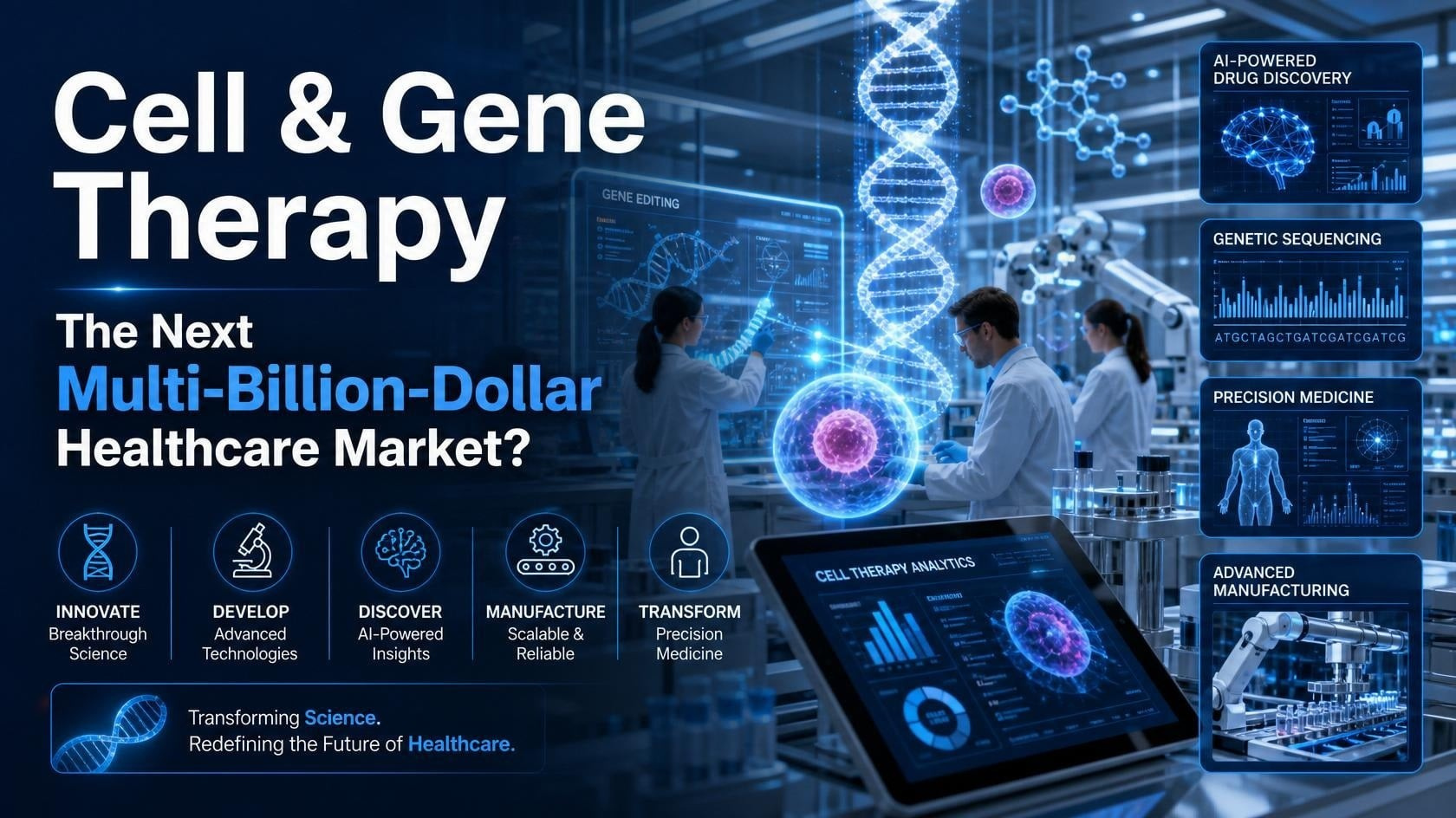
The global healthcare industry is undergoing one of its most significant transformations since the rise of biologics. Cell and gene therapies, once considered highly experimental, are rapidly evolving into commercially viable treatment platforms with the potential to redefine how diseases are treated. From inherited genetic disorders to cancer and autoimmune diseases, these advanced therapies are moving healthcare beyond symptom management toward potentially curative interventions.
With increasing regulatory approvals, growing investment, expanding manufacturing capacity, and continuous scientific breakthroughs, cell and gene therapy (CGT) is emerging as one of the fastest-growing segments in the life sciences industry. What was once a niche area of biotechnology is now attracting major pharmaceutical companies, venture capital firms, healthcare providers, and governments seeking to build leadership in next-generation medicine.
For healthcare organizations, investors, and life sciences companies, the key question is no longer whether cell and gene therapies will transform healthcare but how quickly organizations can position themselves to capitalize on this rapidly expanding market.
A New Era of Precision Medicine
Traditional pharmaceuticals have largely focused on controlling disease symptoms or slowing disease progression. Cell and gene therapies introduce a fundamentally different approach by targeting the underlying biological cause of disease.
Gene therapies aim to replace, repair, or modify defective genes responsible for inherited conditions, while cell therapies use living cells to restore, replace, or enhance biological functions. These approaches have demonstrated remarkable potential across several therapeutic areas, including:
- Rare genetic disorders
- Hematologic cancers
- Solid tumors
- Autoimmune diseases
- Neurological disorders
- Ophthalmic diseases
- Cardiovascular conditions
Rather than requiring lifelong treatment, many cell and gene therapies are designed as one-time or limited-administration treatments capable of delivering long-term clinical benefits.
This shift is redefining both patient expectations and pharmaceutical business models.
Why the Market Is Growing So Rapidly
Several factors are accelerating the commercialization of cell and gene therapies.
1. Scientific Breakthroughs
Advances in gene editing technologies, viral vector engineering, stem cell biology, and synthetic biology have significantly improved the safety and effectiveness of advanced therapies.
Innovations such as CRISPR gene editing, CAR-T cell therapies, and next-generation viral delivery systems are expanding the range of diseases that may become treatable.
2. Regulatory Support
Regulatory agencies worldwide are increasingly creating accelerated pathways for therapies addressing serious diseases and unmet medical needs.
Priority review programs, orphan drug incentives, and adaptive regulatory frameworks are helping reduce development timelines while encouraging innovation.
3. Rising Investment
Global investment in biotechnology continues to grow as investors recognize the long-term commercial potential of advanced therapies.
Major pharmaceutical companies are acquiring innovative biotech firms, forming strategic partnerships, and expanding internal cell and gene therapy capabilities.
4. Expanding Clinical Pipeline
Hundreds of cell and gene therapy candidates are currently progressing through clinical development across multiple disease categories.
As more therapies receive regulatory approval, commercialization is expected to accelerate significantly during the coming decade.
Commercialization Is the Next Competitive Battlefield
Scientific innovation alone is no longer sufficient for market leadership.
As the field matures, commercialization capabilities are becoming equally important.
Organizations must now address challenges including:
- Regulatory strategy
- Manufacturing scalability
- Global market access
- Pricing and reimbursement
- Supply chain resilience
- Physician education
- Patient identification
- Long-term outcome monitoring
Companies that successfully integrate these capabilities into their commercialization strategies will be better positioned to achieve sustainable market success.
Manufacturing: The Industry’s Biggest Challenge
Unlike conventional pharmaceuticals, cell and gene therapies require highly specialized manufacturing processes.
Production often involves:
- Viral vector manufacturing
- Cell harvesting and processing
- Cryogenic storage
- Personalized production workflows
- Stringent quality assurance
- Cold-chain logistics
Building scalable manufacturing infrastructure requires significant investment and technical expertise.
Many organizations are partnering with specialized Contract Development and Manufacturing Organizations (CDMOs) to accelerate commercialization while reducing capital expenditures.
Companies that establish reliable manufacturing capabilities early may gain significant competitive advantages as market demand increases.
Pricing and Reimbursement Must Evolve
One of the defining characteristics of many cell and gene therapies is their potential to provide long-term or even curative benefits through a single treatment.
However, these therapies often carry substantial upfront costs.
This creates new challenges for healthcare systems and payers, who must balance short-term expenditure with long-term health and economic benefits.
Emerging reimbursement models include:
- Outcomes-based agreements
- Installment payment models
- Risk-sharing contracts
- Value-based pricing
- Long-term performance guarantees
Organizations that proactively develop innovative pricing strategies may improve patient access while supporting sustainable commercial growth.
Global Expansion Creates New Opportunities
While North America and Europe currently lead the commercialization of cell and gene therapies, Asia-Pacific is rapidly becoming a major innovation hub.
Countries including China, Japan, South Korea, and Singapore are investing heavily in:
- Biotechnology infrastructure
- Clinical research
- Advanced manufacturing
- Regulatory modernization
- Precision medicine initiatives
This regional growth creates opportunities for multinational companies seeking to expand manufacturing, clinical development, and commercialization activities globally.
Market intelligence and regional regulatory expertise will become increasingly valuable as competition intensifies across international markets.
Consulting Perspective: Building Competitive Advantage
The rapid expansion of the cell and gene therapy market is creating demand for strategic advisory services across the healthcare ecosystem.
Organizations increasingly require expertise in:
- Market opportunity assessment
- Competitive intelligence
- Technology scouting
- Regulatory strategy
- Commercialization planning
- Manufacturing optimization
- Market access strategy
- Partnership identification
For consulting firms, supporting clients through these complex strategic decisions represents a growing opportunity as advanced therapies continue to reshape the pharmaceutical landscape.
Companies that align scientific innovation with commercial execution will be better positioned to capture long-term value.
Looking Ahead
Cell and gene therapies are no longer confined to research laboratories. They are becoming commercially viable healthcare solutions capable of transforming patient outcomes and redefining pharmaceutical business models.
As regulatory approvals increase, manufacturing technologies mature, and reimbursement frameworks evolve, the global market is expected to experience sustained growth over the coming years.
Success in this emerging sector will depend not only on scientific excellence but also on strategic execution. Organizations that invest in scalable manufacturing, regulatory expertise, commercialization planning, and global market intelligence today may become the market leaders of tomorrow.
For healthcare innovators, investors, and life sciences companies, the rise of cell and gene therapy represents more than a technological breakthrough—it marks the beginning of a new era in precision medicine and one of the most significant commercial opportunities in modern healthcare.
Key Takeaways
- Cell and gene therapies are transitioning from experimental treatments to commercially viable healthcare solutions.
- Growth is being driven by scientific innovation, regulatory support, and increased investment.
- Manufacturing scalability, reimbursement strategies, and commercialization capabilities will determine future market leaders.
- Asia-Pacific is emerging as a major hub for advanced therapy development and commercialization.
- Companies that invest early in strategic capabilities will be better positioned to capture long-term growth opportunities.