

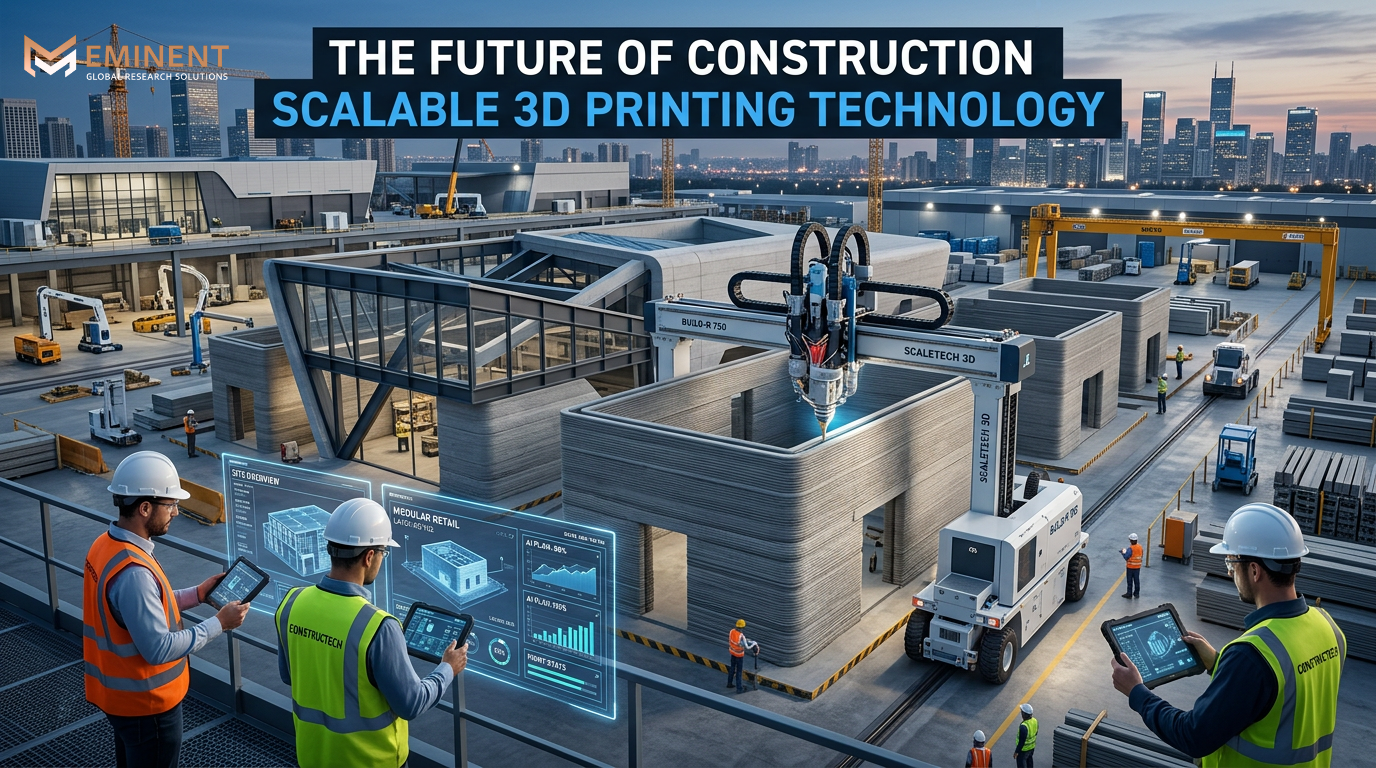
Walmart’s partnership with Alquist 3D to develop one of the largest commercial 3D-printing construction projects in the United States represents a major milestone in the evolution of the construction industry. What was once considered an experimental building method is now increasingly emerging as a commercially viable solution capable of addressing long-standing challenges related to construction speed, labor shortages, project scalability, and operational efficiency.
The rise of 3D-printed construction reflects a broader transformation occurring across industrial sectors where automation, robotics, advanced materials, and digital manufacturing technologies are reshaping traditional operational models.
For the construction industry, this shift could fundamentally alter how buildings are designed, manufactured, and delivered over the next decade.
As large-scale organizations begin adopting additive construction technologies for commercial infrastructure projects, the market is moving beyond pilot experimentation toward real-world scalability. This creates significant opportunities for construction firms, material suppliers, real estate developers, and infrastructure investors willing to evaluate the long-term strategic potential of automated construction systems.
However, large-scale adoption also introduces important considerations around regulatory compliance, structural quality assurance, workforce adaptation, and evolving building standards.
The companies that successfully balance innovation with operational reliability may become leaders in the next generation of construction technology.
The Construction Industry’s Need for Transformation
The global construction sector has historically faced persistent operational challenges, including:
- Labor shortages
- Rising material costs
- Project delays
- Low productivity growth
- Safety concerns
- Supply chain disruptions
Traditional construction methods often rely heavily on manual labor, fragmented workflows, and lengthy project timelines. As infrastructure demand continues to grow worldwide, these inefficiencies are becoming increasingly difficult to sustain.
At the same time, industries across manufacturing, logistics, and infrastructure are rapidly adopting automation technologies to improve speed, consistency, and cost efficiency.
Construction has been slower to digitize compared to other industrial sectors, but advancements in robotics, AI-driven design systems, and additive manufacturing are beginning to accelerate change.
3D printing technology introduces a fundamentally different construction model where buildings can be produced layer by layer using automated systems capable of reducing manual labor dependency and improving operational precision.
The Walmart-Alquist 3D project highlights how major commercial organizations are beginning to view additive construction as a scalable business solution rather than a niche experimental technology.
Why 3D Printing Is Gaining Momentum in Construction
3D-printed construction uses automated robotic systems to deposit specialized construction materials, often concrete-based mixtures, in programmed layers to create structural components.
The technology offers several potential advantages over traditional building methods:
- Faster construction timelines
- Reduced labor requirements
- Lower material waste
- Improved design flexibility
- Greater construction consistency
- Potential cost optimization
One of the most significant drivers behind adoption is speed.
Large-scale 3D-printing systems can operate continuously and automate portions of construction that would traditionally require extensive manual labor. This can shorten project schedules and improve operational efficiency, particularly in repetitive or standardized building environments.
Labor shortages are also accelerating interest in construction automation.
Many construction markets face aging workforces and declining labor availability. Automated construction technologies may help firms maintain productivity while reducing dependency on difficult-to-source skilled labor.
Additionally, additive manufacturing can reduce excess material usage by applying materials with greater precision, supporting sustainability and waste reduction goals.
As material science and printing technology continue improving, the range of commercially viable construction applications is expected to expand significantly.
Commercial Real Estate Is Becoming a Testing Ground
The involvement of a major retailer like Walmart signals growing confidence in the commercial scalability of 3D-printed construction.
Large corporations often prioritize:
- Operational efficiency
- Cost predictability
- Deployment scalability
- Standardized construction models
- Long-term infrastructure optimization
Commercial real estate provides an ideal environment for testing automated construction systems because many facilities involve repeatable layouts and high-volume development requirements.
If 3D printing can consistently deliver faster project completion and lower operational costs while maintaining structural quality, adoption could accelerate across:
- Retail infrastructure
- Warehousing and logistics
- Industrial facilities
- Affordable housing
- Hospitality projects
- Public infrastructure
This may gradually shift construction from highly labor-intensive project execution toward increasingly automated and digitally managed production systems.
The transition could resemble transformations previously seen in manufacturing industries where automation improved scalability and operational consistency.
Cost Efficiency and Scalability Potential
One of the strongest arguments supporting 3D-printed construction is its long-term cost optimization potential.
Traditional construction costs are heavily influenced by:
- Labor expenses
- Material waste
- Project delays
- Rework requirements
- Supply chain inefficiencies
Automated additive construction systems may help reduce several of these cost drivers.
For example:
- Fewer workers may be needed on-site
- Material application can become more precise
- Construction timelines may shorten
- Repetitive design elements can be standardized
- Project coordination complexity may decrease
However, large-scale cost advantages will depend heavily on achieving operational scalability.
Current 3D-printing systems still require substantial upfront investment in:
- Robotics equipment
- Specialized materials
- Software systems
- Engineering expertise
- Workforce training
Organizations evaluating adoption must carefully analyze whether projected long-term efficiency gains justify initial infrastructure and technology investments.
Scalability will also depend on how effectively additive construction integrates with broader project management, supply chain logistics, and regulatory approval processes.
Regulatory and Quality Control Challenges
Despite its potential, 3D-printed construction also introduces new regulatory and operational challenges.
Building codes and construction standards were largely developed around traditional construction methods. As additive manufacturing becomes more common, regulators and industry bodies will need to adapt standards addressing:
- Structural integrity
- Material performance
- Safety compliance
- Long-term durability
- Inspection procedures
- Quality assurance protocols
Construction firms adopting 3D-printing technologies must ensure that automated systems consistently meet evolving engineering and compliance requirements.
Quality control will become especially important as projects scale commercially.
Unlike conventional construction where issues may be corrected manually during multiple stages, automated systems require highly reliable digital planning and execution processes.
Organizations that successfully implement strong testing, inspection, and compliance frameworks may gain competitive advantages as industry standards mature.
Workforce Transformation in Construction
The rise of automated construction technologies will also reshape workforce requirements across the industry.
While 3D printing may reduce certain forms of manual labor dependency, it simultaneously creates demand for new technical skills involving:
- Robotics operation
- Construction software management
- Digital engineering
- Material science
- Automation maintenance
- AI-driven project planning
Construction companies may increasingly require hybrid workforces combining traditional engineering expertise with advanced technology capabilities.
Firms that invest early in workforce training and digital construction competencies may adapt more effectively to future industry transformation.
The Future of Automated Construction
The Walmart-Alquist 3D partnership reflects a broader shift toward industrialized and technology-driven construction ecosystems.
Over the next decade, advancements in:
- Robotics
- AI-driven design
- Additive manufacturing
- Smart materials
- Digital twins
- Automated project management
may significantly accelerate construction automation globally.
3D printing is unlikely to replace all traditional construction methods in the near term. However, it may become increasingly important for specific commercial, industrial, and infrastructure applications where speed, repeatability, and efficiency are critical.
For consulting firms, developers, construction companies, and investors, the emergence of additive construction creates growing demand for expertise in:
- Construction technology strategy
- Regulatory compliance planning
- Automation integration
- Digital infrastructure development
- Operational scalability
- Risk management
The future construction industry may be defined not only by physical building materials but also by software systems, robotics platforms, and automated manufacturing capabilities.
Companies that successfully combine technological innovation with regulatory reliability and operational scalability may lead the next era of infrastructure development.