

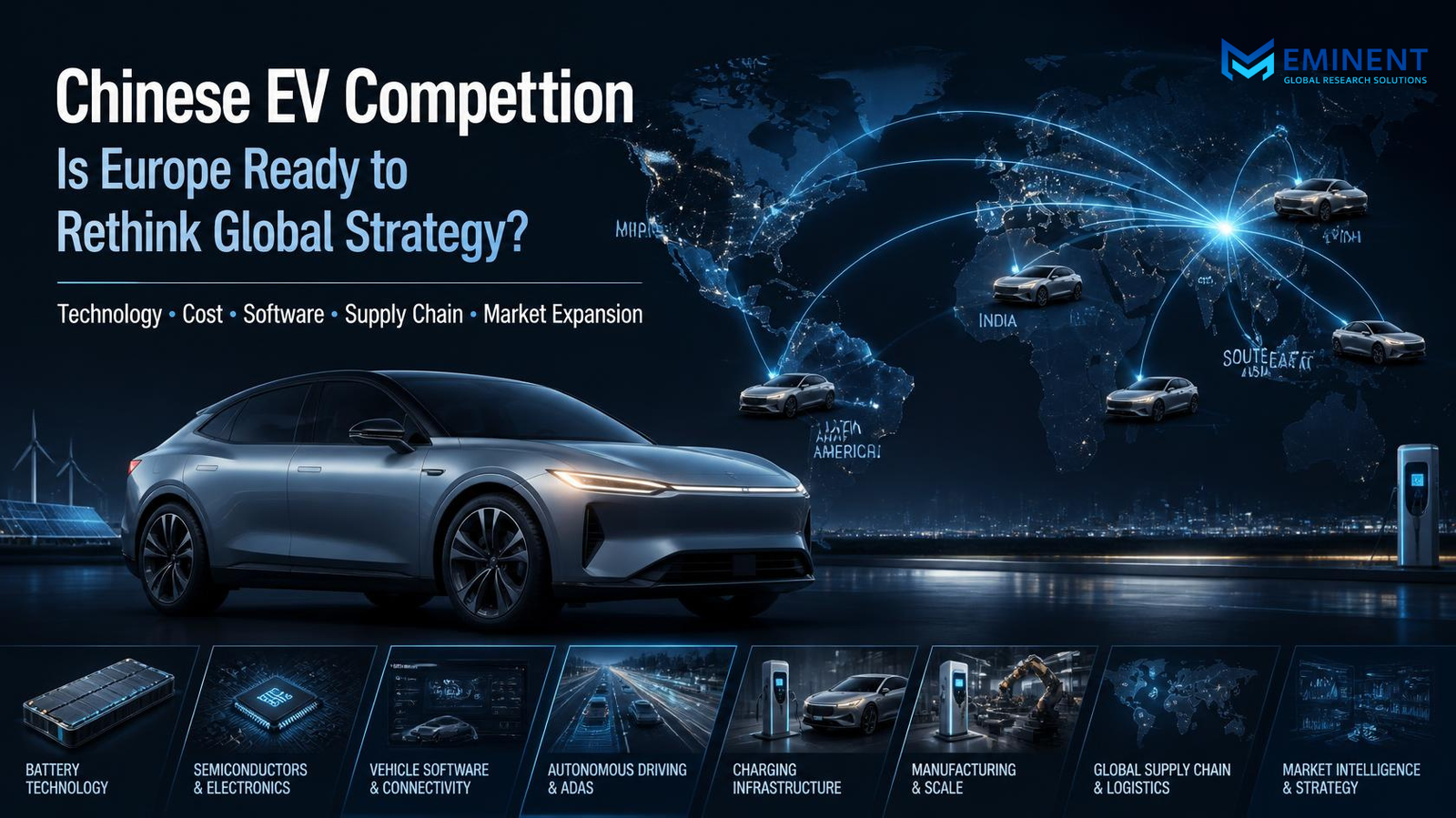
The global automotive industry is undergoing one of its most significant competitive transformations in decades. The rapid expansion of Chinese electric vehicle (EV) manufacturers is challenging established automotive leaders across technology, pricing, manufacturing, supply chains, and international market strategy.
For European automakers, the challenge extends far beyond competition in the EV segment. It raises a fundamental strategic question: Can traditional automotive companies maintain global leadership while competing against manufacturers that have built highly integrated EV ecosystems around batteries, software, electronics, manufacturing, and cost efficiency?
Chinese EV manufacturers have increasingly moved beyond their domestic market, targeting Europe, Southeast Asia, Latin America, the Middle East, and other emerging markets. Their expansion is creating new competitive dynamics that European automakers can no longer address solely through product launches or short-term pricing adjustments.
The next phase of automotive competition will increasingly depend on technology intelligence, regional market prioritization, supply-chain resilience, product localization, and commercialization strategy.
The Competitive Landscape Is Changing
For decades, European automakers built competitive advantage around engineering excellence, premium branding, performance, safety, and manufacturing quality.
These capabilities remain valuable. However, EVs are changing the sources of automotive differentiation.
Electric vehicles rely heavily on batteries, power electronics, software, semiconductors, connectivity, and digital interfaces. This has created opportunities for companies with strong capabilities in electronics and battery technology to enter and disrupt the traditional automotive market.
Chinese manufacturers have developed increasingly integrated EV ecosystems, allowing them to compete across multiple dimensions simultaneously.
Their advantages can include:
- Competitive battery costs
- High manufacturing scale
- Strong domestic supply chains
- Rapid product development cycles
- Software integration
- Broad EV model portfolios
- Aggressive international expansion
- Competitive pricing
This creates a fundamentally different competitive environment for European automakers.
The question is no longer simply whether European manufacturers can produce competitive EVs. It is whether they can innovate and commercialize them quickly enough at competitive costs while preserving their brand differentiation.
Cost Competitiveness Is Becoming Critical
One of the biggest strategic challenges facing European automakers is cost.
EV economics are heavily influenced by battery costs, raw materials, manufacturing efficiency, semiconductor availability, and supply-chain integration.
Companies with greater control over these inputs can potentially achieve lower production costs and respond more aggressively to price-sensitive markets.
European manufacturers therefore face a strategic dilemma.
Reducing prices can protect market share but potentially pressure margins and premium positioning. Maintaining higher prices protects profitability and brand equity but may create vulnerability in increasingly competitive EV segments.
The long-term answer may not be simple price competition.
Instead, automakers may need to identify where they can create differentiated value through:
Technology + Brand + Software + Customer Experience + Operational Efficiency.
Battery Technology Will Shape Competitive Advantage
Battery technology is becoming one of the most important determinants of EV competitiveness.
Range, charging speed, durability, safety, weight, and cost directly influence consumer adoption and vehicle economics.
This makes battery technology a strategic priority rather than simply a component-level engineering issue.
European automakers may need to strengthen their capabilities across:
- Battery chemistry
- Cell manufacturing
- Battery management systems
- Energy density
- Fast charging
- Battery recycling
- Second-life applications
- Critical mineral sourcing
Strategic partnerships and localized battery ecosystems could become increasingly important as automakers attempt to reduce supply-chain vulnerabilities.
For European manufacturers, competitive intelligence around battery technology will therefore become essential.
Understanding which technologies are approaching commercial scale, which suppliers are gaining momentum, and where intellectual property is concentrated can influence billions of euros in future investment decisions.
Software Is Becoming a New Battleground
The automotive competitive landscape is also shifting from mechanical engineering toward software-defined mobility.
Modern EVs increasingly depend on software for:
- Vehicle control
- Advanced driver assistance
- Infotainment
- Connectivity
- Energy management
- Over-the-air updates
- Personalized user experiences
This creates opportunities for recurring software revenue and continuous product improvement.
European automakers therefore need to compete not only on vehicle engineering but also on software development capabilities.
The ability to update vehicles after purchase can transform the traditional automotive business model from a one-time transaction into an ongoing customer relationship.
This raises another strategic question:
Should automakers increasingly become technology platforms rather than traditional vehicle manufacturers?
Those that successfully answer this question could create new revenue streams while strengthening customer retention.
Global Expansion Requires a Regional Strategy
Chinese EV competition is also forcing European automakers to reconsider how they approach international markets.
A single global product strategy may become increasingly ineffective.
Consumer preferences, charging infrastructure, regulations, purchasing power, incentives, and competitive intensity vary significantly by region.
For example, the optimal EV strategy for Western Europe may differ substantially from strategies for Southeast Asia, India, Latin America, or the Middle East.
Automakers should therefore evaluate markets based on factors such as:
- EV adoption trajectory
- Competitive intensity
- Regulatory environment
- Charging infrastructure
- Consumer purchasing power
- Local manufacturing economics
- Supply-chain availability
- Government incentives
- Technology adoption
- Partnership opportunities
This makes market prioritization a critical strategic capability.
Rather than attempting to compete everywhere simultaneously, automakers may need to identify markets where their technology, brand, manufacturing footprint, and distribution capabilities provide the strongest opportunity for sustainable growth.
Protectionism Can Change the Competitive Equation
Trade policy is another major factor influencing the global EV landscape.
Tariffs, local-content requirements, subsidies, technology regulations, and investment restrictions can significantly influence the competitiveness of imported vehicles.
European automakers therefore need to evaluate geopolitical and regulatory developments alongside traditional market indicators.
Manufacturing localization may become increasingly important.
Instead of exporting vehicles from a limited number of production hubs, manufacturers may increasingly consider regional production and supplier ecosystems to improve cost competitiveness and regulatory alignment.
This creates a need for integrated market intelligence + geopolitical intelligence + supply-chain intelligence.
What Should European Automakers Do?
The response to Chinese EV competition should not be based purely on defensive measures.
European automakers have significant strengths, including established brands, global distribution networks, engineering capabilities, manufacturing expertise, and strong customer relationships.
The opportunity is to combine these strengths with faster technology and commercial execution.
Five strategic priorities stand out:
1. Accelerate EV Innovation
Shorter product development cycles will become increasingly important. Automakers must reduce the time between technology development and commercial deployment.
2. Strengthen Battery Ecosystems
Long-term competitiveness requires stronger relationships across battery technology, raw materials, cell manufacturing, and recycling.
3. Invest in Software Capabilities
Software should increasingly become a strategic pillar rather than an engineering support function.
4. Prioritize Markets Strategically
Automakers should identify markets where they can achieve attractive growth and defendable competitive positions rather than pursuing undifferentiated global expansion.
5. Build Continuous Competitive Intelligence
Companies need systematic visibility into competitors’ products, pricing, technology roadmaps, patents, partnerships, manufacturing investments, and market-entry strategies.
Competitive intelligence should increasingly become an ongoing strategic capability rather than an occasional research exercise.
The Strategic Opportunity for European Automakers
Chinese EV competition represents a significant challenge—but it can also become a catalyst for transformation.
European automakers have an opportunity to rethink their global operating models and move toward a more technology-driven, data-driven, and regionally differentiated strategy.
The winners of the next automotive cycle may not necessarily be the companies producing the most vehicles.
They may be the companies that can identify market opportunities earlier, commercialize technology faster, manage costs more effectively, and continuously adapt their strategy to changing competitive conditions.
For European automakers, the future of global growth will therefore depend on more than winning the EV race.
It will depend on building the intelligence and strategic agility required to compete in an automotive industry where technology, geopolitics, software, batteries, and consumer expectations are converging.
The strategic question is no longer whether Chinese EV competition will reshape the automotive industry. It is whether European automakers can adapt quickly enough to shape what comes next.