

Innovation has long been recognized as one of the most powerful drivers of competitive advantage. Across industries, organizations invest billions of dollars annually in research and development (R&D), seeking breakthrough technologies that can reshape markets, improve customer experiences, and fuel long-term growth. Yet despite these substantial investments, a striking reality remains: only a small fraction of innovations successfully reach the market and generate meaningful commercial returns.
The problem is rarely a lack of innovation. Instead, many organizations struggle with the critical transition from invention to commercialization. Promising technologies often remain confined to laboratories, patent portfolios, or pilot projects because companies fail to validate market demand, develop scalable business models, secure intellectual property, or execute effective go-to-market strategies.
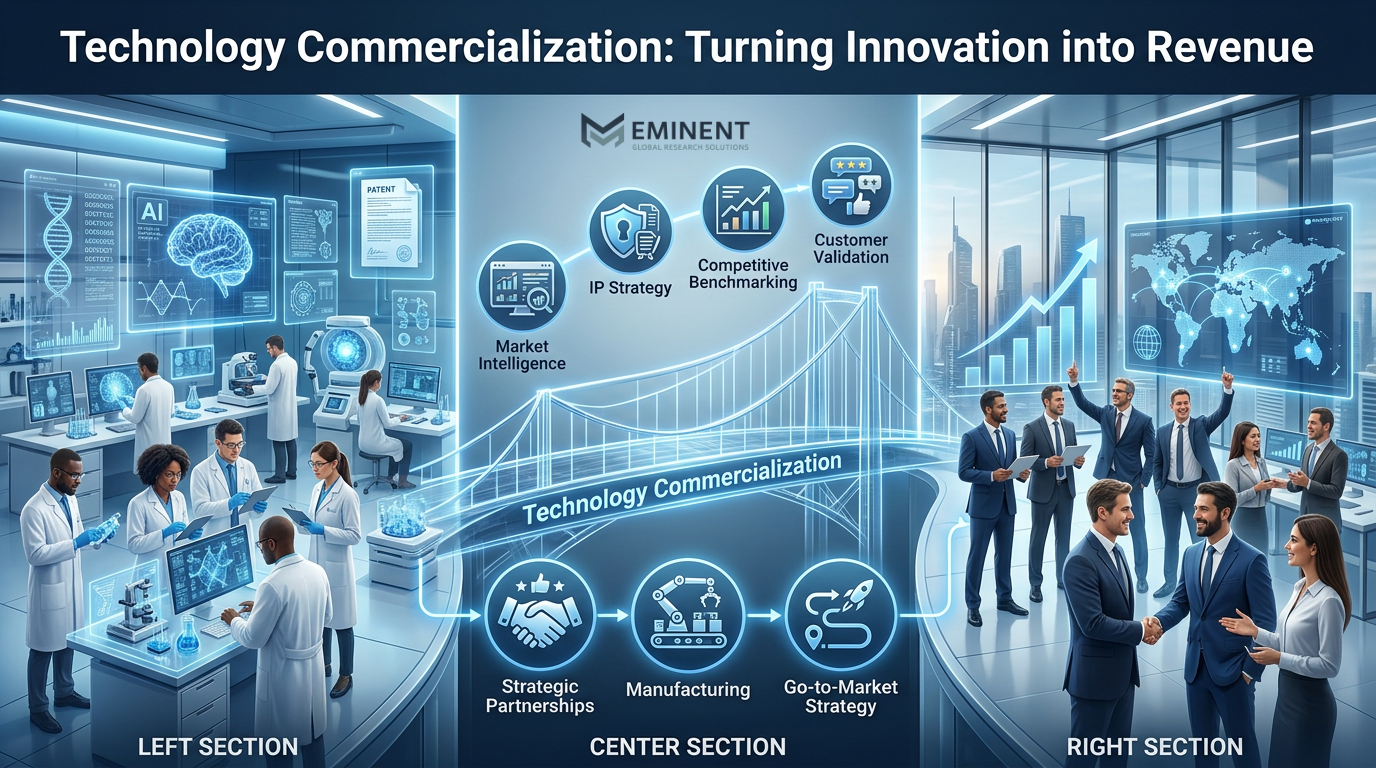
Technology commercialization bridges this gap. It transforms technical innovation into commercially viable products and services by integrating market intelligence, technology assessment, intellectual property strategy, competitive analysis, customer validation, and commercialization planning.
For organizations seeking sustainable revenue growth, commercialization is no longer a post-R&D activity—it is a strategic capability that should be embedded throughout the innovation lifecycle.
The Commercialization Gap
Many organizations measure innovation success by the number of patents filed, research projects completed, or technologies developed. While these metrics demonstrate scientific progress, they do not necessarily translate into business success.
The commercialization gap occurs when technically superior innovations fail to achieve market adoption.
Several factors contribute to this disconnect:
- Limited understanding of customer needs
- Weak market validation
- Inadequate competitive positioning
- Poor timing of product launches
- Regulatory and compliance challenges
- Manufacturing limitations
- Ineffective commercialization planning
In many cases, organizations focus heavily on solving technical problems while giving comparatively little attention to commercial viability.
As a result, products that perform exceptionally well in controlled environments often struggle to gain traction in real-world markets.
Innovation Without Market Validation Creates Risk
One of the most common reasons innovations fail is the assumption that technological superiority automatically creates market demand.
In reality, customers rarely purchase technology—they purchase solutions to business or personal problems.
Before significant investment is committed to product development, organizations should answer several fundamental questions:
- Is there a clearly defined customer problem?
- How large is the addressable market?
- Who are the primary competitors?
- What unmet needs remain underserved?
- What value proposition differentiates the innovation?
- Are customers willing to pay for the solution?
Market intelligence provides the foundation for answering these questions.
Through market sizing, customer segmentation, trend analysis, and competitive benchmarking, organizations can determine whether an innovation has genuine commercial potential before committing substantial development resources.
This significantly reduces commercialization risk while improving capital allocation decisions.
Technology Readiness Does Not Equal Market Readiness
Organizations often assume that a technology is ready for commercialization simply because technical development is complete.
However, technology readiness and market readiness are fundamentally different concepts.
Technology readiness focuses on scientific maturity, engineering performance, and product functionality.
Market readiness considers entirely different factors, including:
- Customer adoption barriers
- Pricing acceptance
- Distribution channels
- Regulatory approvals
- Manufacturing scalability
- Competitive positioning
- Service infrastructure
- Sales capabilities
An innovation may achieve outstanding technical performance while remaining commercially unprepared.
Successful commercialization requires balancing both dimensions simultaneously.
Companies that evaluate market readiness alongside technology readiness often accelerate adoption while avoiding costly launch failures.
Intellectual Property Creates Sustainable Competitive Advantage
Technology commercialization extends beyond product development.
A well-designed intellectual property (IP) strategy protects innovation while strengthening long-term competitive positioning.
Patents, trademarks, trade secrets, and licensing agreements create barriers that prevent competitors from easily replicating technological advancements.
More importantly, IP can generate value independently through licensing, partnerships, joint ventures, and technology transfer agreements.
Organizations with strong IP portfolios often gain greater negotiating power during strategic collaborations while increasing investor confidence.
Rather than treating patents as legal assets alone, leading organizations integrate IP strategy into their commercialization roadmap from the earliest stages of innovation.
Customer Discovery Should Begin Before Product Launch
Many commercialization failures occur because customer engagement begins too late.
Organizations frequently develop complete products before validating whether customers actually need them.
Customer discovery reverses this process.
Instead of asking customers to evaluate finished products, companies involve potential users early through interviews, pilot programs, prototype testing, and iterative feedback.
This approach helps organizations:
- Validate market demand
- Improve product-market fit
- Identify pricing expectations
- Refine product features
- Reduce development waste
- Accelerate customer adoption
Customer-centered commercialization creates stronger alignment between innovation and market needs.
Strategic Partnerships Accelerate Commercial Success
Few organizations possess every capability required for successful commercialization.
Technology developers may lack manufacturing capacity.
Research institutions may require commercialization expertise.
Startups often need market access.
Large corporations may seek external innovation to strengthen internal pipelines.
Strategic partnerships address these challenges by combining complementary capabilities.
Examples include:
- Technology licensing agreements
- University-industry collaborations
- Joint development partnerships
- Contract manufacturing relationships
- Distribution alliances
- Corporate venture investments
Effective partnerships reduce commercialization timelines while expanding market reach and minimizing operational risk.
Manufacturing and Supply Chain Readiness
Commercial success depends not only on creating innovative products but also on delivering them consistently and efficiently.
Manufacturing scalability often becomes a bottleneck during commercialization.
Organizations should evaluate:
- Production capacity
- Supply chain resilience
- Quality management systems
- Cost optimization
- Global sourcing strategies
- Regulatory manufacturing compliance
Products that cannot be manufactured economically at scale may struggle to achieve sustainable profitability despite strong customer demand.
Early manufacturing planning reduces commercialization delays while supporting long-term growth.
Developing an Effective Go-to-Market Strategy
Even highly innovative technologies require structured market entry strategies.
Successful go-to-market planning involves aligning multiple commercial functions, including marketing, sales, pricing, distribution, and customer support.
Key considerations include:
- Target customer prioritization
- Market segmentation
- Value proposition development
- Pricing strategy
- Channel partnerships
- Commercial launch planning
- Customer success programs
Organizations that integrate commercialization planning during product development rather than after completion typically experience faster adoption and stronger financial performance.
Measuring Commercialization Success
Innovation performance should be measured by commercial outcomes rather than technical achievements alone.
Useful commercialization KPIs include:
- Time-to-market
- Commercial adoption rate
- Revenue generated from new products
- Return on R&D investment
- Licensing revenue
- Customer acquisition cost
- Product profitability
- Market share growth
- Patent commercialization rate
- Customer retention
These metrics provide a more comprehensive understanding of how effectively organizations convert innovation into business value.
Technology Commercialization Across Industries
The importance of commercialization extends across virtually every innovation-driven industry.
In biotechnology and pharmaceuticals, commercialization determines whether scientific discoveries become approved therapies that improve patient outcomes.
Medical device companies must integrate regulatory planning, clinical validation, manufacturing, and reimbursement strategies.
Beauty and personal care organizations increasingly commercialize biotechnology, AI diagnostics, and personalized skincare solutions.
Industrial manufacturers transform advanced materials and automation technologies into scalable production systems.
Energy companies commercialize clean technologies through infrastructure partnerships and regulatory alignment.
Agriculture businesses convert precision farming innovations into commercially viable solutions that improve productivity and sustainability.
Although industries differ, the commercialization principles remain remarkably consistent.
Conclusion
Innovation creates possibility. Commercialization creates value.
Organizations that focus exclusively on scientific discovery risk leaving significant economic potential unrealized. The most successful innovators recognize that invention represents only the beginning of the journey.
True competitive advantage comes from combining technological excellence with market intelligence, intellectual property strategy, customer validation, competitive analysis, strategic partnerships, scalable operations, and disciplined commercialization planning.
At Eminent Global Research Solutions, we believe that successful innovation requires more than breakthrough technology—it requires a clear pathway to market success. Through technology intelligence, IP intelligence, market research, competitive benchmarking, and commercialization strategy, we help organizations bridge the gap between innovation and revenue generation.
As industries become increasingly technology-driven, the organizations that master commercialization will not simply invent the future—they will lead it.