
The pharmaceutical industry spends billions of dollars and years of research trying to discover new medicines. Yet, some of the most promising opportunities may already exist within drugs that have been approved, discontinued, or investigated for different diseases.
This is where drug repurposing is gaining strategic importance.
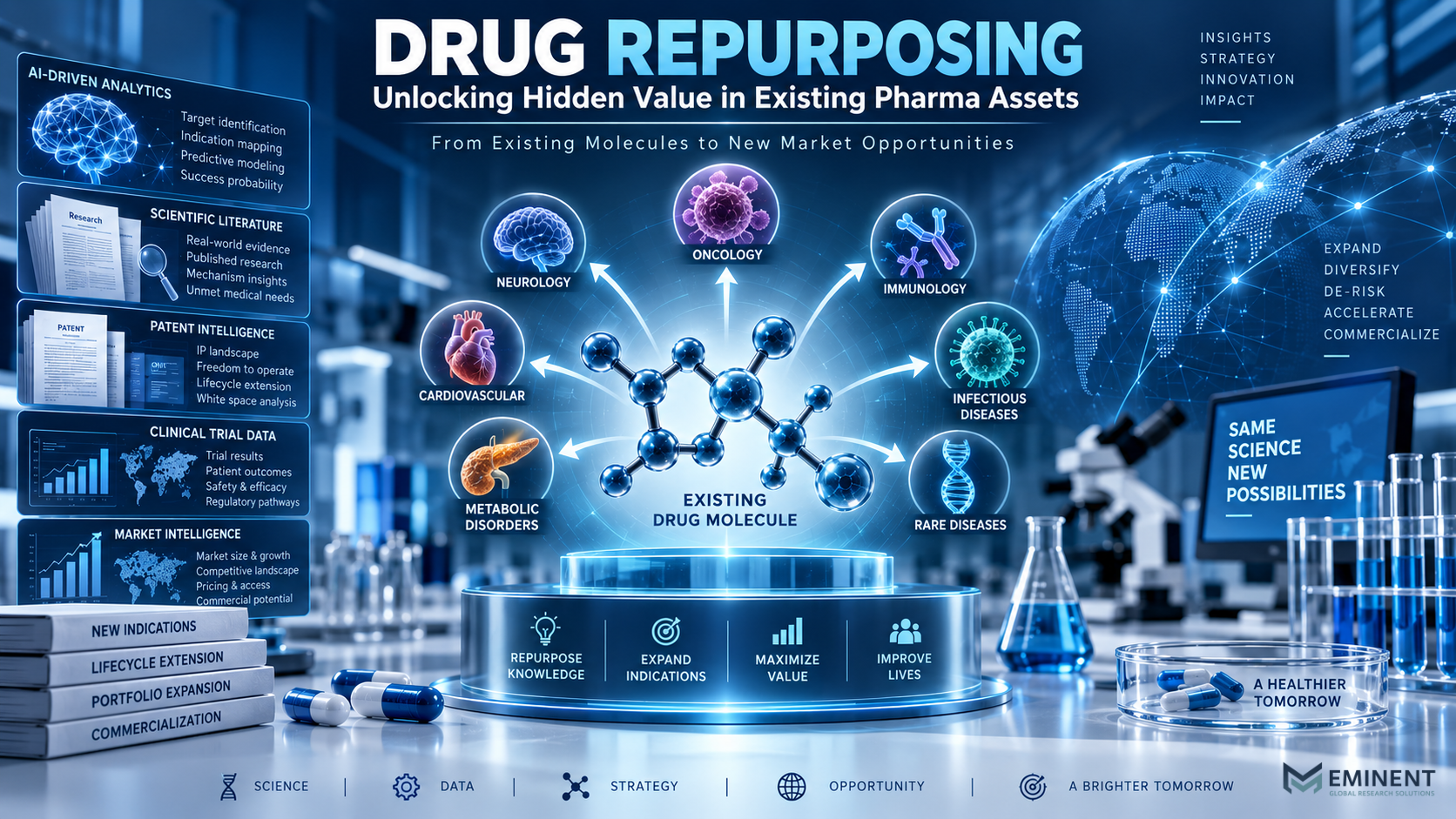
Drug repurposing identifying new therapeutic applications for existing drugs offers pharmaceutical companies a potentially faster and more capital-efficient route to innovation. Instead of starting from an entirely new molecule, companies can leverage existing knowledge around pharmacology, safety, manufacturing, and clinical development to explore new indications.
As pressure increases to control R&D costs, accelerate time to market, and improve pharmaceutical pipeline productivity, repurposing could become an increasingly important component of portfolio strategy.
The question is no longer simply whether an existing drug can treat another disease. The strategic question is whether pharmaceutical companies are systematically identifying and commercializing these opportunities before competitors do.
Why Drug Repurposing Deserves More Attention
Traditional drug discovery is inherently risky.
A promising molecule can take years to progress from discovery through preclinical studies and clinical trials, with substantial attrition at every stage. Even successful programs can require significant investment before generating commercial returns.
Drug repurposing potentially changes this equation.
An existing molecule may already have established information regarding its mechanism of action, pharmacokinetics, toxicity, manufacturing process, and clinical safety profile.
This accumulated knowledge can provide an important starting point for exploring additional indications.
Repurposing can therefore help companies:
- Expand the commercial life of existing assets
- Identify new revenue opportunities
- Reduce certain development risks
- Strengthen underutilized portfolios
- Address unmet medical needs
- Potentially accelerate development timelines
However, repurposing should not be viewed as a shortcut that eliminates clinical and regulatory requirements. New indications still require appropriate evidence demonstrating safety and efficacy.
The opportunity lies in potentially improving the economics and probability of innovation by starting with a stronger knowledge base.
The Hidden Value Within Existing Portfolios
One of the most overlooked opportunities may be sitting inside pharmaceutical companies’ existing portfolios.
A company may have compounds that were originally developed for one indication but demonstrated biological characteristics relevant to other diseases.
Similarly, previously discontinued programs may contain valuable intellectual property, clinical data, biological insights, or platform technologies that could become commercially relevant as scientific understanding evolves.
This creates a strategic opportunity for portfolio intelligence.
Companies can systematically examine their assets based on:
Mechanism of action → Biological pathway → Disease relevance → Clinical evidence → Competitive landscape → IP position → Commercial opportunity
Such analysis can reveal opportunities that may not be obvious through conventional pipeline reviews.
For example, advances in disease biology may reveal that a drug’s molecular target has relevance to another therapeutic area that was not fully understood when the asset was originally developed.
The result is a potentially valuable intersection between historical pharmaceutical data and emerging scientific knowledge.
AI Is Changing the Repurposing Equation
Artificial intelligence is further increasing the potential of drug repurposing.
Modern AI systems can analyze large volumes of biomedical information across scientific publications, clinical trials, molecular databases, patents, disease pathways, and real-world evidence.
Instead of evaluating drug-disease relationships manually, researchers can use computational approaches to identify previously overlooked connections.
AI-powered approaches can help investigate:
- Drug-target relationships
- Disease mechanisms
- Molecular pathways
- Patient subgroups
- Clinical trial outcomes
- Scientific literature
- Patent landscapes
- Real-world evidence
This creates an opportunity to move from traditional hypothesis-driven repurposing toward data-driven opportunity discovery.
The competitive advantage, however, will not come simply from possessing AI tools.
The real advantage will come from combining AI-driven discovery with scientific validation, IP analysis, regulatory intelligence, and commercial assessment.
IP Strategy Can Determine Repurposing Potential
Intellectual property is one of the most important considerations in drug repurposing.
A scientifically attractive new indication does not automatically represent a commercially attractive opportunity.
Companies need to understand whether meaningful intellectual property protection can be established around the new use, formulation, dosage, delivery mechanism, patient population, or combination therapy.
This makes IP intelligence critical.
Before investing heavily in a repurposing opportunity, organizations should evaluate:
- Existing composition-of-matter patents
- Expiration timelines
- Method-of-use patents
- Formulation opportunities
- Competitive patent filings
- Freedom-to-operate considerations
- Patent activity across target markets
A strong IP position can significantly improve the commercial attractiveness of a repurposed asset.
Conversely, weak exclusivity potential may limit the return on investment even when the clinical opportunity is compelling.
Regulatory Strategy Matters
Regulatory strategy is another critical component.
The development pathway for a repurposed drug depends heavily on the extent of existing evidence and the requirements associated with the new indication.
Companies must determine what existing clinical and nonclinical evidence can support the development program and what additional studies may be required.
Regulatory intelligence can therefore help companies identify:
- Relevant precedents
- Potential development pathways
- Clinical evidence requirements
- Regulatory risks
- Competitive approvals
- Market-specific considerations
Early regulatory assessment can prevent companies from investing in opportunities that appear attractive scientifically but face significant development barriers.
Commercial Potential Is Not Guaranteed
Drug repurposing has significant potential, but not every repurposing opportunity is commercially viable.
A new indication must be evaluated within its competitive and economic context.
Key questions include:
Is the patient population large enough?
Is there significant unmet medical need?
Are competing therapies already well established?
Can the product achieve differentiated clinical outcomes?
Does the intellectual property position support commercialization?
Will payers recognize sufficient value?
Can the existing manufacturing infrastructure support the new opportunity?
This is where market intelligence becomes essential.
Scientific feasibility should be evaluated alongside market attractiveness and commercial defensibility.
From Cost Optimization to Growth Strategy
Drug repurposing is sometimes viewed primarily as a cost-saving mechanism.
That perspective may underestimate its strategic value.
Repurposing can become a genuine growth strategy when companies use it to identify new markets, extend product lifecycles, strengthen therapeutic franchises, and address emerging healthcare needs.
For established pharmaceutical companies, it can provide an additional layer of innovation alongside traditional discovery and external business development.
For biotechnology companies, repurposed assets may provide an opportunity to enter therapeutic areas with potentially lower development risk.
For investors, systematic repurposing capabilities can reveal hidden value within pharmaceutical portfolios.
What Should Pharma Companies Do?
Organizations considering drug repurposing should adopt a structured approach rather than relying on isolated scientific opportunities.
A strategic framework could include:
1. Portfolio Mapping
Identify approved, discontinued, shelved, and underutilized assets.
2. Scientific Opportunity Screening
Evaluate new disease mechanisms, pathways, biomarkers, and emerging scientific evidence.
3. Competitive Intelligence
Assess competing development programs and treatment landscapes.
4. IP Landscape Analysis
Determine protection opportunities and potential freedom-to-operate challenges.
5. Regulatory Assessment
Understand development requirements and relevant precedents.
6. Market Attractiveness Analysis
Evaluate patient populations, unmet needs, pricing potential, competitors, and market access.
7. Commercialization Prioritization
Rank opportunities based on scientific feasibility, IP defensibility, regulatory complexity, and commercial potential.
This integrated approach can transform drug repurposing from an opportunistic research activity into a structured portfolio strategy.
The Strategic Opportunity for Life Sciences Companies
The pharmaceutical industry’s next major growth opportunities will not necessarily come from discovering entirely new molecules.
Some may emerge from reinterpreting what is already known.
Scientific knowledge continues to expand, AI is accelerating data analysis, and healthcare markets are demanding more efficient innovation models. Together, these factors create favorable conditions for drug repurposing to become a more systematic component of pharmaceutical strategy.
For pharmaceutical companies, the opportunity is to look beyond the conventional pipeline.
Existing assets may contain untapped therapeutic, intellectual property, and commercial value.
The companies that combine scientific intelligence, AI-enabled discovery, IP analysis, regulatory insight, and market intelligence may be best positioned to uncover these opportunities.
Drug repurposing may not replace traditional drug discovery.
But as pharmaceutical companies search for more efficient paths from innovation to commercialization, it could become one of the industry’s most undervalued strategic growth levers.