

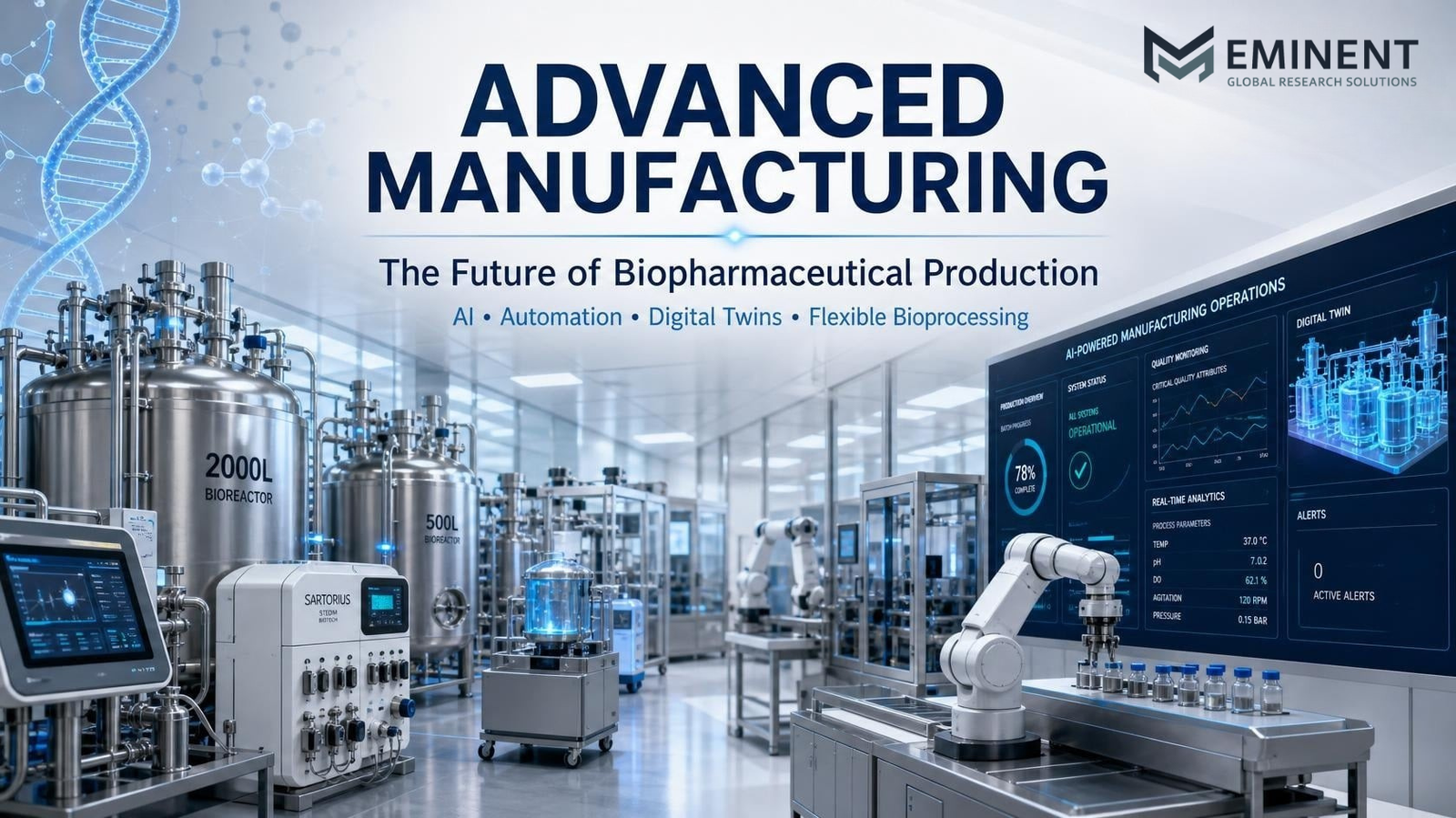
The biopharmaceutical industry is entering a new phase of manufacturing transformation. As biologics, vaccines, cell and gene therapies, and other complex medicines become increasingly important to the global healthcare market, traditional manufacturing approaches are being challenged by growing demands for flexibility, speed, quality, scalability, and cost efficiency.
Advanced manufacturing technologies are emerging as a potential solution.
From continuous bioprocessing and single-use systems to automation, artificial intelligence, digital twins, and real-time process monitoring, the next generation of biopharmaceutical manufacturing is becoming increasingly digital and data-driven.
For pharmaceutical companies, the question is no longer simply whether advanced manufacturing technologies work. The more strategic question is whether adopting them early can create a competitive advantage in an industry where manufacturing capability increasingly determines how quickly innovative therapies can reach patients.
Why Biopharmaceutical Manufacturing Is Changing
Biopharmaceutical production is fundamentally different from conventional pharmaceutical manufacturing.
Biologics are often produced through complex biological processes involving living cells, microorganisms, recombinant systems, or highly sensitive molecular structures. Maintaining consistency and quality across these processes requires sophisticated manufacturing environments and stringent controls.
At the same time, the industry is facing several pressures:
Increasing demand for biologic medicines
More complex therapeutic modalities
Shorter commercialization timelines
Manufacturing capacity constraints
Rising production costs
Greater regulatory expectations
Increasing supply-chain uncertainty
These pressures are forcing companies to rethink how pharmaceutical products are manufactured.
Advanced manufacturing provides an opportunity to redesign production systems around flexibility, automation, data integration, and real-time decision-making.
The Rise of Flexible Manufacturing Platforms
One of the most important developments is the move toward flexible and modular manufacturing.
Traditional pharmaceutical facilities often require large fixed infrastructure and significant capital investment. Such facilities can be highly effective for large-volume products but may be less suitable for emerging therapies with smaller patient populations or uncertain demand.
Advanced manufacturing technologies are changing this model.
Single-use bioprocessing equipment, modular facilities, and flexible production platforms can allow manufacturers to adapt capacity more efficiently.
This is particularly relevant for personalized medicines, rare disease therapies, and emerging cell and gene therapy products where production volumes may be relatively small but technical complexity is extremely high.
For pharmaceutical companies, flexibility can reduce the risk associated with investing heavily in fixed manufacturing infrastructure before market demand is fully established.
Automation Is Reshaping Manufacturing Operations
Automation is becoming another critical component of advanced biopharmaceutical manufacturing.
Modern facilities can integrate automated systems for material handling, process control, environmental monitoring, quality testing, and production management.
This can reduce manual intervention while improving consistency and operational efficiency.
Automation also enables manufacturers to collect significantly more process data. Instead of relying primarily on periodic sampling and manual assessments, companies can increasingly monitor production conditions continuously.
This creates opportunities for earlier detection of deviations and faster intervention.
For organizations operating highly complex manufacturing processes, these capabilities can translate into improved batch consistency, reduced downtime, and potentially lower manufacturing costs.
Artificial Intelligence and Predictive Manufacturing
Artificial intelligence is taking advanced manufacturing one step further.
Biopharmaceutical production generates enormous volumes of data from sensors, equipment, laboratory testing, environmental monitoring, and process parameters.
AI and machine learning systems can analyze these datasets to identify relationships and patterns that may not be obvious through conventional analysis.
Potential applications include:
Predictive maintenance
Process optimization
Quality prediction
Anomaly detection
Yield improvement
Production scheduling
Supply-chain forecasting
Instead of responding to manufacturing problems after they occur, companies can increasingly use predictive analytics to identify potential issues before they disrupt production.
This represents a significant shift from reactive manufacturing toward predictive manufacturing.
Digital Twins Could Transform Process Development
Digital twins are another emerging technology with significant potential for biopharmaceutical production.
A digital twin creates a virtual representation of a physical manufacturing process or facility. By combining historical and real-time data, manufacturers can simulate different scenarios and evaluate potential process changes before implementing them in the physical environment.
This can support:
Process optimization
Equipment planning
Scale-up decisions
Manufacturing troubleshooting
Facility design
Workforce training
For companies developing new biologics or advanced therapies, digital twins could reduce experimentation requirements and accelerate process development.
They may also provide valuable support when organizations transition processes from development laboratories to commercial manufacturing facilities.
Advanced Manufacturing and Cell & Gene Therapy
The importance of advanced manufacturing becomes even more apparent in cell and gene therapy.
These therapies often involve highly individualized and technically complex production processes. Traditional large-scale manufacturing approaches may not always be appropriate.
Manufacturers therefore require platforms that can support flexibility, traceability, automation, and stringent quality control.
The industry is increasingly exploring closed manufacturing systems, automated processing, decentralized production models, and digital batch records.
As cell and gene therapies expand commercially, manufacturing capabilities may become one of the most important determinants of market success.
A company may develop a scientifically groundbreaking therapy, but if it cannot manufacture that therapy consistently, efficiently, and at commercial scale, its innovation may never reach its full market potential.
Manufacturing Is Becoming a Strategic Differentiator
Historically, manufacturing was often viewed primarily as an operational function.
That perspective is changing.
In today’s biopharmaceutical environment, manufacturing can directly influence commercialization timelines, product availability, cost structures, regulatory outcomes, and market access.
Companies with scalable and reliable manufacturing platforms may be able to launch products faster and respond more effectively to changes in market demand.
This means manufacturing strategy should increasingly be considered alongside R&D, regulatory, clinical, and commercial strategy.
For pharmaceutical executives, the question should not simply be:
“How do we manufacture this product?”
It should be:
“What manufacturing model will give this product the strongest long-term competitive position?”
The Investment Challenge
Despite the opportunities, advanced manufacturing requires significant investment.
Companies must evaluate the costs of new equipment, digital infrastructure, automation systems, workforce training, technology integration, validation, and regulatory compliance.
There can also be challenges associated with integrating new technologies into legacy facilities.
For this reason, companies should avoid adopting advanced manufacturing technologies simply because they are technologically attractive.
A strategic business case should consider:
Expected productivity improvements
Total cost of ownership
Product portfolio requirements
Manufacturing capacity needs
Regulatory implications
Workforce capabilities
Scalability requirements
Long-term commercialization plans
Pilot projects and phased implementation can help organizations evaluate value before committing to large-scale transformation.
What Should Biopharma Companies Do Next?
Biopharmaceutical companies should begin treating manufacturing transformation as a strategic growth initiative rather than a technology upgrade.
Organizations can start by identifying manufacturing bottlenecks across their product portfolios and assessing where automation, AI, modular production, or advanced process technologies could create measurable value.
They should also evaluate whether their existing manufacturing infrastructure is capable of supporting the next generation of therapies.
This requires collaboration between R&D, manufacturing, regulatory, quality, supply-chain, technology, and commercial teams.
The Future of Biopharmaceutical Production
Advanced manufacturing is unlikely to replace every traditional production model. Instead, the future will probably involve a combination of conventional and advanced technologies selected according to product complexity, market demand, manufacturing scale, and therapeutic requirements.
However, the direction of travel is clear.
Biopharmaceutical manufacturing is becoming more flexible, automated, connected, predictive, and data-driven.
For pharmaceutical companies, this transformation represents both a challenge and an opportunity.
The companies that invest strategically in manufacturing capabilities today may be better positioned to reduce production risks, accelerate commercialization, improve supply resilience, and support increasingly complex therapies.
Advanced manufacturing is therefore more than an operational evolution.
It could become one of the defining competitive advantages of the next generation of biopharmaceutical companies.