

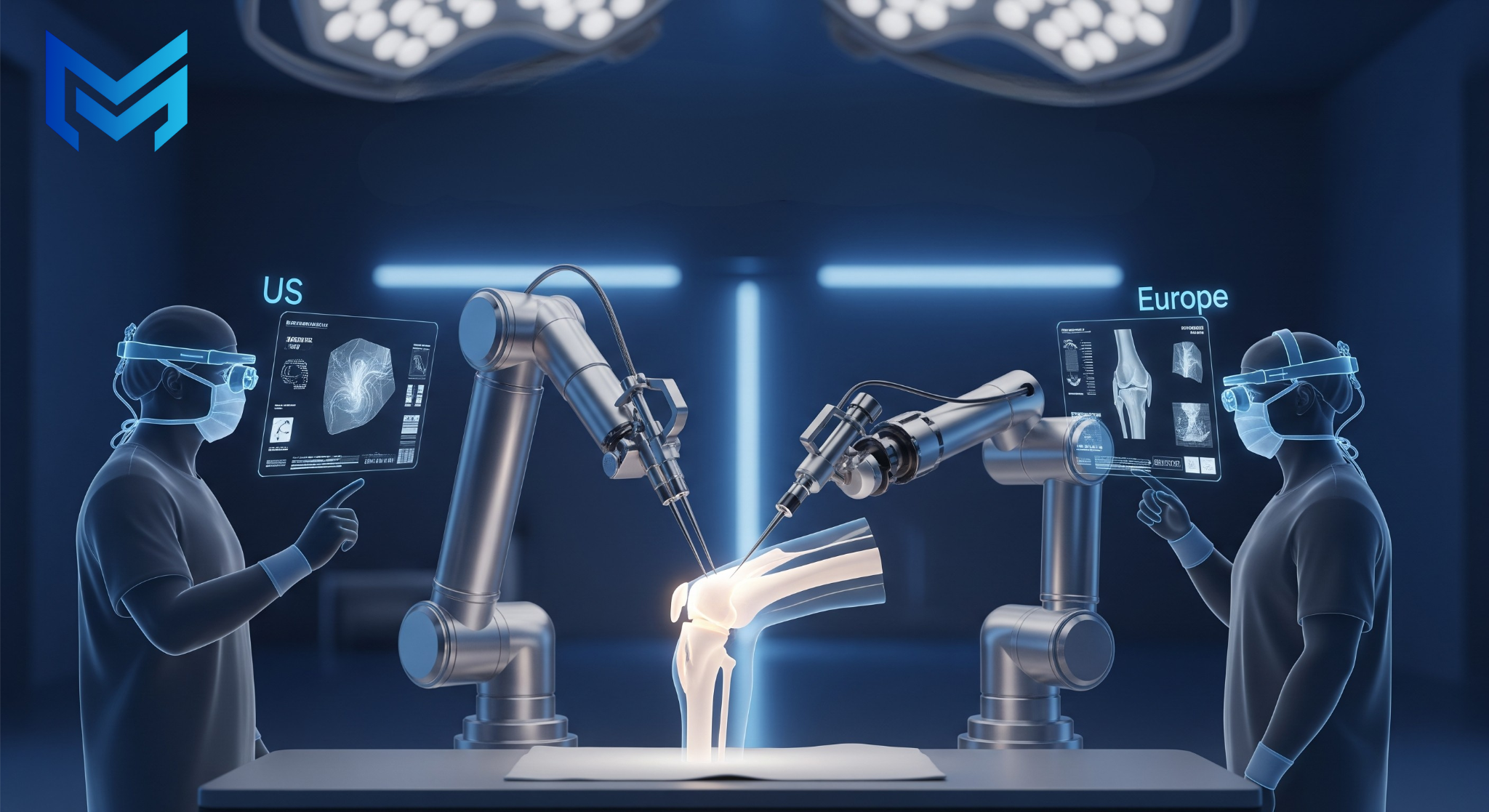
Robotics in Orthopaedics: How the US and Europe Are Entering a New Surgical Era
The global orthopaedics industry is undergoing a structural transformation. What began as experimental robotic assistance in joint replacement is now becoming a strategic pillar of modern surgical care across the United States and Europe. Robotic-assisted orthopaedic systems are redefining precision, outcomes, and operational efficiency—forcing hospitals, med-tech manufacturers, and policymakers to rethink long-term care delivery models.
As adoption accelerates, the conversation is shifting from whether robotics should be used to how fast healthcare systems can scale them responsibly and profitably.
The Current Landscape: From Innovation to Standard of Care
Robotic systems in orthopaedics are now widely used in knee and hip replacements, spine surgery, trauma fixation, and increasingly in shoulder and sports medicine procedures. These systems enable surgeons to plan procedures digitally, execute cuts with sub-millimeter accuracy, and customize implants based on patient anatomy.
In the United States, private hospital networks and ambulatory surgical centers are leading adoption. Robotics is increasingly positioned as a competitive differentiator—helping providers reduce revision surgeries, shorten hospital stays, and improve patient satisfaction metrics.
In Europe, adoption is more uneven. While countries such as Germany, France, the UK, and the Nordics are expanding robotic surgery programs, public funding structures, reimbursement variability, and regulatory frameworks continue to influence deployment speed. However, the long-term direction is clear: robotics is becoming integral to orthopaedic care pathways.
Why Robotics Matters More Than Ever in Orthopaedics
Several structural forces are driving the rapid expansion of robotic orthopaedic surgery:
1. Aging Populations and Rising Procedure Volumes
Both the US and Europe are experiencing a sharp rise in degenerative joint diseases. Hip and knee replacements are projected to increase significantly over the next decade, placing pressure on surgical capacity and workforce availability.
2. Demand for Precision and Predictable Outcomes
Robotic assistance improves implant alignment and reproducibility, directly impacting long-term outcomes. This is particularly critical in value-based healthcare models, where reimbursement is tied to performance and patient outcomes.
3. Surgeon Workforce Constraints
Robotics helps standardize procedures, reduce fatigue, and shorten learning curves—key advantages in regions facing skilled surgeon shortages.
4. Shift Toward Outpatient and Minimally Invasive Care
Robotic orthopaedic procedures support faster recovery times, enabling a shift from inpatient hospitals to outpatient surgical centers, especially in the US.
Key Differences Between the US and Europe
While technology adoption is accelerating on both sides of the Atlantic, the drivers and challenges differ:
United States
Faster commercialization and procurement cycles
Stronger influence of private healthcare economics
Greater emphasis on ROI, throughput, and competitive differentiation
Rapid integration of AI-enabled surgical planning
Europe
Centralized decision-making in public health systems
Strong focus on cost-effectiveness and clinical evidence
Fragmented reimbursement and approval processes across countries
Growing role of national health strategies and public funding initiatives
Understanding these regional nuances is critical for any stakeholder planning expansion, investment, or product launches.
The Strategic Challenges Holding Back Scale
Despite the promise, robotic orthopaedics faces several barriers:
High upfront capital costs for hospitals
Inconsistent reimbursement models, particularly in Europe
Training and change-management requirements for surgeons and operating room staff
Data gaps in long-term cost-benefit analysis across diverse healthcare systems
This is where data-driven market intelligence and strategic research becomes essential.
How Eminent Global Research Solutions Supports the Robotics Ecosystem
Eminent Global Research Solutions plays a critical role in helping stakeholders navigate the evolving orthopaedic robotics landscape across the US and Europe.
For Medical Device & Robotics Manufacturers
Market sizing and demand forecasting by procedure type and geography
Competitive benchmarking of robotic platforms and technology differentiation
Go-to-market and pricing strategy support tailored to regional healthcare models
Voice-of-surgeon and hospital procurement insights
For Hospitals & Healthcare Networks
ROI and cost-effectiveness analysis of robotic adoption
Comparative studies between traditional and robotic procedures
Strategic planning for outpatient expansion and surgical throughput optimization
Evidence-based decision support for capital investments
For Investors & Private Equity Firms
Due diligence on orthopaedic robotics companies and startups
Technology maturity and adoption-readiness assessments
Risk mapping across regulatory and reimbursement environments
Long-term growth forecasts aligned with demographic and policy trends
For Policymakers & Public Health Bodies
Health-economic impact assessments
Scenario modeling for scaling robotic surgery programs
Insights into workforce optimization and surgical backlog reduction
Policy-focused research to support evidence-based funding decisions
The Next Frontier: AI, Personalisation, and Data-Driven Surgery
The future of orthopaedic robotics extends beyond mechanical assistance. The next wave includes:
AI-driven surgical planning and intraoperative guidance
Personalized implants based on patient-specific anatomy
Predictive analytics for post-surgical outcomes
Integration of robotics with digital twins and remote surgical collaboration
These advancements will further blur the line between technology, data, and clinical expertise—making robust research and strategic foresight indispensable.
Conclusion: Robotics Is No Longer Optional
Robotic-assisted orthopaedic surgery is transitioning from innovation to infrastructure. For healthcare providers, it represents a pathway to better outcomes and operational efficiency. For manufacturers and investors, it is a high-growth, high-complexity market requiring deep regional understanding. For policymakers, it is a lever to address aging populations and system-wide capacity challenges.
In this rapidly evolving environment, Eminent Global Research Solutions acts as a strategic partner, enabling clients across the US and Europe to make confident, data-backed decisions—turning robotic innovation into sustainable clinical and commercial success.