

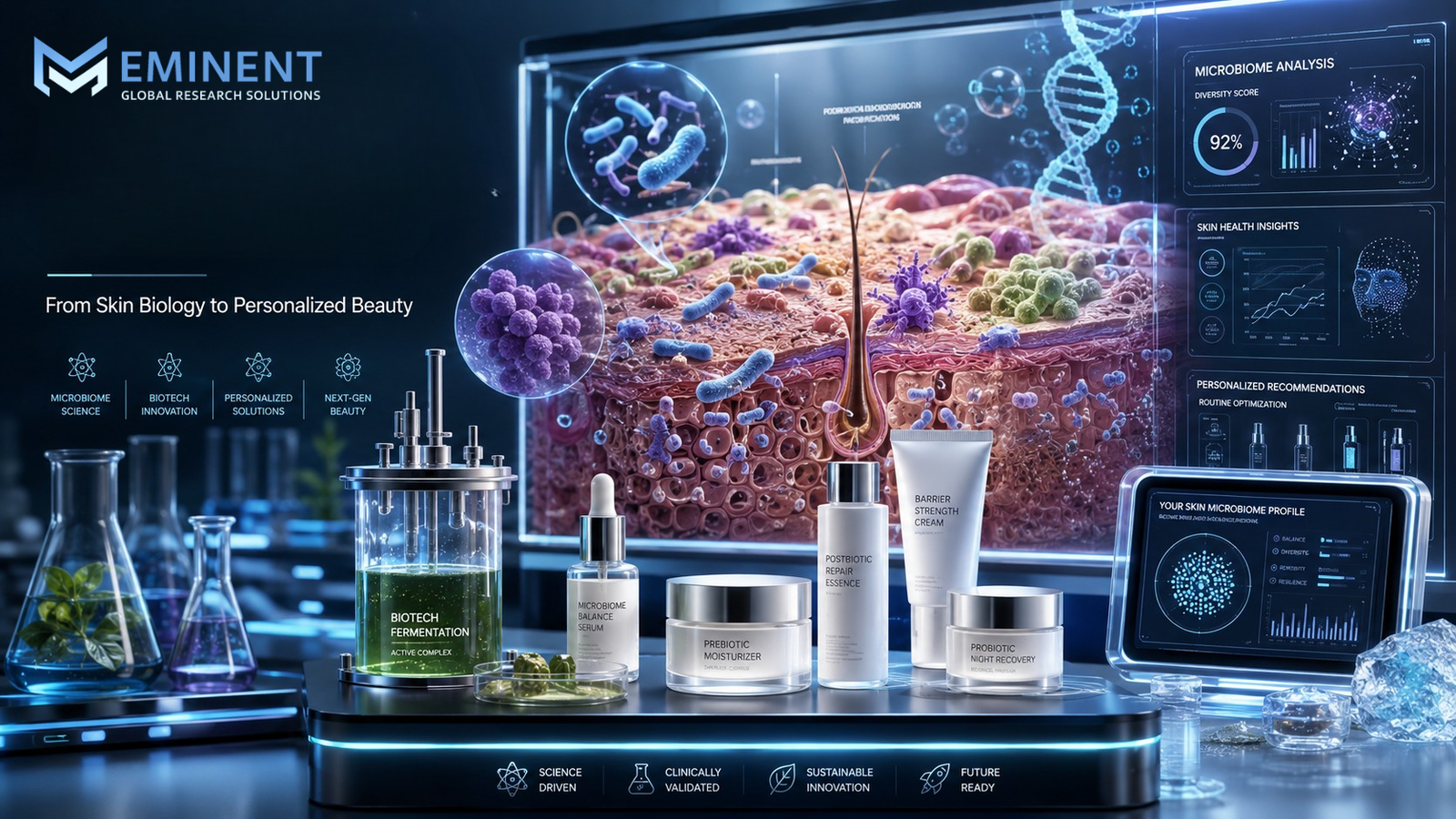
The personal care industry is entering a new phase of innovation in which product development is increasingly influenced by biology, biotechnology, and personalized consumer science. Among the most promising areas is the human microbiome the complex ecosystem of microorganisms that interacts continuously with the skin, scalp, and broader body environment.
For decades, personal care innovation focused primarily on visible outcomes such as hydration, cleansing, anti-aging, hair growth, and appearance enhancement. Microbiome science introduces a different perspective: rather than simply treating the skin or scalp, products can be designed to support the biological ecosystem that contributes to its health and function.
This shift could create entirely new categories within skincare, haircare, body care, and wellness.
For beauty and personal care companies, microbiome science represents more than an emerging ingredient trend. It offers an opportunity to rethink product development, consumer segmentation, claims strategy, personalization, and premiumization.
From Cosmetic Care to Biological Care
Traditional personal care products are generally formulated around a specific consumer need or visible benefit. A moisturizer is designed to improve hydration, while a shampoo cleanses the scalp and hair.
Microbiome-focused products introduce another layer of complexity.
The skin is home to diverse microbial communities that interact with the skin barrier and its surrounding environment. Factors such as age, lifestyle, climate, product usage, and environmental exposure can influence this microbial ecosystem.
This growing understanding creates opportunities to develop products designed not simply to produce a cosmetic effect, but to support the skin’s natural biological environment.
The result is a potential transition from cosmetic care toward microbiome-informed care.
This could lead to products positioned around concepts such as:
- Microbiome balance
- Skin barrier support
- Scalp ecosystem health
- Sensitive-skin management
- Personalized skin maintenance
- Long-term skin resilience
Such positioning could fundamentally expand the addressable market for personal care companies.
Why Microbiome Science Matters for Product Innovation
The microbiome provides an additional biological dimension for product developers.
Instead of asking only, “What ingredient improves the appearance of skin?” researchers can increasingly ask, “How does this formulation interact with the skin’s microbial ecosystem?”
This creates opportunities for new formulation strategies involving:
- Prebiotics
- Probiotics and probiotic-derived ingredients
- Postbiotics
- Fermentation-derived compounds
- Microbiome-compatible formulations
- Bioactive ingredients designed to support the skin barrier
Importantly, microbiome science is still an evolving field. Companies need to distinguish between scientifically validated benefits and marketing claims that may exceed available evidence.
For R&D leaders, this makes scientific validation a critical component of successful commercialization.
The Opportunity for Personalized Personal Care
One of the most significant long-term opportunities lies in personalization.
Consumers do not have identical microbiomes. Differences in genetics, age, lifestyle, environment, diet, climate, and product usage can influence individual microbial ecosystems.
This creates the possibility of moving beyond conventional segmentation such as “dry skin,” “oily skin,” or “combination skin.”
Future personal care models could incorporate microbiome profiling to develop more individualized product recommendations.
A potential consumer journey could involve:
Diagnostic → Microbiome Profile → Personalized Recommendation → Customized Product → Continuous Monitoring
This model could transform personal care from a transactional product category into an ongoing service ecosystem.
For brands, that creates opportunities for recurring revenue, subscription models, personalized product portfolios, and stronger consumer relationships.
Microbiome Science Could Create New Product Categories
The biggest commercial opportunity may not simply be improving existing products.
Microbiome research could create entirely new categories.
For example, the industry could see further development of:
Microbiome-Focused Skincare
Products specifically designed to support microbial balance and skin-barrier function could expand beyond conventional moisturizers and serums.
Scalp Microbiome Care
Haircare companies could increasingly address the scalp as a biological ecosystem rather than focusing exclusively on hair fibers.
This may create new opportunities in scalp wellness, dandruff management, hair-loss support, and sensitive-scalp care.
Microbiome-Friendly Cleansing
Cleansing products could increasingly focus on maintaining skin comfort and barrier integrity while minimizing unnecessary disruption to the skin ecosystem.
Beauty-Wellness Products
The convergence between beauty and wellness could produce products positioned around long-term skin resilience, environmental stress, and healthy aging.
These categories could support premium positioning because they combine scientific innovation with personalized consumer benefits.
Biotechnology Is Accelerating the Opportunity
Advances in biotechnology are making microbiome innovation increasingly commercially relevant.
Modern analytical technologies can provide deeper insights into microbial communities, while fermentation and biotechnology platforms can produce specialized ingredients with greater consistency and scalability.
This creates an important intersection between microbiome research and ingredient innovation.
Ingredient manufacturers can potentially differentiate themselves through proprietary:
- Fermentation platforms
- Microbial strains
- Postbiotic compounds
- Bioactive molecules
- Delivery technologies
- Microbiome testing capabilities
For B2B ingredient companies, this creates opportunities to move from commodity ingredient supply toward higher-value technology platforms.
Scientific Evidence Will Determine Market Winners
The microbiome category also presents a significant challenge.
Consumer interest can grow much faster than scientific understanding. Companies therefore need to establish strong evidence before making microbiome-related claims.
R&D teams should consider:
- Clinical validation
- Microbiome testing methodologies
- Long-term safety
- Ingredient compatibility
- Mechanistic evidence
- Reproducibility
- Appropriate consumer claims
The companies that invest in robust scientific substantiation may be better positioned to build credibility as the category matures.
This will become especially important as regulators and consumers increasingly scrutinize health-related claims in beauty and personal care.
Regulatory and Commercialization Considerations
Microbiome-based products exist at the intersection of cosmetics, consumer health, biotechnology, and potentially healthcare.
That creates an increasingly complex regulatory environment.
Companies must carefully evaluate how product claims influence regulatory classification and market access requirements.
A product positioned around cosmetic appearance may face a very different regulatory pathway from one making explicit therapeutic or disease-related claims.
Therefore, regulatory strategy should be incorporated early into R&D and commercialization planning.
This is particularly important for companies planning global launches, where microbiome-related claims may be treated differently across markets.
Premiumization and Consumer Trust
Scientific differentiation can create significant premiumization opportunities.
Consumers are increasingly interested in products that offer more than immediate cosmetic benefits. They want products backed by research, personalized experiences, and credible scientific explanations.
Microbiome science can provide that differentiation—but only if companies communicate responsibly.
Brands should avoid turning complex microbiome science into exaggerated marketing claims.
Instead, successful brands will likely focus on:
Science + Transparency + Demonstrated Efficacy + Personalization
This combination can help establish consumer trust while supporting premium pricing.
What Should Personal Care Companies Do Now?
Companies should begin evaluating microbiome science as a strategic technology platform rather than simply another ingredient trend.
Key priorities include:
- Map the competitive landscape
Identify emerging brands, ingredient suppliers, patents, technologies, and research institutions. - Assess technology maturity
Separate commercially validated technologies from early-stage research. - Identify whitespace opportunities
Determine which microbiome applications remain underserved. - Evaluate regulatory requirements
Understand how product claims could affect classification and market access. - Build scientific partnerships
Collaborate with biotechnology companies, universities, dermatology researchers, and testing organizations. - Develop evidence-led claims
Build clinical and scientific substantiation before scaling marketing. - Explore personalization models
Assess how diagnostics and consumer data could support individualized product recommendations.
The Future of Personal Care May Be Biological
Microbiome science could represent one of the most important technology shifts in personal care over the next decade.
The opportunity extends beyond creating new skincare products. It could redefine how companies understand consumers, develop ingredients, formulate products, establish claims, and build long-term relationships.
The winners may not simply be the companies with the most innovative microbiome ingredient.
They will be the organizations capable of connecting microbiome science, biotechnology, diagnostics, personalization, regulatory intelligence, and commercialization strategy into a scalable business model.
For personal care companies, ingredient manufacturers, investors, and R&D leaders, the strategic question is therefore no longer whether microbiome science is interesting.
The bigger question is:
Which companies will successfully convert microbiome science into commercially scalable categories before the market becomes crowded?
For Eminent Global Research Solutions, this represents a significant opportunity for market intelligence, technology scouting, competitive intelligence, IP landscaping, opportunity assessment, and commercialization strategy across the rapidly evolving microbiome and personal care ecosystem.