

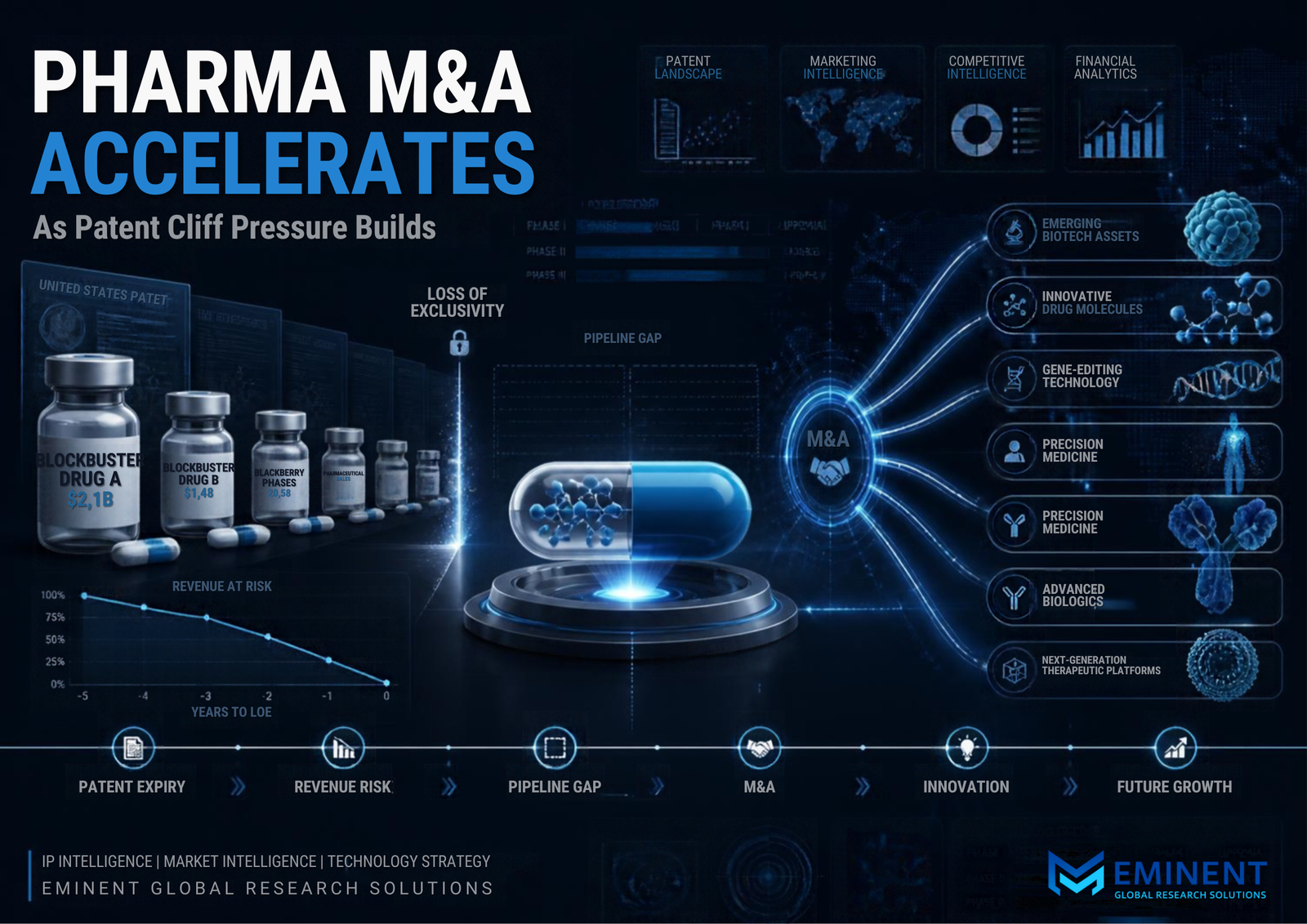
How loss-of-exclusivity exposure is reshaping pharmaceutical portfolio strategy, dealmaking, and competitive positioning
The pharmaceutical M&A landscape is entering a strategically important phase. Large drugmakers are facing increasing pressure to replace revenue that could be eroded as blockbuster medicines approach loss of exclusivity (LOE), while at the same time seeking exposure to new growth markets, differentiated technologies, and late-stage clinical assets.
This is turning M&A from a conventional growth lever into a pipeline-replenishment strategy.
In 2026, biopharma dealmaking has already shown significant momentum. PwC reported that pharmaceutical and life sciences deal value exceeded $65 billion in Q1 2026, the strongest first quarter since 2020, with companies pursuing acquisitions to replenish pipelines ahead of LOE events and strengthen positions in areas such as cardiometabolic disease, immunology, oncology, and radiopharmaceuticals.
The underlying issue is straightforward: blockbuster revenues do not remain protected indefinitely.
But replacing those revenues is anything but straightforward.
The Patent Cliff Is Becoming a Strategic Imperative
A patent cliff occurs when valuable medicines lose market exclusivity, allowing generic or biosimilar competitors to enter and potentially erode branded-product revenues.
IQVIA estimates that more than $230 billion in biopharma industry revenue could face loss-of-exclusivity exposure by 2030, with additional exposure expected in the early 2030s.
Several major products are among the therapies approaching important exclusivity milestones, creating a long-term revenue-replacement challenge for large pharmaceutical companies.
The problem is compounded by development timelines.
A pharmaceutical company cannot wait until a major product loses exclusivity before beginning to replace its revenue base. Developing a new medicine internally can take many years, and clinical and regulatory uncertainty makes the outcome difficult to predict.
Consequently, companies are increasingly looking externally.
M&A provides access to assets, platforms, technologies, and commercial capabilities that would otherwise take years to develop internally.
This explains why patent exposure is increasingly influencing acquisition strategy.
2026: From Defensive M&A to Strategic Pipeline Renewal
The current M&A cycle is different from purely defensive consolidation.
Companies are not simply acquiring competitors to increase scale.
They are looking for future revenue engines.
PwC identifies three major strategic priorities behind current biopharma dealmaking:
- Replenishing late-stage pipelines ahead of LOE cliffs
- Building positions in high-growth therapeutic areas
- Deploying available capital while biotech valuations and asset availability remain attractive
This creates a more selective acquisition environment.
Buyers increasingly want evidence that an asset can contribute meaningfully to future growth rather than simply adding another molecule to the portfolio.
That means acquisition targets are being evaluated across several dimensions:
Clinical differentiation → regulatory probability → market opportunity → competitive landscape → IP durability → manufacturing scalability → commercial potential
The strongest assets therefore command significant strategic value.
Asset Scarcity Is Increasing Competition
One of the biggest challenges for pharmaceutical companies is that there are not enough highly differentiated, commercially meaningful assets to satisfy every buyer.
McKinsey describes the combination of increasing LOE exposure and a shrinking pool of differentiated scalable assets as a key force shaping life sciences M&A in 2026.
This creates an interesting dynamic.
Pharma companies have capital.
Biotech companies have innovation.
But the number of assets capable of replacing blockbuster-scale revenues is limited.
As a result, competition for high-quality clinical-stage assets can intensify.
This may also increase the importance of licensing, strategic partnerships, co-development, and option-based transactions alongside outright acquisitions.
For some companies, buying an entire biotech may be unnecessary. Securing rights to a high-potential asset or platform could provide the desired strategic exposure with less capital and integration risk.
The Rise of Therapeutic-Area Competition
The patent cliff is also influencing where pharmaceutical companies want to compete.
Oncology remains a major area of activity, but dealmaking is increasingly expanding into other therapeutic categories.
Current strategic interest includes:
- Cardiometabolic disease
- Obesity and metabolic health
- Immunology
- Neurology
- Rare diseases
- Radiopharmaceuticals
- Cell and gene therapy
- Next-generation biologics
- Precision medicine
- AI-enabled drug discovery
Deloitte’s 2026 outlook highlights continued oncology activity alongside increasing deal interest in cardiovascular, metabolic and neuroscience opportunities.
The strategic objective is increasingly broader than replacing one product with another.
Companies want to construct portfolio platforms capable of generating multiple future products.
That is why technology platforms can become particularly attractive.
Why Platform Technologies Matter
A single successful drug can replace part of a revenue gap.
A successful platform could potentially generate an entire pipeline.
This distinction is becoming increasingly important in M&A.
For example, buyers may evaluate:
- Novel drug-delivery platforms
- Bispecific or multispecific antibodies
- RNA technologies
- In-vivo gene editing
- Cell therapy platforms
- Radiopharmaceutical platforms
- AI-enabled discovery platforms
- Precision medicine technologies
The attraction is optionality.
Rather than purchasing one future commercial product, a company may acquire a technology capable of producing multiple candidates across different indications.
However, platform acquisition also introduces greater scientific and commercialization uncertainty.
Therefore, sophisticated diligence becomes critical.
IP Intelligence Becomes Central to M&A
A patent cliff is fundamentally an IP and commercial timing problem.
Therefore, M&A strategy cannot rely solely on financial projections or clinical data.
Acquirers need to understand:
- Patent expiry timelines
- Patent-family strength
- Continuation and divisional strategies
- Freedom-to-operate considerations
- Competitor patent positions
- Litigation exposure
- Biosimilar or generic entry risks
- Regulatory exclusivity
- Formulation and delivery patents
- Manufacturing-related IP
- Geographic differences in IP protection
This is where IP intelligence can materially influence transaction strategy.
A seemingly attractive asset can become considerably less attractive if its effective exclusivity period is shorter than expected.
Conversely, a company with a strong IP estate, differentiated technology and multiple potential indications may command a strategic premium.
M&A Alone Cannot Solve the Patent Cliff
There is an important strategic limitation.
Acquisition does not automatically create sustainable growth.
If multiple pharmaceutical companies pursue the same small pool of late-stage assets, valuations can rise rapidly.
This creates the risk of overpaying for pipeline replacement.
Furthermore, an acquired asset still needs to succeed clinically, obtain regulatory approval, achieve market access and reach commercial scale.
That is why current buyers are becoming more selective.
PwC notes that buyers are prioritizing assets with stronger clinical evidence, proven biology and clearer regulatory pathways.
The implication is significant:
The next generation of pharma M&A will increasingly be driven by quality of assets rather than quantity of transactions.
What Pharmaceutical Companies Should Do Now
Pharma companies approaching significant LOE exposure should consider a more systematic portfolio strategy.
1. Map the revenue exposure
Identify products facing exclusivity loss and quantify potential revenue erosion under different scenarios.
2. Identify pipeline gaps
Determine where internal R&D is unlikely to replace declining revenues quickly enough.
3. Map external innovation
Conduct systematic technology scouting across biotech companies, universities, emerging platforms and geographic innovation hubs.
4. Build an acquisition target universe
Rank potential targets according to strategic fit, clinical maturity, IP strength, regulatory probability and commercial opportunity.
5. Compare M&A with licensing
Not every opportunity requires a full acquisition.
Licensing, partnerships and co-development may provide more capital-efficient access to innovation.
6. Integrate IP and market intelligence
Patent landscapes, competitor intelligence, clinical intelligence and market forecasts should be integrated into the transaction thesis.
7. Think beyond the next blockbuster
The strongest strategy may not be finding one replacement product.
It may be building a multi-asset portfolio capable of generating sustained growth through the next decade.
The Strategic Outlook
The pharmaceutical patent cliff is not simply an expiration calendar.
It is becoming a catalyst for portfolio transformation.
Companies with deep cash reserves, strong commercial franchises and significant LOE exposure have an incentive to act before pipeline gaps become visible in financial performance.
At the same time, emerging biotech companies possess valuable innovation but often face funding constraints and commercialization challenges. IQVIA notes that emerging biopharma companies account for a large share of clinical-stage assets, creating a substantial supply of potential external innovation for larger companies.
This creates a powerful strategic equation:
Patent pressure + available capital + biotech innovation + asset scarcity = sustained M&A activity.
But successful companies will not simply be the ones that make the most acquisitions.
They will be the ones that identify the right assets before competitors, accurately assess their strategic value, protect against IP and regulatory risks, and integrate those assets into a coherent long-term growth strategy.
For pharmaceutical leadership teams, the question is therefore shifting from:
“What should we acquire?”
to:
“Which technologies, assets and capabilities will give us a defensible growth position after the patent cliff?”
That is a much more strategic question—and one that requires integrated market intelligence, IP intelligence, technology scouting, competitive intelligence and commercialization analysis.
How Eminent Global Research Solutions Can Support
Eminent Global Research Solutions can help pharmaceutical and life sciences organizations evaluate emerging opportunities through IP landscape analysis, technology scouting, competitive intelligence, market intelligence, regulatory intelligence and commercialization strategy.
The objective is not simply to identify potential acquisition targets, but to determine which opportunities can create sustainable strategic value.