

The Silent Collapse: How Loss of Subcutaneous Fat Disrupts Collagen Signaling And Why No Formulation Can Fully Replace It
By Eminent Global Research Solutions
The modern skincare and aesthetic industry is built on a powerful promise: that topical formulations, injectables, and advanced treatments can restore youthful skin. While these innovations have delivered impressive results, a fundamental biological reality is often overlooked — the critical role of subcutaneous fat in maintaining collagen integrity.
Emerging research and clinical observations point toward a deeper truth: the loss of subcutaneous fat doesn’t just change how skin looks; it disrupts a vital collagen-signaling system. And importantly, no currently available formulation fully compensates for this loss.
Understanding Subcutaneous Fat Beyond Volume
Subcutaneous fat, located just beneath the dermis, has traditionally been viewed as a passive structural layer — a cushion that provides fullness and softness. However, this perspective is outdated.
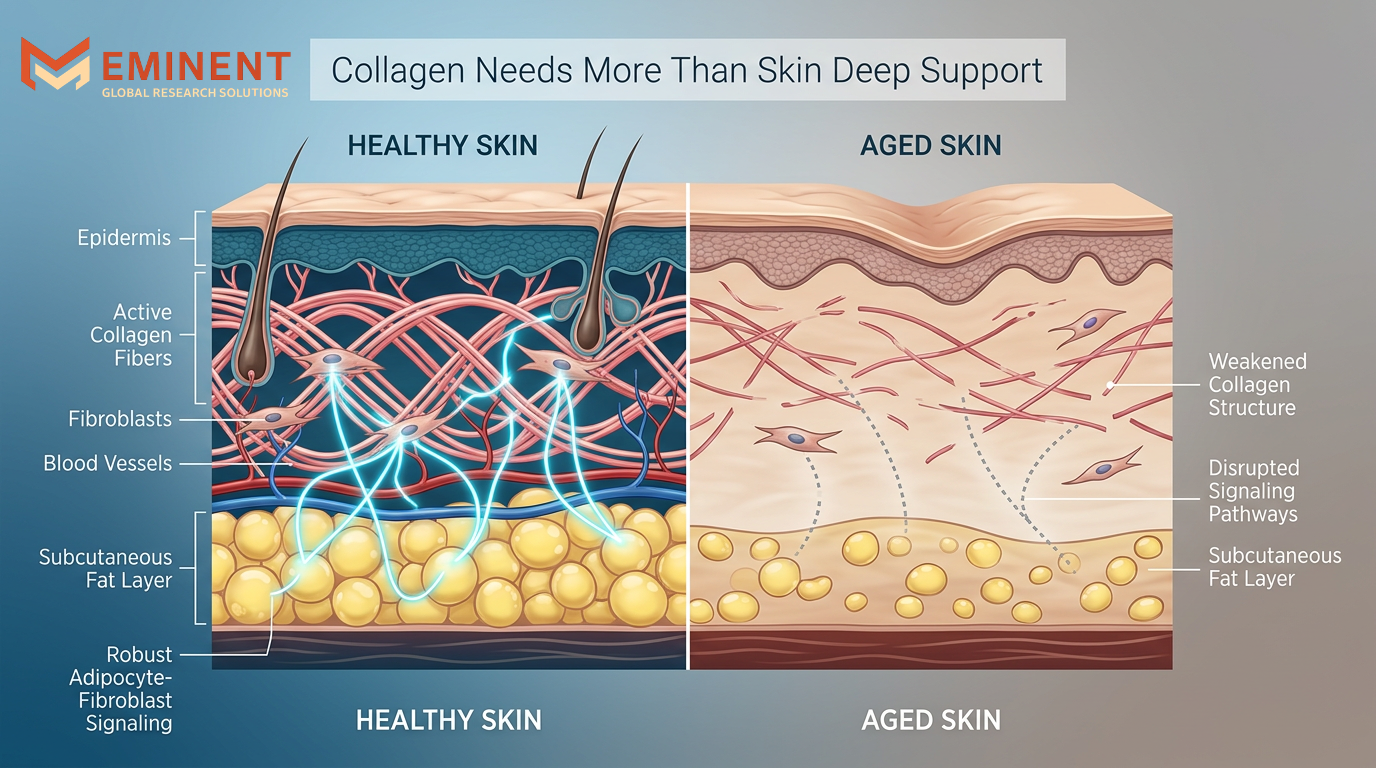
In reality, subcutaneous fat is metabolically active and biologically communicative. It interacts with the dermis through biochemical signaling pathways, influencing fibroblast activity — the cells responsible for producing collagen, elastin, and extracellular matrix components.
This means subcutaneous fat is not just supportive; it is regulatory.
The Collagen-Signaling System: A Hidden Network
Collagen production is governed by a complex network of signals involving growth factors, cytokines, and mechanical cues. Subcutaneous fat plays a central role in this system by:
- Releasing adipokines that influence fibroblast behavior
- Maintaining dermal tension and mechanical signaling
- Supporting vascular networks that nourish collagen-producing cells
When subcutaneous fat is intact, this system operates in balance. Fibroblasts receive consistent signals to produce and maintain collagen, preserving skin thickness, elasticity, and resilience.
What Happens When Subcutaneous Fat Is Lost?
Aging, weight loss, hormonal changes, and certain medical conditions contribute to the gradual depletion of subcutaneous fat. When this occurs, the impact extends far beyond visible volume loss.
The consequences include:
1. Disrupted Biochemical Signaling
The reduction of adipokine secretion weakens communication between fat cells and fibroblasts, leading to decreased collagen synthesis.
2. Mechanical Signal Breakdown
Subcutaneous fat contributes to structural tension. Its loss alters the mechanical environment, which directly affects fibroblast activity and collagen organization.
3. Reduced Nutrient Support
With diminished fat tissue comes reduced vascular support, limiting oxygen and nutrient delivery to the dermis.
4. Accelerated Collagen Degradation
Without proper signaling, collagen breakdown outpaces production, leading to thinning skin and reduced elasticity.
The Industry Response: Why Formulations Fall Short
The skincare and aesthetics industry has responded to collagen loss with a wide array of solutions:
- Retinoids to stimulate collagen production
- Peptides to mimic signaling molecules
- Hyaluronic acid for hydration and plumping
- Energy-based devices to induce dermal remodeling
While these approaches offer measurable benefits, they operate within a limited scope. They attempt to stimulate collagen production without restoring the system that naturally regulates it.
This is the critical gap.
Topical formulations primarily act on the epidermis and upper dermis. Injectables and devices can reach deeper layers, but they do not recreate the dynamic, ongoing signaling provided by living subcutaneous fat.
The Irreplaceable Role of Biological Context
Collagen production is not an isolated process; it depends on its biological environment. Subcutaneous fat provides:
- Continuous signaling feedback
- Structural integrity
- Cellular cross-talk
- Adaptive response to stress and aging
No formulation — regardless of its sophistication — can replicate this multi-dimensional interaction. At best, treatments can temporarily enhance or stimulate certain aspects of collagen production. They cannot rebuild the lost biological ecosystem.
Implications for Anti-Aging Strategies
This understanding shifts how we should approach skin aging and rejuvenation.
1. From Surface-Level to System-Level Thinking
Instead of focusing solely on stimulating collagen, strategies must consider the entire dermal-fat interface.
2. Importance of Volume Preservation
Maintaining subcutaneous fat becomes a priority, not just for aesthetics but for biological function.
3. Limitations of “Collagen Boosting” Claims
Marketing narratives often oversimplify collagen regeneration. True restoration requires more than topical or injectable intervention.
4. Integrated Treatment Approaches
Combining volumizing treatments, regenerative medicine, and lifestyle interventions may offer more meaningful outcomes.
The Future: Regenerative and Bio-Integrated Solutions
The next frontier in skin science lies in regenerative approaches that aim to restore or mimic the biological functions of subcutaneous fat.
Potential directions include:
- Adipose-derived stem cell therapies
- Tissue engineering for fat regeneration
- Advanced biomaterials that simulate cellular signaling
- Personalized regenerative treatments
These innovations are still evolving, but they acknowledge a critical reality: restoring function is more important than temporarily correcting appearance.
A Strategic Perspective for Businesses
For organizations in research, skincare, and aesthetics, this insight carries significant implications:
- Product Development: Move beyond single-function formulations toward system-oriented solutions
- Market Positioning: Educate consumers on realistic outcomes and biological limitations
- Innovation Focus: Invest in regenerative and cross-disciplinary technologies
- Client Trust: Build credibility through transparency rather than exaggerated claims
At Eminent Global Research Solutions, we believe that understanding these deeper biological mechanisms is essential for driving meaningful innovation and sustainable growth in the industry.
Conclusion
The loss of subcutaneous fat represents more than a cosmetic concern — it is the breakdown of a critical collagen-signaling system. While modern formulations and treatments can offer improvements, they cannot fully compensate for the absence of this biological foundation.
Recognizing this limitation is not a setback; it is an opportunity. It allows the industry to move beyond surface-level solutions and toward a more sophisticated, science-driven approach to skin health and aging.
The future of skincare will not be defined by how well we mimic collagen production, but by how effectively we restore the systems that naturally sustain it.