
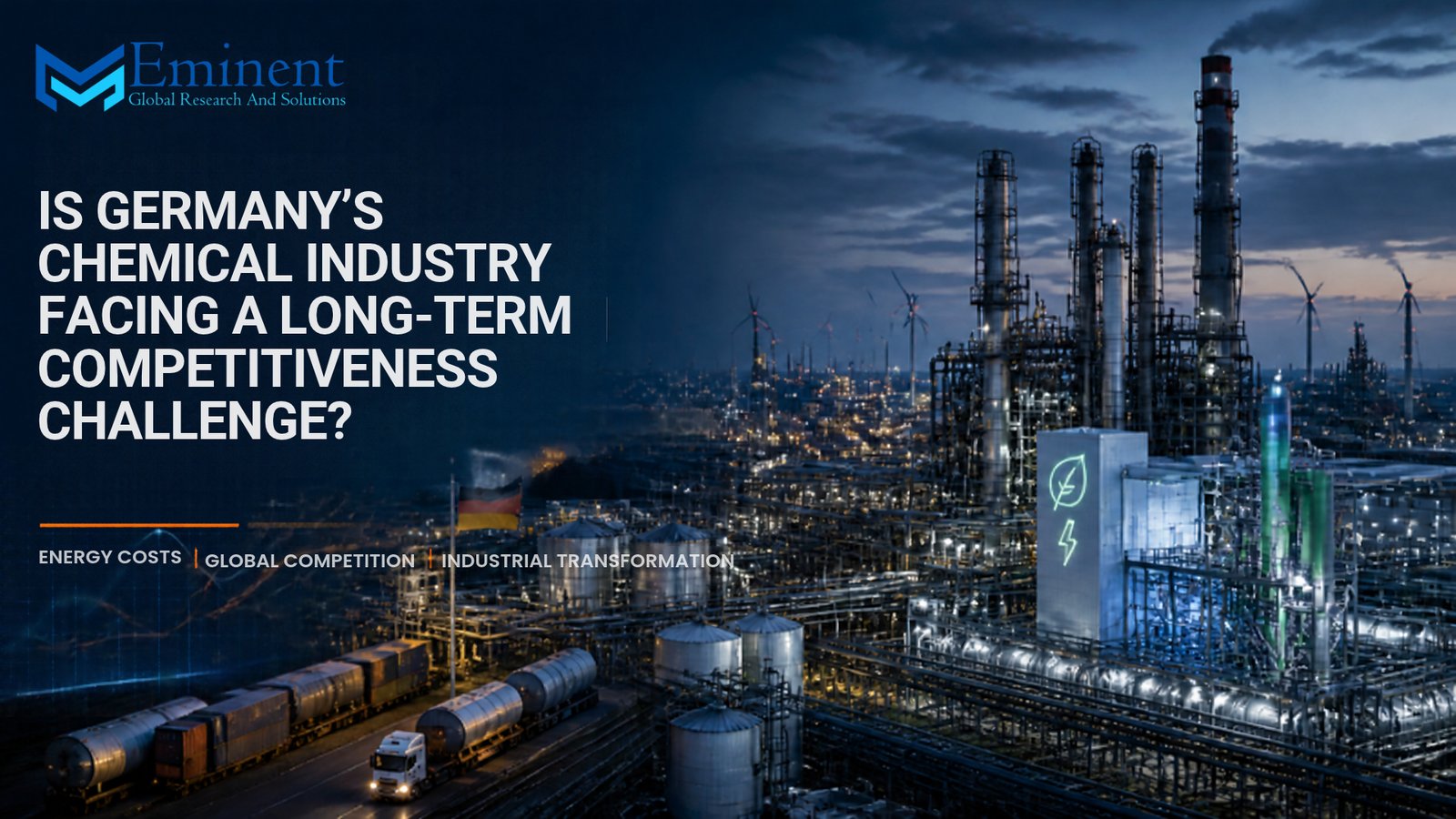
Is Germany’s Chemical Industry Facing a Long-Term Competitiveness Challenge?
Published Date: 12 November 2026
Category: Chemicals & Materials | Manufacturing & Industrial
Introduction
Germany has long been one of the world’s leading chemical manufacturing hubs, supported by advanced industrial infrastructure, skilled workers, research capabilities and strong connections with sectors such as automotive, pharmaceuticals, agriculture and engineering.
However, the country’s chemical industry is facing growing pressure. High energy costs, weak industrial demand, international competition and uncertainty around investment are making it increasingly difficult for manufacturers to maintain their global position.
Recent industry figures offer a mixed picture. Although Germany’s chemical and pharmaceutical industry has increased its sales growth forecast for 2026, production continues to decline. This raises an important question: is the sector experiencing a temporary slowdown, or are deeper competitiveness challenges affecting its long-term future?
What Do the Latest Industry Figures Reveal?
Germany’s chemical industry association, the VCI, raised its 2026 sales growth forecast to 3.5%, compared with its previous estimate of 2.5%. However, this improvement is mainly linked to higher producer prices rather than stronger production volumes.
During the third quarter of 2026:
- Industry revenue reached approximately €53 billion, increasing 5.8% year-on-year.
- Chemical and pharmaceutical production declined 3.5% compared with the same period in 2025.
- Revenue fell 2.7% compared with the previous quarter.
- Capacity utilisation reached 76.6%, remaining below the industry’s long-term average.
- Employment declined by approximately 2.5% to around 464,000 people.
The VCI continues to expect production to decline by 1.5% across 2026. These figures suggest that higher revenues alone are not enough to demonstrate a meaningful industrial recovery.
Why Is Germany’s Chemical Industry Losing Competitiveness?
1. High Energy and Production Costs
Chemical manufacturing requires substantial energy for heating, processing, refining and other industrial operations. Natural gas is particularly important because it serves both as an energy source and as a raw material for several chemical products.
When energy prices rise, manufacturers face higher operating expenses and pressure on profit margins. This makes production in Germany more difficult to compete with regions where energy and feedstock costs are lower.
2. Growing International Competition
Chemical producers in Asia, the Middle East and North America are competing with European manufacturers through pricing, production capacity and investment.
Companies operating in regions with more favourable energy costs and expanding industrial infrastructure may have greater flexibility to increase production and attract new customers.
For German manufacturers, maintaining competitiveness increasingly depends on improving efficiency, controlling costs and developing higher-value products.
3. Weak Demand from Key Industrial Sectors
The chemical industry supplies essential materials to automotive, construction, agriculture, electronics and pharmaceutical manufacturers.
When these customer industries reduce production or delay purchases, chemical suppliers also experience weaker demand.
The slowdown in Germany’s automotive and broader manufacturing sectors has therefore created additional pressure on chemical producers. Weak demand can also discourage companies from expanding existing facilities or investing in new production technologies.
4. Delayed Investment and Plant Closures
Uncertain market conditions and high operating costs are influencing investment decisions across the sector.
Some companies are delaying projects, reducing production capacity and reviewing their manufacturing locations. Plant closures can also affect connected businesses because chemical production sites often operate as integrated industrial clusters.
If investment continues moving towards more competitive international locations, Germany could face difficulties maintaining its industrial capabilities over the long term.
How Are German Chemical Companies Responding?
Chemical manufacturers are adjusting their strategies to manage the changing business environment.
Cost optimisation: Companies are reviewing operating expenses, improving energy efficiency and restructuring production processes.
International investment: Some businesses are considering expansion in markets where energy, feedstock and operating conditions are more favourable.
Portfolio restructuring: Manufacturers are evaluating product portfolios, closing less competitive facilities and focusing on specialised or higher-value chemical products.
Sustainable production: Investment in recycling, low-carbon manufacturing, renewable energy and alternative feedstocks may help companies reduce long-term resource dependence.
However, these measures require substantial investment, stable policies and reliable infrastructure to deliver lasting results.
What Role Does Government Policy Play?
Germany’s industrial competitiveness depends not only on company-level decisions but also on the wider business environment.
Industry representatives have highlighted the importance of internationally competitive energy prices, faster permitting procedures, reduced administrative burdens and investment-friendly policies.
The transition towards lower-carbon manufacturing also requires reliable access to renewable electricity, hydrogen infrastructure and supporting technologies.
A successful industrial transition must balance environmental objectives with the practical requirements of energy-intensive businesses. Without predictable costs and infrastructure, manufacturers may find it difficult to justify long-term investment in Germany.
What Does This Mean for the Global Chemical Industry?
Germany’s challenges have implications beyond its domestic market.
As one of Europe’s important chemical manufacturing centres, changes in German production capacity can influence regional supply chains, industrial investment and the availability of essential chemical materials.
Companies operating across international markets may need to reassess sourcing strategies, production locations and exposure to energy-price volatility.
For investors and industry participants, Germany’s situation also highlights the importance of evaluating manufacturing competitiveness through more than revenue growth. Production volumes, capacity utilisation, energy costs, capital expenditure and employment trends provide a broader picture of industrial health.
What Is the Outlook for 2027 and Beyond?
The outlook for Germany’s chemical industry will depend on whether companies can restore cost competitiveness while adapting to changing global demand and sustainability requirements.
A stronger recovery may require:
- More stable and affordable industrial energy supplies.
- Increased investment in modern production facilities.
- Greater efficiency across chemical manufacturing operations.
- Improved domestic and international demand.
- Stronger supply-chain resilience and access to raw materials.
- Predictable regulatory and investment conditions.
Without improvements in these areas, the industry may continue to experience capacity reductions and investment shifts towards other manufacturing regions.
Eminent’s Perspective
At Eminent Global Research Solutions, we believe that Germany’s chemical industry represents an important case study in global manufacturing competitiveness.
The current situation highlights how energy economics, industrial policy, international competition and investment decisions can influence the long-term position of an established manufacturing hub.
Businesses and investors should monitor production trends, capacity utilisation, energy prices, capital expenditure and regional market developments to identify emerging risks and opportunities.
Through market research, industry analysis and competitive intelligence, organisations can better understand changing market conditions and make informed strategic decisions.
Conclusion
Germany’s chemical industry is not simply facing a temporary decline in demand. It is dealing with broader structural challenges involving energy costs, international competition, investment conditions and industrial transformation.
Although higher selling prices have supported the industry’s 2026 revenue outlook, declining production indicates that the recovery remains fragile.
The coming years will be important in determining whether Germany can strengthen its position as a competitive chemical manufacturing hub or whether more production and investment will shift towards other global markets.
Post a Comment